Flowers that look familiar but whose names you just can't recall
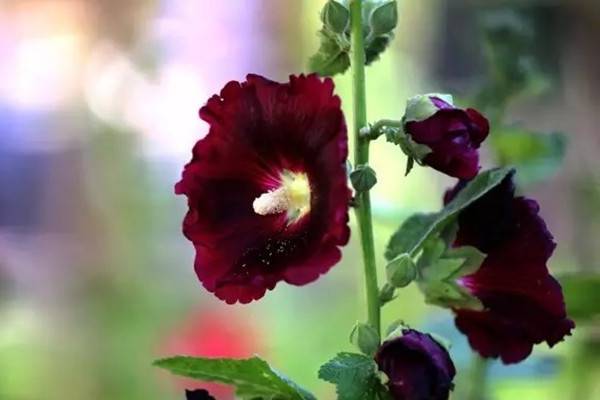
Hollyhock
Doesn't it look familiar? When we were kids, every household grew this flower in the yard. Basically, you could just toss the seeds into the soil and they would grow. The adults all called it jiejiegao, meaning "rising higher section by section" - not because it symbolized passing the imperial exam as top scholar, but because the flowers bloom section by section up the stalk. In fact, its real name is hollyhock (Alcea rosea). You might not know that the hollyhock is also the city flower of Shuozhou City, Shanxi Province!
Southern Magnolia
Southern magnolia (Magnolia grandiflora), because its flowers are very large and shaped like lotus blossoms, is also called "lotus magnolia." It is more commonly seen in the Yangtze River basin and areas to the south. This is definitely not the white magnolia (Magnolia denudata) - the white magnolia drops its leaves in winter, leaving the whole tree bare, while the southern magnolia stays evergreen all year round. It is also the city tree of Changzhou City!
Gesang Flower
The Gesang flower is also called Gesang Meiduo. In Tibetan, "Gesang" means "happiness" and "Meiduo" means flower, so the Gesang flower is also called the happiness flower.
Autumn Zephyr Lily
A common edging flower in flowerbeds. Before it blooms, it looks exactly like the small scallions used in cooking. When it blooms, the flowers are small, tender and lovely. It is very common, yet people can't name it. It is also called yulian or congjian (Zephyranthes candida).
Persian Speedwell
Back home, every March and April, the fields and roadsides would be covered with this small four-petaled blue flower, growing in big clumps. Who would have thought that such an inconspicuous little roadside flower would have such an impressive name (Veronica persica).
Bigleaf Hydrangea
Often seen in parks and scenic areas, known simply as the hydrangea. Its flower color can change - white at first, gradually turning blue or pink. Legend has it that when the Eight Immortals crossed the sea, He Xiangu scattered flower seeds in a beautiful spot, and the following year eight colors of flowers grew, so it was called the Eight Immortals flower (Hydrangea macrophylla).
Oleander
Because of its ornamental and environmental value, it is commonly found in the green belts along roadsides, but it is highly toxic - if humans or animals eat it by mistake, it can be fatal!
Canna Lily
You could pull out the flower and suck on it - it was sweet inside, truly a childhood nectar! According to Buddhist legend, the canna lily was transformed from the blood that flowed from the Buddha's toe. Thinking about it really is a bit off-putting.
Daylily
You've eaten dried daylily stir-fried with pork, and you've heard of the "forget-your-worries grass," but you never knew that the daylily is the forget-your-worries grass. According to the Book of Songs, in ancient times a woman whose husband had gone off to war planted daylilies in the northern hall of her home to relieve her worries and forget her sorrows. From then on, people called it the "forget-your-worries grass" (Hemerocallis fulva).
Crape Myrtle
Another beautiful name, as fresh and elegant as Xia Ziwei from "My Fair Princess." However, some of its other names are not so lovely - itchy flower, mosquito flower, barkless tree. What a funny contrast!
Forsythia
So this is what you are - forsythia!!!
I knew forsythia and I often saw this little yellow flower, but I never knew it was forsythia.
Field Bindweed
This is not the morning glory - morning glory leaves are palmate, while field bindweed leaves are willow-shaped. Next time you see it, don't mistake it!
Velvetleaf
As kids we called it "hemp steamed bun." It grew everywhere in the fields and we often picked it to eat. In the past, when people made mooncakes by hand, they would gather the seed pods that had turned black and hard, which had beautiful patterns, and press them onto the mooncakes to make them look nicer (Abutilon theophrasti).