What are the characteristics of the succulent plant Huoji (Crassula capitella 'Campfire')?
Huoji is a succulent in the Crassulaceae family, genus Crassula. Its bright red fleshy leaves are where its unique charm lies, giving people a feeling of vigorous, upward passion and vitality like burning flames, with very strong appeal.
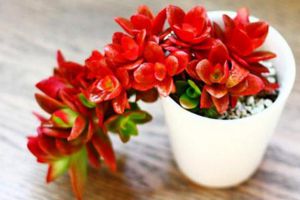
Common names of Huoji
Huoji is commonly known as Qiuhuolian.
Habits of Huoji
Huoji is a succulent in the Crassulaceae family, genus Crassula, and summer is its growing season.
Huoji originated in Africa and likes a warm, dry, semi-shaded environment. Its most suitable growing temperature is 18~24°C.
Huoji is drought-tolerant and afraid of waterlogging. During the growing season, watering once a week is enough. Keep the potting soil slightly moist.
Common propagation method for Huoji: cuttings.
Care tips for Huoji
Repotting: Repot every year in early spring. If the plant grows too tall, it can be pruned or pinched back during repotting to lower it
Watering: Water once a week during the growing season, and once every 2~3 weeks at other times, keeping the potting soil slightly moist. In winter, the plant is in a semi-dormant state, so keep the potting soil dry and avoid excessive moisture, which can cause leggy growth and affect the plant's shape.
Fertilizing: Fertilize once a month, using decomposed organic fertilizer or special succulent fertilizer, and stop fertilizing in winter.
Water culture: In spring, cut 10~15 cm branches and insert them in water or sand. They will root after 2~3 weeks, then place them in a glass bottle to grow. Be careful that the water level does not cover the stem.
Propagation methods of Huoji
Cuttings: Cut full, plump top stems and leaves, 3~4 cm long, insert them into a sand bed, keep the room temperature between 18~20°C, and pot them after new leaves grow.
Suggested planting combinations: Cotyledon undulata, Cotyledon orbiculata.
For more professional agricultural science and technology information, please scan the QR code to follow WeChat: NongXunNET

Please indicate the source when reprinting.