What is the flower name of the edelweiss? This article answers in detail
Morphological characteristics of edelweiss
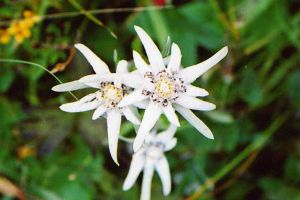
Edelweiss is a perennial herbaceous plant, with plants 15-45cm tall. The underground stem is thick, wrapped in short leaf sheaths, with numerous clustered flowering stems and root shoots of the same form as the flowering stems, without a rosette leaf cluster. The flowering stems are upright, relatively thin, covered with gray-white long soft hairs or nearly silky white hairs, unbranched or sometimes with corymb-like or nearly raceme-like inflorescence branches in the upper part, with denser leaves in the lower part and sparser leaves in the upper part, internodes 5-20mm long, sometimes reaching 10cm in the upper part. Leaves are upright, linear or linear-lanceolate, 2-4.5cm long, 0.2-0.5cm wide, without sheaths, sessile, gray-green on the upper surface and covered with soft hairs, densely white or gray-white woolly on the lower surface or sometimes silky. Bracts are few, slightly shorter than the upper leaves, oblong or linear, covered with thick white or gray-white downy hairs on both surfaces or the lower surface, more or less spreading into a bract group in male plants, more or less upright in female plants, not arranged into an obvious bract group. The capitulum is large, 7-10mm in diameter in female plants, 3-7 densely clustered, rarely 1 or more, often with longer peduncles arranged in a corymb in female plants; the involucre is hemispherical, 4-6mm long, covered with white woolly hairs; involucral bracts about 4 layers, often narrowly pointed, slightly protruding above the hairs; florets dioecious, rarely monoecious; male corolla about 3.5mm long, narrowly funnel-shaped, with small lobes; female corolla filiform, growing after flowering, 4.5-5mm long; pappus white, about 4mm long; male pappus has serrations or hair-like teeth; female pappus has minute teeth; the fertile ovary is hairless and has papillae. The achene is oblong, yellow-brown, about 1mm long, with papillae or dense coarse hairs. Flowering and fruiting period is July-October.
The value and uses of edelweiss
Ornamental value. Edelweiss is a precious flower. It has the characteristic of both flowers and leaves being beautiful, with a small and exquisite plant shape, brilliant silver-gray leaves, and white inflorescences like snow, simple and elegant. At the same time, it has the advantages of drought tolerance and barren tolerance, and is also a perennial herbaceous plant, so it is especially suitable for rock garden planting or potted ornamental use.
Medicinal value. Edelweiss is famous for its unique medicinal value. It is cold in nature and slightly bitter in taste. It has the effects of clearing heat and cooling blood, tonifying the kidney and promoting diuresis, and is mainly used for acute and chronic nephritis and hematuria, and is effective in eliminating proteinuria and hematuria. Folk single prescriptions are used to treat nephritis edema, with relatively significant effects.
Beauty effects. Edelweiss is now also more widely used in the beauty field. Edelweiss is cold in nature, and its essence contains rich minerals. It can clear heat and cool blood, and has soothing, calming, whitening, and nourishing protective effects on the skin. It is extremely effective in resisting skin aging and is a natural beauty treasure for local women in Switzerland. In addition, as various countries have researched and extracted edelweiss ingredients, researchers have found that edelweiss also has strong detoxifying and acne-removing effects on the skin.
Local origins and varieties of edelweiss
Edelweiss is native to the high-altitude regions of Europe. It is one of the famous alpine flowers and is known as the iconic flower of the Alps. There are about 40 species of edelweiss, distributed in the Alpine regions of Asia and Europe. This flower usually grows in the Alps at altitudes above 1700 m. Because it only grows on very rare rocky ground, it is extremely scarce.
In Yuxian County, Hebei Province, China, which is known as the "sky grassland," this grass is locally called "huorongcao." Because this grass has a special smell, when it is used to feed livestock, the livestock dislike it and refuse to eat it. Before people knew it was the precious edelweiss, most tourists who came to the "sky grassland" would not pick this flower either, because its appearance is not at all bright and eye-catching, and it has no fragrance. After the local government learned that this flower is edelweiss, it took protective measures here, banned grazing, and the yurts originally set up on this grassland were also removed. Also after the discovery of edelweiss, the number of tourists coming to the "sky grassland" increased greatly. With the fame brought by edelweiss, Yuxian County, in addition to being known as the "home of paper-cutting," gained another name - "home of edelweiss."
For more professional agricultural science and technology information, please scan the QR code to follow WeChat: NongXunNET

Please indicate the source when reprinting.