What is Moonlight? A detailed introduction to Moonlight
Also known as Moonlight Goddess, it is a perennial succulent herbaceous plant, a small variety. Moonlight's leaves are arranged in a ring-shaped cluster, and the leaf surface is relatively smooth. It usually dies after flowering. It is a hybrid variety of Echeveria pulidonis and Echeveria elegans.
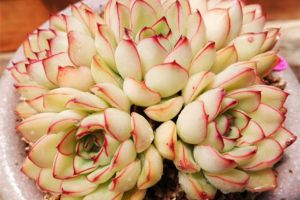
Moonlight's growth habits
Native to Africa. It likes a warm, dry and semi-shaded environment. It is drought-tolerant, afraid of waterlogging, and averse to strong light.
Favorite temperature: 18-24℃
Watering: once a week during the growing period.
Light: slightly tolerant of shade
Propagation: cuttings
Pests and diseases: whiteflies
Combination suggestions: Sedum rubrotinctum, Sedum adolphi
Moonlight's planting and care tips
Moonlight's care tips
Potting soil: repot in early spring every year. Use a mixed soil of leaf mold, culture soil and coarse sand for the potting soil, and add a small amount of bone meal.
Watering: water once a week during the growing period, and once every 2-3 weeks at other times. Keep the potting soil slightly dry in winter.
Fertilizing: fertilize once a month with diluted cake fertilizer water or "Huiyou 15-15-30 special fertilizer for potted flowers.
Pests and diseases: when indoor ventilation is poor, it is susceptible to whitefly damage. You can spray with a 1500-fold solution of 50% fenitrothion emulsion to kill them.
Moonlight's propagation methods
Cuttings: carry out during the growing period, preferably in spring and autumn. Select a plump leaf and cut it off with a short stem. After drying, insert it into a sand bed. The cutting medium temperature is 20-22℃. Roots form 15-20 days after insertion. Top cuttings can also be used: cut off the top with 4-5 leaves, let it dry, then insert it into a sand bed. After about 20-25 days it heals and then roots.
For more professional agricultural science and technology information, please scan the QR code to follow WeChat: NongXunNET

Please indicate the source when reprinting.