In what environment does Iris lactea grow more advantageously?
Iris lactea is also called malian, malan, malan flower, hanpu, lishi, licao, jucao, shishou, sanjian, and majiu. The flower language of Iris lactea is "messenger of love." As a perennial herbaceous plant, Iris lactea has unique ecological and biological characteristics and utilization value.
Other names of Iris lactea
Iris lactea, also called malian, malan, malan flower, hanpu, lishi, licao, jucao, shishou, sanjian, and majiu, is a perennial herbaceous fibrous-rooted plant belonging to the genus Iris in the family Iridaceae.
The uses and value of Iris lactea
Iris lactea is salt-alkali tolerant, trampling tolerant, and has a well-developed root system; it grows in wastelands, roadsides, hillside grass clumps, and saline-alkali meadows, and can be used for soil and water conservation, the improvement of saline-alkali land and industrial waste land, and as ground cover, edging, or specimen planting in landscaping.
The whole plant can be used as medicine and has the effects of clearing heat, stopping bleeding, and detoxifying.
The leaves can be used as binding and grass-weaving material, and it is relatively common in grassland areas.
The flower language and legend of Iris lactea
The flower language of Iris lactea is: lover of a previous life, messenger of love.
Iris lactea is commonly known as malian flower or malan flower, and is also called Zhu Yingtai flower. In legend, Iris lactea is the flower transformed from Zhu Yingtai, who could not stay together with Liang Shanbo; its shape resembles a butterfly, and it is a messenger that conveys love. The existence of Iris lactea is full of legend and tragic heroism.
To this day, Greeks often plant this flower in cemeteries, that is, longing that the soul after a person's death can be entrusted to Alice to bring back to heaven.
Morphological characteristics of Iris lactea
Iris lactea is a perennial densely clumping herb.
The rhizome is thick and strong, woody, slanting, and externally covered with a large amount of dense red-purple broken old leaf residual sheaths and hair-like fibers; the fibrous roots are thick and long, yellow-white, and sparsely branched. The leaves are basal, tough, gray-green, linear or narrowly sword-shaped, about 50 cm long and 4-6 mm wide, with acuminate apex, sheath-like base, tinged with red-purple, and no obvious midvein.
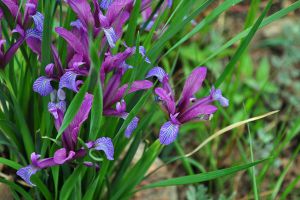
The flowering stem is smooth, 3-10 cm tall; the bracts are 3-5, herbaceous, green, with white edges, lanceolate, 4.5-10 cm long and 0.8-1.6 cm wide, with acuminate or long-acuminate apex, containing 2-4 flowers; the flowers are blue, 5-6 cm in diameter; the pedicel is 4-7 cm long; the perianth tube is very short, about 3 mm long, the outer perianth lobes are oblanceolate, 4.5-6.5 cm long and 0.8-1.2 cm wide, with obtuse or acute apex and wedge-shaped claw, the inner perianth lobes are narrowly oblanceolate, 4.2-4.5 cm long and 5-7 mm wide, with a narrowly wedge-shaped claw; the stamens are 2.5-3.2 cm long, the anthers are yellow, and the filaments are white; the ovary is spindle-shaped, 3-4.5 cm long.
The capsule is long-elliptic and columnar, 4-6 cm long and 1-1.4 cm in diameter, with 6 obvious ribs and a short beak at the apex; the seeds are irregular polyhedra, brown, and slightly glossy. The flowering period is May-June, and the fruiting period is June-September.
Growth habits of Iris lactea
Iris lactea has no strict requirements for soil; as long as there is a certain soil layer, it can grow normally on various types of soil. It can withstand an extreme low temperature of -30°C and can also resist a high temperature of 40°C, and can overwinter and pass summer normally in northern regions.
Its roots and leaves have drought-resistant structures, and generally it only needs to be watered 2-3 times a year to grow normally, flower, and set seed.
It is extremely salt-alkali tolerant; seeds can germinate normally under conditions with a salt content of 0.4%, and plants can grow and develop normally under a salt content of 0.5% and a pH value below 8.8.
It has extremely strong resistance to diseases, insects, and rodents. Generally, Iris lactea seeds or vegetation never suffer from disease, insect, or rodent damage, and when mixed with other vegetation, disasters also rarely occur. However, under dry, high-temperature, poor, and harsh environmental conditions, the aboveground growth of Iris lactea will decrease, while the root system will become more developed to ensure its normal survival in adverse environments.
Distribution of origin of Iris lactea
Iris lactea is native to Heilongjiang, Jilin, Liaoning, Inner Mongolia, Hebei, Shanxi, Shandong, Henan, Anhui, Jiangsu, Zhejiang, Hubei, Hunan, Shaanxi, Gansu, Ningxia, Qinghai, Xinjiang, Sichuan, and Tibet in China.
It grows in wastelands, roadsides, and hillside grasslands, and is especially more abundant on overgrazed salinized grasslands; it is also produced in Korea, the former Soviet Union, and India.
Iris lactea has an extremely wide natural distribution, a well-developed root system, extremely strong resistance and adaptability, and salt-alkali tolerance. These characteristics determine that it is very suitable for soil and water conservation and the greening improvement of saline-alkali land in the dry-climate and soil-desertification areas of northern China.
Appreciation of Iris lactea pictures
For more professional agricultural science and technology information, please scan the QR code to follow WeChat: NongXunNET

Please indicate the source when reprinting.