What are the characteristics and symbolic meaning of the crape myrtle flower?
Alternative names
The crape myrtle is a woody plant of the small tree or deciduous shrub type, and has alternative names such as "Hundred-Day Red", "All-Red Hall", "Mosquito Flower" and "Tickle Tree".
Morphological characteristics
The crape myrtle tree grows to about 7 m at its tallest; the bark is gray or brown, relatively smooth to the touch, and most branches and trunks grow twisted, while the twigs are rather slender.
The leaves of the crape myrtle are obovate, (elliptic, broadly oblong) rounded papery leaves.
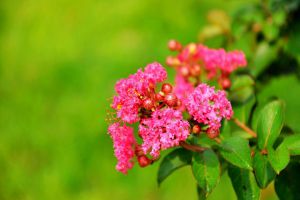
Crape myrtle flowers come in rich colors such as rose red, deep pink, bright red, purple and white; the flowers are about 3-4 cm in diameter, and the flowering period is usually in the flower-sparse autumn and lasts a long time, which is why it is also called "Hundred-Day Red".
Growth habits
The crape myrtle is suitable for growing in a warm, humid, sunny environment, and can also tolerate a semi-shaded environment.
Its growth requires sufficient fertilizer, and the planting soil is best a fertile, deep sandy soil; both acidic soil and calcareous soil are acceptable.
In terms of humidity, the crape myrtle is best planted in moist soil; it has a certain adaptability to dry environments, but it is afraid of waterlogging, so when planting in the ground one must not choose low-lying, wet spots with a high water table.
The crape myrtle also has a fairly strong resistance to pollution, and to a certain extent can resist pollution from sulfur dioxide, hydrogen fluoride and chlorine gas, among others.
Value and uses
Ornamental value: The crape myrtle flower has long enjoyed the fine name "Hundred-Day Red", and the flowers, roots and trunks of the bonsai made from it all have good ornamental value. Crape myrtles planted in courtyards, parks and along roads also have good landscaping functions.
Practical value: The trunk wood of the crape myrtle tree is hard and has good rot resistance, and can be used as material for furniture, buildings and farm tools.
Medicinal value: After the leaves of the crape myrtle are used as medicine, they can dispel wind and dissipate blood stasis, and also have effects such as clearing heat and detoxifying, and stopping bleeding and reducing swelling.
Flower language
The crape myrtle flower represents "obsessive love", and also has different symbolic meanings such as "good luck", "women" and "eloquence".
For more professional agricultural science and technology information, please scan the QR code to follow WeChat: NongXunNET

Please indicate the source when reprinting.