It looks like a series of painted opera faces, and its comical appearance is irresistible.
Introduction: Gazania is a perennial herbaceous plant of the genus Gazania in the Asteraceae family, with rhizomes. The leaves grow in a rosette, lanceolate or obovate-lanceolate, with entire or shallowly pinnatifid margins, and the underside of the leaves is densely covered with white woolly hairs. The ligulate flowers are white, yellow, and orange-red with a glossy sheen. Also known as gazania, it gets its name because its shape resembles a medal. Gazania has unusual flower shapes and rich colors, and its
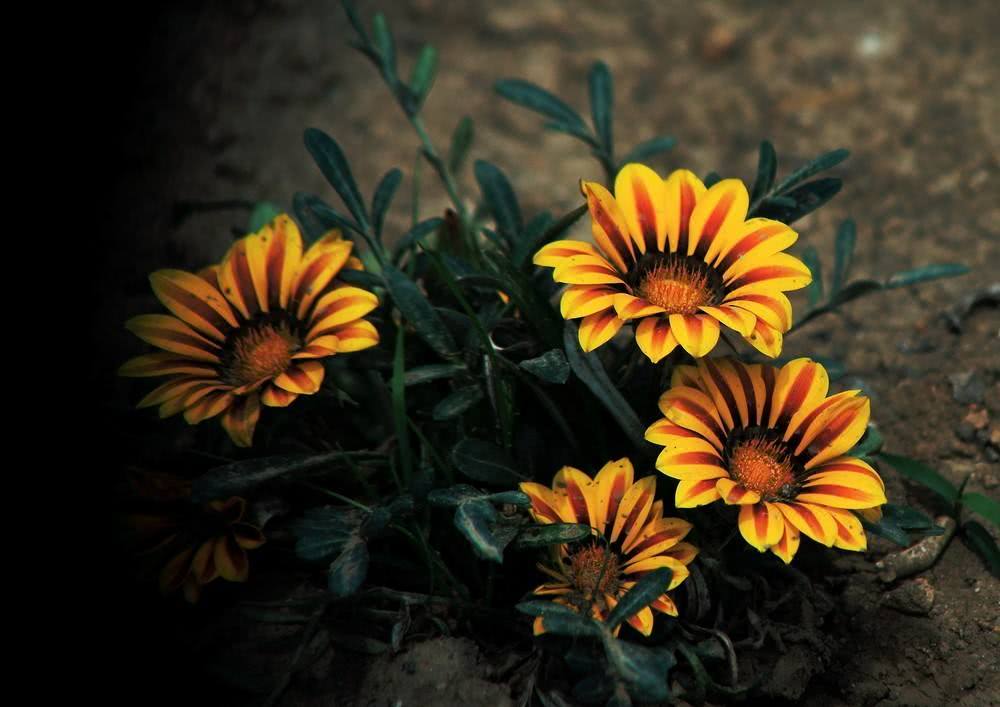
Gazania is a perennial herbaceous plant of the genus Gazania in the Asteraceae family, with rhizomes. The leaves grow in a rosette, lanceolate or obovate-lanceolate, with entire or shallowly pinnatifid margins, and the underside of the leaves is densely covered with white woolly hairs. The ligulate flowers are white, yellow, and orange-red with a glossy sheen.
Also known as gazania, it gets its name because its shape resembles a medal. Gazania has unusual flower shapes and rich colors, with a dark eye spot in the center of the flower that resembles a medal, giving it a strong wild charm. It is a common potted flower and flowerbed flower in gardens. It is native to southern Africa. New cultivars are constantly emerging and are now widely cultivated around the world.
Morphological characteristics:
A perennial herbaceous plant, also known as gazania, it gets its name because its shape resembles a medal. Gazania has unusual flower shapes and rich colors, with a dark eye spot in the center of the flower that resembles a medal, giving it a strong wild charm. It is a common potted flower and flowerbed flower in gardens. Gazania has rhizomes, and the leaves grow in a rosette from the base of the plant. The leaf blades are lanceolate or obovate-lanceolate, with entire or shallowly pinnatifid margins, and the underside of the leaves is densely covered with white hairs; the capitulum has ligulate flowers in white, yellow, orange-red, and other colors, and the petals are glossy. The flower diameter is 7~8cm, and the flowering period is April to May.
Ornamental species in the same genus include white-haired gazania; single-flowered gazania, with gray-green leaves and flower colors including yellow, white, and orange; and pinnate-leaved gazania, with pinnately lobed leaves and orange-yellow ligulate flowers with a black eye at the base.
Growing environment:
1. Light: Gazania likes sunlight and prefers to grow in cooler places. It is drought-tolerant and tolerant of poor soil; it is semi-hardy, so it can overwinter successfully in areas with milder winters. Growth and the flowering period require sufficient sunlight. If the light at the cultivation site is insufficient, the leaves become soft, the flower buds decrease, the flowers become smaller, and the flower colors fade. On the contrary, with sufficient sunlight, the flower colors are vivid and flowering is continuous.
2. Temperature: The suitable growth temperature for gazania is 15~20°C, 13~24°C from March to September, and 7~13°C from September to the following March. However, gazania is relatively adaptable to high temperatures above 30°C, with slower leaf growth and reduced flowering. In winter, the temperature should not be lower than 5°C, but it can withstand 0°C for a short time; if the low temperature lasts for a long time, frost damage is likely to occur.
3. Water: Gazania is relatively sensitive to water. Although the soil needs to be moist during the stem and leaf growth period, excessive soil moisture during the plum rain season can easily cause waterlogging and kill the entire plant. At the same time, during high summer temperatures, the air humidity should not be too high, and the potting soil should not accumulate water; otherwise, both are unfavorable to the growth and flowering of gazania.
4. Soil: Choose fertile, loose, and well-drained sandy loam soil. For potting soil, a mixture of equal parts potting soil, leaf mold soil, and coarse sand can be used.
Distribution range:
Native to South Africa, it is distributed in various places in China, including Shenyang, Huludao, Dalian, Dandong, Anshan, Liaoyang, Jinzhou, Yingkou, Panjin, Beijing, Tianjin, Taiyuan, Linfen, Changzhi, Shijiazhuang, Qinhuangdao, Baoding, Tangshan, Handan, Xingtai, Chengde, Jinan, Dezhou, Yan'an, Baoji, and Tianshui. It grows in warm temperate deciduous broad-leaved forest areas.
For more professional agricultural science and technology information, please scan the QR code to follow WeChat: NongXunNET

Please indicate the source when reprinting.