Many beautiful flowers have very different names
Introduction: Clerodendrum bungei is also known as Dahongpao, Choubabao, Aitongzi, Yezhutong, Choufengcao, Chouzhuotong, Chounaoke. Its appearance closely resembles a peony, and because it carries a foul odor it is commonly called "stinky peony." It is a plant in the genus Clerodendrum of the family Verbenaceae. Its leaves are deep green, its flowers are graceful, and its flowering period is long, making it a very beautiful garden flower. It is suitable for planting on slopes, in forests
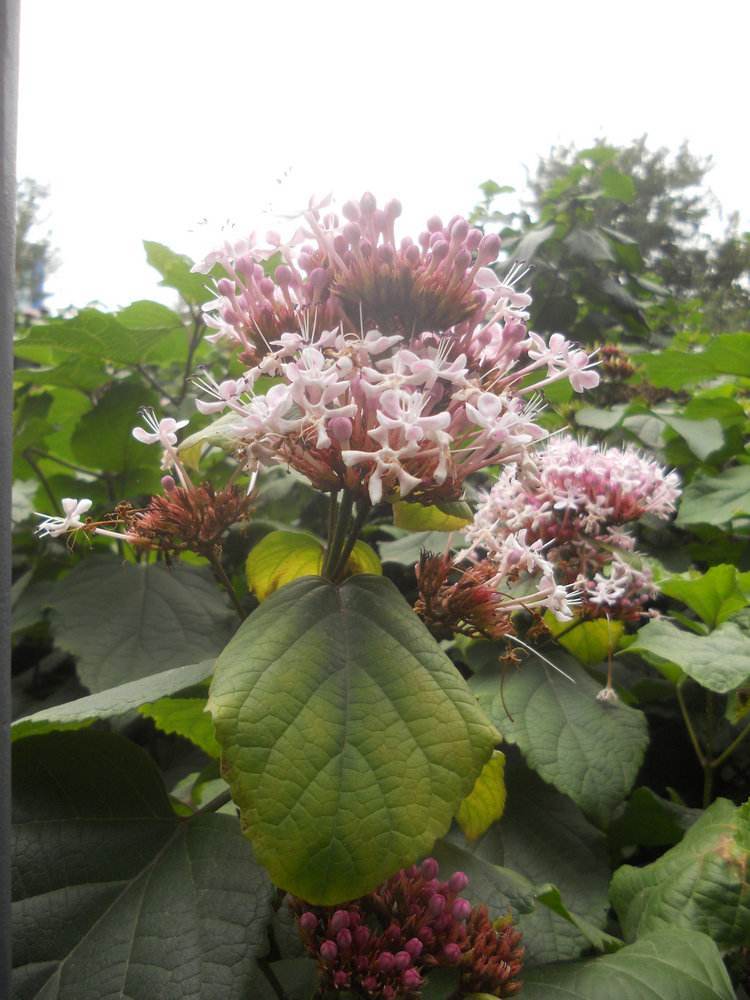
Clerodendrum bungei is also known as Dahongpao, Choubabao, Aitongzi, Yezhutong, Choufengcao, Chouzhuotong, Chounaoke. Its appearance closely resembles a peony, and because it carries a foul odor it is commonly called "stinky peony." It is a plant in the genus Clerodendrum of the family Verbenaceae. Its leaves are deep green, its flowers are graceful, and its flowering period is long, making it a very beautiful garden flower. It is suitable for planting on slopes, under forests or beside groves. It likes sunny and moist environments, has strong adaptability, and is cold- and drought-tolerant. Because it sprouts and grows densely, it can also serve as an excellent soil-and-water conservation plant, used for slope protection and soil and water conservation.
The Chinese medicine "stinky peony" comes from the roots and leaves of Clerodendrum bungei, and has the effects of dispelling wind and detoxifying, reducing swelling and relieving pain. Leaves are collected in summer and roots in autumn, used fresh or dried in the sun for later use. The famous Yunnan snake medicine contains "stinky peony."
Clerodendrum bungei
Growing environment:
It grows on slopes, forest edges, gullies, roadsides and moist places in thickets below 2500 m in altitude. It likes sunny and moist environments, has strong adaptability, is cold- and drought-tolerant, and is also fairly shade-tolerant; it is best grown in fertile, loose leaf mold soil. It grows on slopes, at forest edges or beside ditches. It likes warm, humid, semi-shaded environments and is suitable for loose, fertile, well-drained substrates. The optimum growing temperature is 18-22°C, and the overwintering temperature is 8-12°C.
Clerodendrum bungei
Distribution range:
Domestic: produced in North China, Northwest China and Southwest China; the specific provinces are Sichuan, Jiangsu, Anhui, Zhejiang, Jiangxi, Hunan, Hubei and Guangxi.
Abroad: also distributed in northern India, Vietnam and Malaysia.
Native to tropical South America, it is now cultivated in many places.
Propagation methods:
Mainly by division, but also by root cuttings and sowing. For division, from after leaf fall in autumn and winter until before bud break in spring, dig up suckers above ground and plant them separately. For root cuttings, in the plum rain season cut off the horizontally creeping root suckers and insert them into sandy soil; they root 1-2 weeks after insertion. For sowing, collect seeds in September-October, store them in sand over winter, sow the following spring, and they germinate 2-3 weeks after sowing.
Clerodendrum bungei
Cultivation techniques:
During the growing period, the spread of root suckers must be controlled. Keep the soil moist; fertilizer may be applied once in May-June, and excess sucker seedlings should be pruned at any time. In winter, cut off the withered above-ground parts to reduce pest and disease damage.
Pest and disease control:
Rust and gray mold often cause damage; spray gray mold-infected plants with 50% benomyl wettable powder at 2500 times dilution, and control rust-infected plants with 20% triadimefon EC at 400 times dilution. Pests include leaf beetles and stinging caterpillars, which can be killed by spraying 2.5% deltamethrin at 3000 times dilution.
For more professional agricultural science and technology information, please scan the QR code to follow WeChat: NongXunNET

Please indicate the source when reprinting.