Succulents that grow into strings of coins are fresh and lovely, it would be a shame not to keep a pot
Crassula rupestris subsp. marnieriana, a succulent in the Crassulaceae family, genus Crassula, is also called "coin string" because it grows to resemble strings of ancient copper coins. Isn't that interesting? Let's take a look! 1. Color changes of Crassula rupestris subsp. marnieriana. Its leaves are opposite, with leaves...
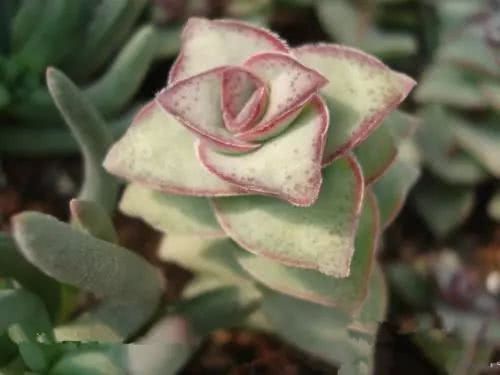
Crassula rupestris subsp. marnieriana, a succulent in the Crassulaceae family, genus Crassula, is also called "coin string" because it grows to resemble strings of ancient copper coins. Isn't that interesting? Let's take a look!
1. Color changes of Crassula rupestris subsp. marnieriana
Its leaves are opposite, heart-shaped or long triangular, deep green in color. In winter and early spring during the cool season or under conditions of sufficient sunlight, the leaves turn reddish-brown or brown, and the leaf margins have a white cuticle. The leaves of the entire plant are arranged densely and neatly, gradually becoming smaller from the base upward, forming a pagoda shape. It is a peculiar and beautiful succulent plant. The flowers of Crassula rupestris subsp. marnieriana are beige-yellow, opening from May to June.
2. Growing environment and light
Crassula rupestris subsp. marnieriana prefers a sunny, warm and dry environment, and dislikes waterlogging, high temperature and muggy conditions, and excessive shade. It is drought-tolerant and tolerates partial shade. Its growing season is in winter, when it should be given sufficient light, otherwise insufficient light will affect leaf color and gloss. Its growing season is in winter, when it should be given sufficient light, otherwise insufficient light will affect leaf color and gloss.
3. Watering and fertilizing
Keep the potting soil moist but not waterlogged, and apply a diluted, well-rotted liquid fertilizer or a compound fertilizer low in nitrogen and high in phosphorus and potassium once every half month. The application amount should not be too much, to avoid excessive stem and leaf growth and elongation of internode spacing, which would make the plant loose and seriously affect its ornamental value.
4. Summer ventilation
In summer, when temperatures are high, Crassula rupestris subsp. marnieriana enters a dormant or semi-dormant state, with growth slowing or stopping completely. It should be kept in a ventilated, cool, brightly lit place without direct sunlight, and should not be watered too much, to prevent rot.
5. Temperature
In winter, place it indoors in a sunny spot. Above 10°C the plant can continue to grow, and it should be watered appropriately. If the potting soil is kept dry and the plant is allowed to go dormant, it can also tolerate a low temperature of 5°C.
6. Repotting
When the plant has filled the pot, repot it in spring. The potting soil should be loose, fertile and well-draining. Mix garden soil, coarse sand or vermiculite, 2 parts each, with 1 part leaf mold, and add a small amount of bone meal and chicken or cow manure as base fertilizer. Old plants grown for many years can produce very beautiful flowers.
7. Propagation
There are three methods of propagating Crassula rupestris subsp. marnieriana:
(1) Division
Separate densely growing plants into clumps of 3 to 4 stems each, then plant them directly in pots.
(2) Cuttings
In the growing season, cut healthy, plump top stems and root them in sandy soil. Each cutting should have more than 4 pairs of leaves and be 3 to 5 cm long. At 18 to 24°C, keeping them slightly moist, they will root in 2 to 3 weeks.
(3) Sowing
Seeds can be harvested and sown in April to May. At around 20°C, the seeds germinate within two weeks after sowing, and the seedlings grow relatively quickly.
For more professional agricultural science and technology information, please scan the QR code to follow WeChat: NongXunNET

Please indicate the source when reprinting.