What's the deal with tree flowering? A detailed explanation
Introduction: Elaeocarpus apiculatus is the customary name for Elaeocarpus longimucronatus, now mostly called Elaeocarpus rugosus. An evergreen tree in the family Elaeocarpaceae, genus Elaeocarpus, with gray bark; the branchlets are stout, covered with grayish-brown soft hairs, bearing many round scars left by fallen leaf stalks, and shriveled with many straight striations when dry. The leaves are clustered at the tips of the branches, leathery, obovate-lanceolate; the drupe is elliptical, 3-3.5
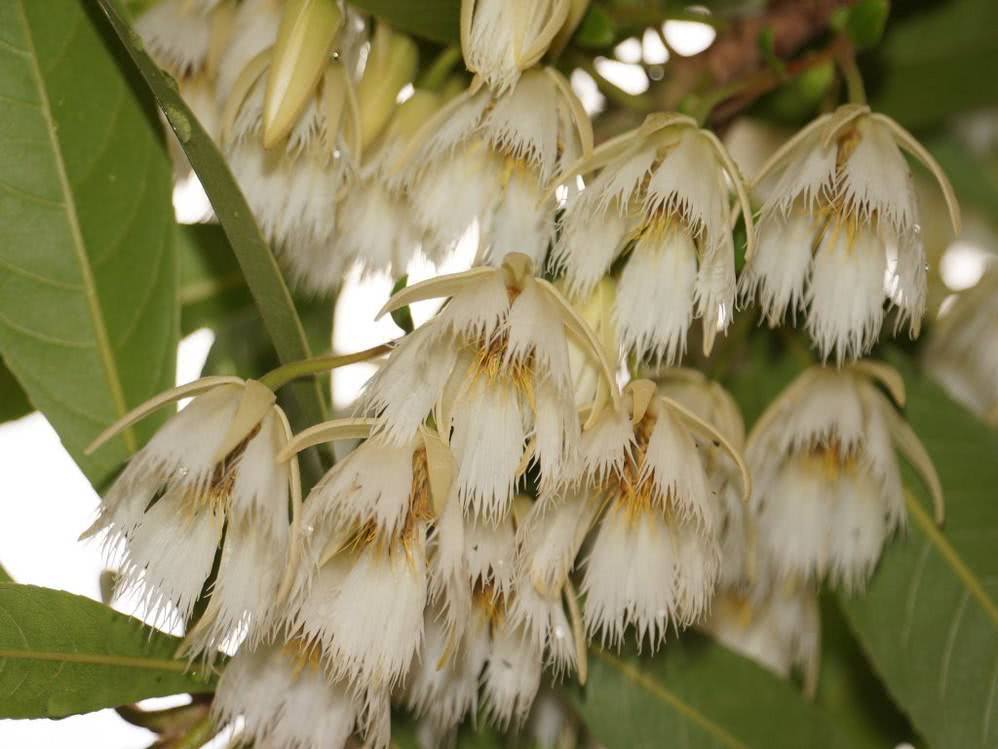
Elaeocarpus apiculatus is the customary name for Elaeocarpus longimucronatus, now mostly called Elaeocarpus rugosus. An evergreen tree in the family Elaeocarpaceae, genus Elaeocarpus, with gray bark; the branchlets are stout, covered with grayish-brown soft hairs, bearing many round scars left by fallen leaf stalks, and shriveled with many straight striations when dry. The leaves are clustered at the tips of the branches, leathery, obovate-lanceolate; the drupe is elliptical, 3-3.5 cm long, with brown downy hairs. Flowering period is August-September, and the fruit ripens in winter.
Elaeocarpus apiculatus
Produced in southern Yunnan, Guangdong and Hainan in China. Found in low-altitude valleys. Also distributed in the Indochina Peninsula and Malaysia. The buttress roots at the base of the trunk of adult trees are quite spectacular. The flowers are pure white like shells, and fragrant. After midsummer, the trees are laden with fruit. It is an excellent woody flowering plant, landscape tree and street tree.
Elaeocarpus apiculatus
The type specimen was collected from Malacca, Malaysia. Gagnepain once designated the Vietnamese specimens of this type as a variety, based on his mistaken belief that the inflorescence of the original Malaysian species was hairless while that of the Vietnamese specimens was hairy. In fact, according to Masters in "Flora of India," the inflorescence is covered with short hairs; the inflorescences of Chinese specimens are also hairy, so they are merged.
Elaeocarpus apiculatus
Main value:
The crown of Elaeocarpus longimucronatus is neat and rounded, with dense branches and leaves, some of which are dark red, creating an attractive mix of red and green. In gardens, it is often planted in clumps on lawns, at road junctions, and along forest edges; it can also be planted in rows to provide screening and sound insulation, or used as a background tree for flowering shrubs or sculptures, with a good enhancing effect. It can also be used as a greening tree species for factory areas. In some areas it has been used as a street tree.
For more professional agricultural science and technology news, please scan the QR code to follow WeChat: NongXunNET

Please indicate the source when reprinting.