Intangible cultural heritage artisans hold fast to craftsmanship, passing traditional skills down from generation to generation
Suzhou bonsai falls mainly into two categories. One is the tree-stump bonsai, also known as potted bonsai, and it is in this type that the characteristics of Suzhou bonsai are most strikingly displayed; the other is the rock bonsai, also called landscape bonsai or rock bonsai, which is further divided into water-and-stone bonsai and dry-stone bonsai.
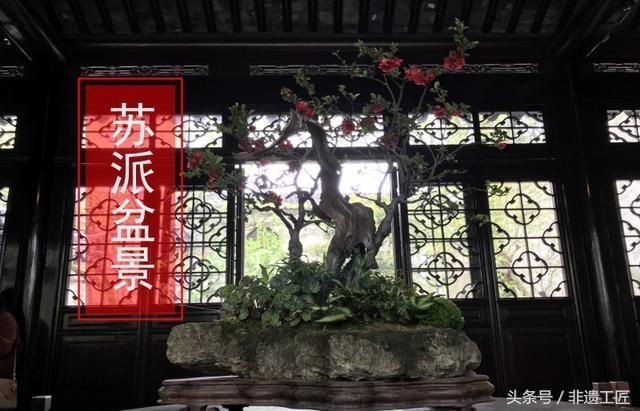
Suzhou bonsai falls mainly into two categories. One is the tree-stump bonsai, also known as potted bonsai, and it is in this type that the characteristics of Suzhou bonsai are most strikingly displayed; the other is the rock bonsai, also called landscape bonsai or rock bonsai, which is further divided into water-and-stone bonsai and dry-stone bonsai.
Suzhou bonsai emphasizes the creation of artistic conception, drawing people in with the artistic charm of a fusion of scene and feeling. It absorbs the essence of classical garden art and combines the strengths of Chinese painting techniques, using scenery to convey emotion and emotion to express scenery, and employing artistic methods such as "seeing the large within the small" to achieve the artistic effect of emotion within the scene and emotion beyond the scene. The works are thought-provoking and make people reluctant to put them down.
Humble Administrator's Garden bonsai
The Humble Administrator's Garden is a representative work of classical gardens in Jiangnan, and together with the Lingering Garden in Suzhou, the Summer Palace in Beijing and the Chengde Mountain Resort, it is celebrated as one of China's four great famous gardens.
The whole Humble Administrator's Garden is centered on water, with mountains and waters winding around, exquisite pavilions, and lush flowers and trees, bearing a rich flavor of the Jiangnan Han Chinese water town.
The bonsai garden is in the western part of the Humble Administrator's Garden. Beyond the Floating Green Pavilion and the Stay and Listen Pavilion, a bamboo fence encloses a stretch of flat open ground, where artworks of varying sizes and forms are displayed, many of them fine examples of the Su style of bonsai.
The Humble Administrator's Garden bonsai garden was first built in 1954 and is one of the earlier specialized bonsai cultivation bases and viewing areas among Suzhou gardens. It holds more than 1,600 pots of various tree-stump and azalea bonsai, of which more than 700 pots are tree-stump bonsai, embodying the unique style of Su-style bonsai: ancient and elegantly simple, old yet ever firmer, free and graceful, and thought-provoking.
Lingering Garden bonsai
The Lingering Garden is known for its exquisitely arranged buildings and numerous curious stones, and together with the Humble Administrator's Garden in Suzhou, the Summer Palace in Beijing and the Chengde Mountain Resort, it is known as one of China's four great famous gardens.
The Lingering Garden is a large classical private garden in China, covering an area of 23,300 sq m. It represents the Qing dynasty style, and the garden is famed for its superb architectural art, with spacious and magnificent halls, courtyards full of variation, and Taihu stones of which the Cloud-Capped Peak is the finest, offering "the pleasure of obtaining mountains and forests without leaving the city walls".
Its handling of architectural space is superb; the garden designers used various artistic methods to form a garden space system with rhythm and cadence, making it a world-famous example of architectural space art.
The bonsai garden at the Lingering Garden's "Another Village" covers an area of about 1,500 sq m. It has a long history and luxuriant flowers and trees, and preserves a rustic charm, and together with the Tiger Hill Ten Thousand Scenes Villa and the Humble Administrator's Garden bonsai garden, it is known as one of the three great bonsai gardens of Suzhou.
The Lingering Garden bonsai brings together the finest of Su-style bonsai and represents the current direction of bonsai development. It is unique in preserving heritage and bringing forth the new, and has won unanimous praise from experts at home and abroad.
Various bonsai are arranged neatly and orderly in the garden by category, giving people a refreshing feeling.
The present bonsai garden has areas for camellia, azalea, water-and-stone and tree-stump bonsai, giving the garden's overall display standard a qualitative improvement.
2018.04.07 (Suzhou)
For more professional agricultural science and technology information, please scan the QR code to follow WeChat: NongXunNET

Please indicate the source when reprinting.