Setting up a tank is hands-on work for others, but it's a nightmare for me
In the past I often shared aquascaping masterpieces by masters at home and abroad. While we admire others, we also have this confusion: where on earth do the masters get their materials? (Voice-over: Can you just drop a link too?) So...
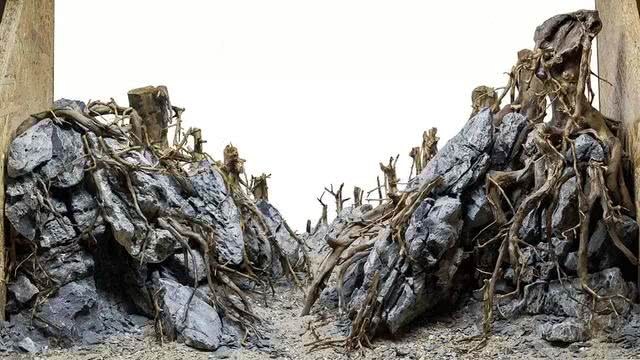
In the past I often shared aquascaping masterpieces by masters at home and abroad. While we admire others, we also have this confusion:
Where on earth do the masters get their materials? (Voice-over: Can you just drop a link too?)
With such wild, surreal yet stunning hardscape, even if you gave me another 500 years I still wouldn't be able to learn it, right? (Voice-over: For others, setting up a tank is hands-on work; for me, setting up a tank is a nightmare! Can't there be something simple, practical and easy to do?)
Actually, most of us aquarium hobbyists don't have the ability to create master-level, exquisitely crafted landscapes. Some people may just like having a bit of nature at home, and some may enjoy the process of creating something with their own hands. It's unavoidable that the result "still has shortcomings."
Because we are non-professionals. We don't have such uniquely perfect materials, and we certainly don't have that much time to study and dig deep... So don't belittle yourself. As long as you do it, that's the right thing!
Just like the aquarium hobbyist Dong Yi introduced below. It was his first time setting up a paludarium himself. Although the process was harder than expected and the final result didn't reach what he had hoped for, it was still a joy to complete it successfully. He wants to share the final joy with everyone, and also asks all the veteran hobbyists for more guidance~~
Let's take a look at Dong Yi's maiden work. Everywhere you look in the tank is green, and the breath of spring rushes at you:
Tank setup
[Tank dimensions] 70*50*40cm
[Substrate setup] Crazy Aquatic Amazon soil, energy powder, filter media, sphagnum moss, akadama soil
[Filtration system] Submersible pump
[Lighting] LED pendant light
[Aquascaping materials] Pine bark stone
[Plant species] Moss, acorus, rock pine, small coconut palm, serissa, golden Phoebe zhennan
[Fish species] Black shell shrimp, white cloud mountain minnow
Tank setup process
Before setting up the tank, I had always wanted to make a paludarium, with high mountains and flowing water, splashing waterfalls, mountains and rivers, and schools of fish and shrimp swimming, as if standing at the foot of a mountain and being able to bring the whole mountain home!
But the ideal is plump, while reality is a bit bony. Since this was my first aquascape, my ability is limited! My experience is insufficient! So... just look at the pictures.
I mainly used pine bark stone for the hardscape, because its color is warm yellow, its lines are clear, and it feels closer to a big mountain, giving a more direct impression. I laid a layer of foam cotton at the bottom to protect the tank.
Since pine bark stone is porous and easily traps mud, it is best to rinse and dry it before use.
The process of building the hardscape, just talking about it brings tears!
I set aside a whole day specifically for setting up the tank, starting to fiddle with the hardscape at 8 in the morning, and only finishing at 2 in the afternoon! The whole time was spent trial-placing, because the number and shapes of the stones were limited, and I had to keep changing directions and angles to see how to get closer to the feeling in my mind, so just building the hardscape alone wasted a lot of time!
Then when making the waterfall I also went through all kinds of hardships! I just couldn't get it right. In the end I used a submersible pump to split the flow, letting the water pass through the pump to create a stream effect.
No glue! It was very hard to arrange the stones into the shape of a river, but fortunately pine bark stone is soft and easy to break, so I smashed many small stones and pieced them together bit by bit.
Building the substrate: for the foreground I used Tank energy powder + Crazy Aquatic Amazon aquarium soil, preparing to plant aquatic plants in the water; for the background I first laid ceramic rings, then sphagnum moss - coconut soil - akadama soil.
Planting
In choosing plants, considering the high humidity of a paludarium, I mainly chose some shade-tolerant, moisture-tolerant, moisture-loving plants: moss, acorus, rock pine, small coconut palm, serissa, golden Phoebe zhennan.
For daily maintenance I plan to have the light on from 8 in the morning to 6 in the evening. Considering that indoors is relatively dry, I plan to spray water three times a day, morning, noon and evening, to maintain the humidity for the plants.
Plant details:
Dong Yi said that because there is no soil, the left background is a bit empty. The next step is to raise the left side and plant some more plants. In the water there are currently only white cloud mountain minnows and black shell shrimp. He plans to buy some small fish and crabs too, and keep a group of shrimp soldiers and crab generals, swimming fish and aquatic plants. That would be a joy too!
Actually, I've been won over by the ivy, climbing above the air conditioner and naturally hanging down, echoing the green plants in the tank from afar. At this point, if the aquarium soil in the tank were replaced with light-colored cosmetic sand, wouldn't it look even fresher?
Plant lovers who enjoy aquascaping, go ahead and try boldly like Dong Yi. After doing it for 3 minutes, trust me, you won't be able to stop~
Image source: Dong Yi
Compiled and edited by: Crazy Jun
[Statement: This article comes from Crazy Aquatic, and the copyright belongs to the original author. If it infringes on your rights, please leave a message to contact us for deletion.]
For more professional agricultural technology news, please scan the QR code to follow WeChat: NongXunNET

Please indicate the source when reposting.