What Plants Are Plum and Lily of the Valley? Let Us Introduce Them to You
Introduction: As a garden owner, Plum is really a bit too beautiful. She is tall and slender, with delicate features and flowing clothes, a former model and current floral designer. In photography theory, it is often said that when a person appears in a frame, they naturally draw the viewer's eye, let alone an outstanding fairy. So, to av
As a garden owner, Plum is really a bit too beautiful. She is tall and slender, with delicate features and flowing clothes, a former model and current floral designer.
In photography theory, it is often said that when a person appears in a frame, they naturally draw the viewer's eye, let alone an outstanding fairy.
So, to keep her from stealing the attention that the plants and scenery deserve, when photographing Plum's garden we first chased her out of the garden.
Plum's garden consists of two adjacent small balconies and a passage. The larger one is about ten sq m, the smaller one just a few sq m, and between them is a narrow passage no more than half a meter wide. It is fair to say this garden is an especially mini one among all we have seen.
But no matter how small the garden, there must be a table and chairs.
With a table and chairs comes a human presence, the flavor of life; it is no longer a wild space left to fend for itself.
The style of the table and chairs is an expression of the owner's personality. Elegant and refined people, innocent and spontaneous people, plain and unadorned people all use different tables and chairs.
From the living room out into Plum's garden, directly facing you is a table with two chairs, and opposite there is also a bench.
The table and chairs are white French openwork, a delicate and exquisite palace style. This style is very common in China, often used in various wedding scenes and photo studios, but to be honest, it is not easy to use well.
The most common mistake is placing it on a large green lawn, or setting it out on an open preservative-treated wood deck.
A simple, spacious environment leaves the exquisite classical style completely at a loss, like exiling a seventeenth-century French noblewoman to an American middle-class courtyard; she would surely be anxious and uneasy.
The right approach is just like here: white louvered wall panels and an equally openwork embroidered tablecloth create a relatively enclosed atmosphere, as if arriving at a private salon.
Looking out from indoors, the white gauze curtains appear and disappear, with deep drapery and fine lace; that is what gives a noblewoman a sense of security.
If you do not want the garden to become a wedding photography set, you also need to be especially careful with the plant arrangement.
Longsha is too stiff, qiangwei is too wild, and any form of bright red and bright yellow should not appear even more. The reason is simple: before modern times in Europe, roses did not yet have vivid red and yellow.
Roses of that era were only deep pink, light pink, white, and purple.
This William and Catherine in Plum's home blooms round and exquisite. Although it is a 2011 variety, it has the pearl-white color of a classical rose and charming button eyes, named after the wedding of Britain's Prince William and Princess Kate.
Next to it is the shell-pink Queen of Sweden; the two potted plants form a pair of royal combinations. Actually the upright Queen of Sweden is a bit too clanging; it would be best to have the kind with weak branches that nods as soon as it opens, a classical flower form. But in view of the queen's apt and on-topic name, let us be tolerant of her.
So, no matter how small the garden, there must be roses.
That is to say, there must be a leading character big enough and beautiful enough. Of course it can also be other plants: peonies, lilies, flowering trees...
However, when it comes to fragrance, texture, shape, height, flowering period, with all these major elements able to achieve enough presence, the rose is the only choice.
In Plum's garden there are about a dozen or more roses: white, yellow, apricot, orange-pink, with no red and no purple, and none of the exaggerated stripes I like. A Free Spirit, known for its softness, is already the most brilliantly colored presence.
The roses are supported by various wrought-iron stands, flower gates, and arches. The intricate black wrought-iron patterns or crossed wooden lattice patterns faintly sketch a background behind the soft petals.
Perhaps because they are potted, Plum's roses are all very slender, basically without the state of bursting the pot or bursting with blooms. Even the 'Margaret Princess' that most easily sends up shoots and bursts open has only two main branches and no more than a dozen or so flowers, smiling lightly on the branch tips, greatly showing the bearing of flowers like their owner.
Setting off the roses are other small herbaceous flowers: purple viola, smoky-gray lobelia, orange-red nasturtium, white sweet alyssum.
There are also ones found goodness knows where: alpine saxifrage, Spanish lavender, hellebore.
Each herbaceous flower is in a tiny pot, and their forms are all slender too. Their nutrition cannot be called poor, but it is certainly not excessive. Fortunately so; otherwise, with so many plants crowded into such a small space, if any of them burst the pot, they would probably not even be able to breathe!
Finally, when it felt possible to invite the owner to appear, we found Plum already standing at the terrace door smiling, holding her ten-month-old little baby Andiu in her arms.
"Come inside and take a look."
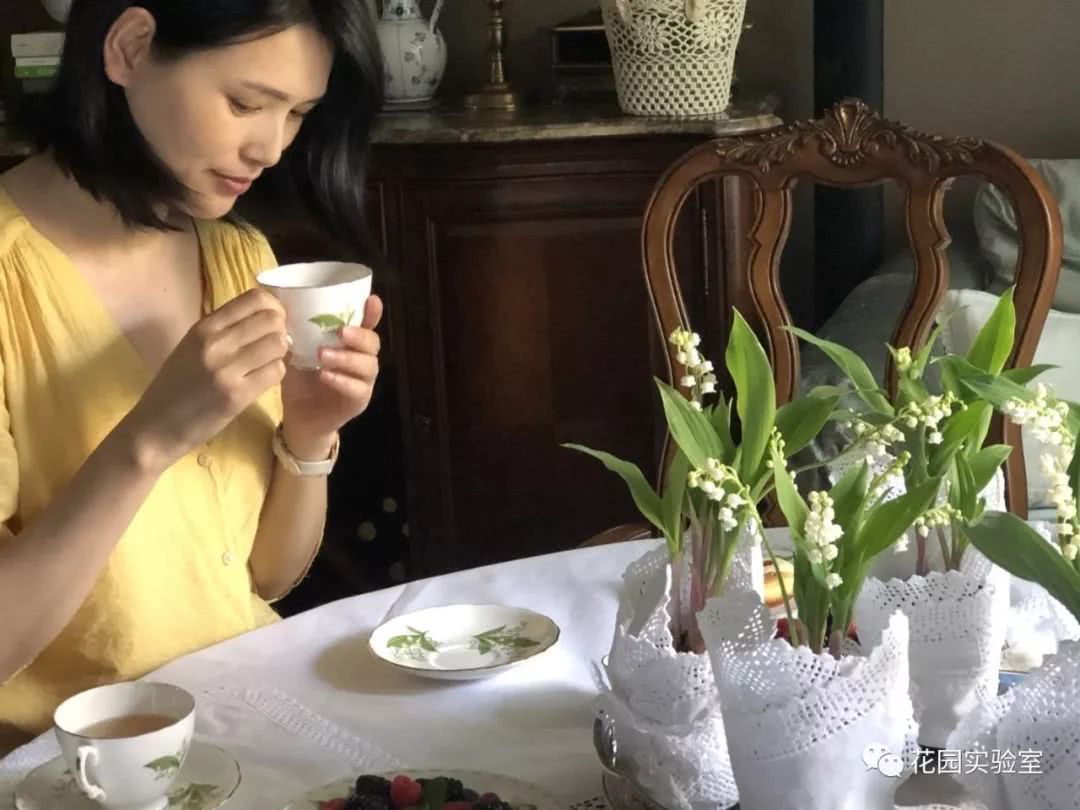
Only then did we realize we had almost missed something important. In the middle of the table were about ten pots of fresh lily of the valley, some about to bloom and some already in full bloom.
Lily of the valley was very popular for a while this spring, and it seemed Plum had not missed out either, except these lily of the valley pots were all wrapped in white lace handkerchiefs, showing the owner's little bit of care.
"I have always loved lily of the valley. Before you came, I found some for sale, so I bought ten pots to wait for you."
We were all a little overwhelmed by the favor.
The lily of the valley was just before full bloom, and strings of small white flowers appeared unusually clear under the slightly dim indoor light.
"I did not expect it to be just right for keeping at home!"
"Yes, the weather is so hot. If it were in the sunlight, it would probably wither quickly."
German lily of the valley, growing under the forests of Northern Europe, is like a little princess: fragile, sensitive, and intolerant of high temperatures. A cool indoor space is a temporary good home for them before they bloom.
"This time it was a group buy with gardening friends from Wuxi. From shipment in the Netherlands to our receiving it, it took only three days. Fortunately logistics is so developed now; otherwise we might not have been able to see such perfect flowers."
Besides those on the table, in front of the mirror stand and on the small tea table there was also a small pot of lily of the valley each, decorated with small white crocheted baskets.
Tea snacks were also set out on the table: handmade cookies and a platter of red, black, and blue berries, but our eyes stayed on the little white flowers of the lily of the valley until we discovered Plum's tea set.
There were all kinds of lily of the valley patterns. Some with one stem, some with two stems, some with more than ten stems, and some growing in clusters among grass and woods, in all sorts of postures.
"I love lily of the valley and have collected many cups with lily of the valley. Today I finally had the chance to bring them out to use."
I count myself as someone who likes plant patterns, but seeing so many lily of the valley designs from different eras and countries was still somewhat astonishing. It is only a small white flower; stepped on, it would not even be noticed, yet it is loved by so many people. What exactly is the reason?
Could it be precisely because of its fragile nature?
I could not help worrying about Plum: with so many lily of the valley, tending them in summer is quite a burden.
The photographer is also a lily of the valley fan. After half an hour of shooting, we repeatedly reminded her that if we did not go out soon, the sunlight would be gone.
"You can go out now!"
The beautiful hostess Plum finally got the chance to be photographed together with her own garden.
When she sat on the flower chair tasting tea and smiling, the surrounding rose princesses and queens gave off the rich fragrance that only appears at dusk.
On the tea table Plum chose a small pot of alpine saxifrage, its tiny pinnately lobed leaves gently holding up star-like little flowers, round with five petals, white tinged with pink.
Alpine saxifrage, as the name suggests, comes from high, cold mountainous regions. This species is native to the rock faces of the European Alps, likes cool conditions, dislikes waterlogging, and is very, very intolerant of heat.
A bit harder even than lily of the valley, is it another princess on a pea?
However, no matter how small the garden, there must be a little princess.
Coming from a distant foreign land, prone to headaches and fevers at any time, it is all the more worrying and frightening. When it rains you fear it will get rained on, when it is sunny you fear it will get sunburned. You are always worrying, always anxious, always asking and asking: What is wrong with it? Is it all right? Will it do that thing or not?
In the end, perhaps one morning you find it has already drifted away.
There is also the one-in-ten-thousand chance that it blooms, survives the summer, and blooms again; then you absolutely must show it off ten thousand times on Moments.
You can imagine, if not for these tormenting little goblins bringing partings and reunions, joys and sorrows, what difference would our gardens be from green belts?
At the gathering the next day, Plum and her friends made a lily of the valley habitat floral arrangement. Soft moss set off the green branches and leaves of the lily of the valley, and the little white bells were fresh one by one, exactly like the scene in the woods in April.
Compared with gardening, the advantage of floral art is that if you cannot have it for a long time, at least it can be beautiful for a while. So the delicate lily of the valley in our country is usually used as a floral material.
I asked casually: "Did you use yesterday's lily of the valley to make the arrangement?"
"No, I went and bought more. Yesterday's are still at home." Plum answered with a slightly shy smile.
For more professional agricultural science and technology information, please scan the QR code to follow WeChat: NongXunNET

Please indicate the source when reprinting.