A soft yellow tint spreads a refined touch of spring, and the spring scenery is delightful.
Introduction: Yellow oleander (Allamanda cathartica): an evergreen shrub with upright growth, about 2 m tall, generally kept at around 1 m when potted. Leaves in whorls of 3 to 5, leaf blades elliptical or oblanceolate-oblong, 5 cm to 12 cm long and 1.5 cm to 4 cm wide, covered with short pubescence. Cyme inflorescence, flowers golden yellow, with orange-red at the throat
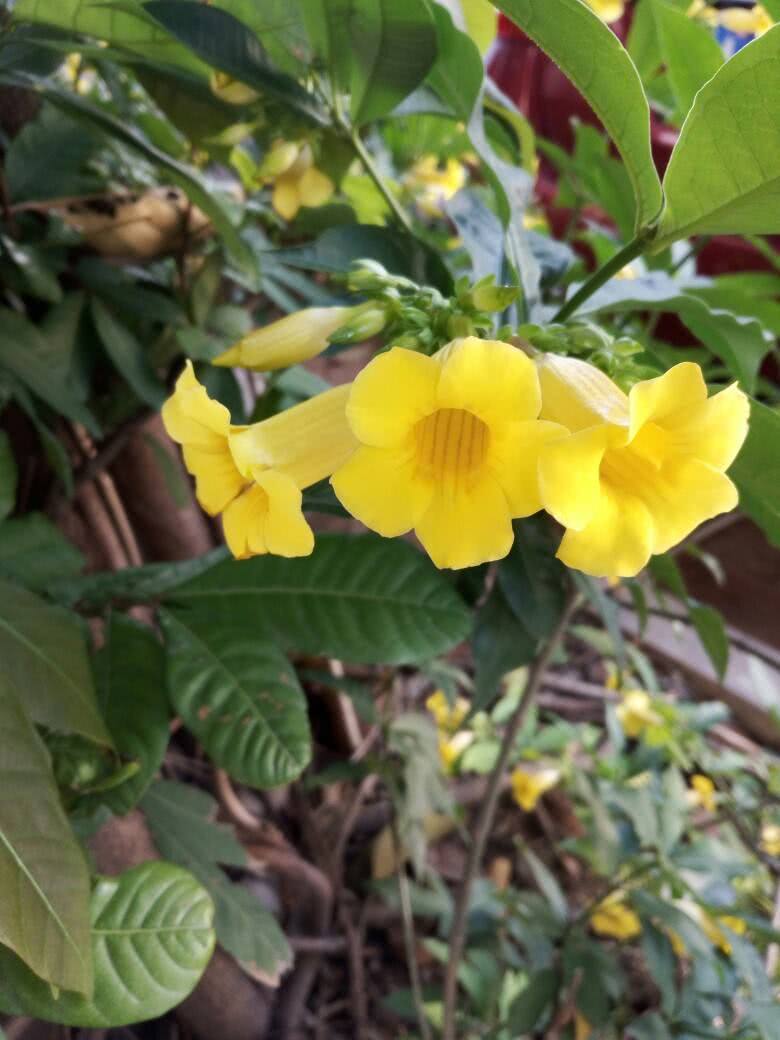
Yellow oleander: an evergreen shrub with upright growth, about 2 m tall, generally kept at around 1 m when potted. Leaves in whorls of 3 to 5, leaf blades elliptical or oblanceolate-oblong, 5 cm to 12 cm long and 1.5 cm to 4 cm wide, covered with short pubescence. Cyme inflorescence, flowers golden yellow, with orange-red stripes at the throat, corolla broadly funnel-shaped, with 5 lobes overlapping to the left or right, base of the corolla swollen, with 5 stamens borne inside. Capsule spherical, with long spines. Flowering period May-June. Native to the southern United States and Brazil, distributed in tropical America, introduced and cultivated in China. Used for garden landscaping; the plant is dense, the leaves are emerald green, and the flowers are bright and brilliant, very eye-catching. It is suitable as medium to large potted plants, decorating living rooms, balconies, parks, shopping malls, meeting venues, and other large indoor spaces, with very good effect.
Yellow oleander
Growth habits:
Prefers high temperature and high humidity, full sunlight, and tolerates slight semi-shade. Suitable for fertile, well-drained soil. Not cold-tolerant, avoids frost; when exposed to long-term low temperatures of 5-6°C, branches and leaves are damaged. Prefers fertile, moist sandy loam; grows poorly in heavy clay soil, and avoids waterlogging and saline-alkali land. Relatively tolerant of moisture, not drought-tolerant, and the soil should be kept moist regularly. The optimum growth temperature is 18-30°C, and it can also grow normally above 35°C. The optimum temperature during the winter dormant period is 12-15°C, not lower than 10°C; below 5°C the plant suffers cold damage.
Yellow oleander
Ornamental value:
Yellow oleander belongs to the genus Allamanda in the dogbane family (Apocynaceae), a semi-climbing evergreen shrub. Leaves are in whorls of 3, initially purplish, later turning emerald green, quite attractive. Flowers often cluster several together at the branch tips, the floral tube is long, slightly swollen at the base, trumpet-shaped, lemon yellow to golden yellow, with reddish-brown mottled stripes inside, glossy; when in full bloom, golden flowers cover the plant, magnificent and quite spectacular. The plant is dense, the leaves are emerald green, and the flowers are bright and brilliant. The flowering period is relatively long, opening from June to August, and in the hot summer when flowers are scarce, it blooms brilliantly all over the branches, adding to the garden scenery. It is suitable for potted display at doors, halls, balconies, living rooms, and other places, and is also suitable for planting in flower beds, flower borders, or at building foundations; combined with colorful flowers, it can enrich the garden scenery. It can also be planted in parks, industrial and mining areas, green spaces, in front of steps, on hillsides, beside ponds, and along roadsides in groups or as flower hedges, for ornamental use in gardens and along roadsides. It can also be cut for cut flowers, for vase arrangements or wreaths, etc.
Yellow oleander
Plant contraindications:
The plant's milky sap is toxic; poisoning in humans and animals stimulates the heart, and the circulatory system and respiratory system are impaired; pregnant animals that accidentally ingest it will miscarry.
For more professional agricultural science and technology information, please scan the QR code to follow WeChat: NongXunNET

Please indicate the source when reprinting.