Falling for the Sorrowful You: That Heartbeat and Sorrow Hidden Deep in the Heart
Introduction: Gentian is a plant of the Gentianaceae family. It is a perennial herb, 30-60 cm tall; the roots are yellow-white, rope-like, more than 20 cm long. The stems are erect, thick, often purplish-brown, and rough. The leaves are opposite, ovate or ovate-lanceolate, 3-7 cm long and 1-2 cm wide, with 3-5 veins, acute or acuminate, sessile
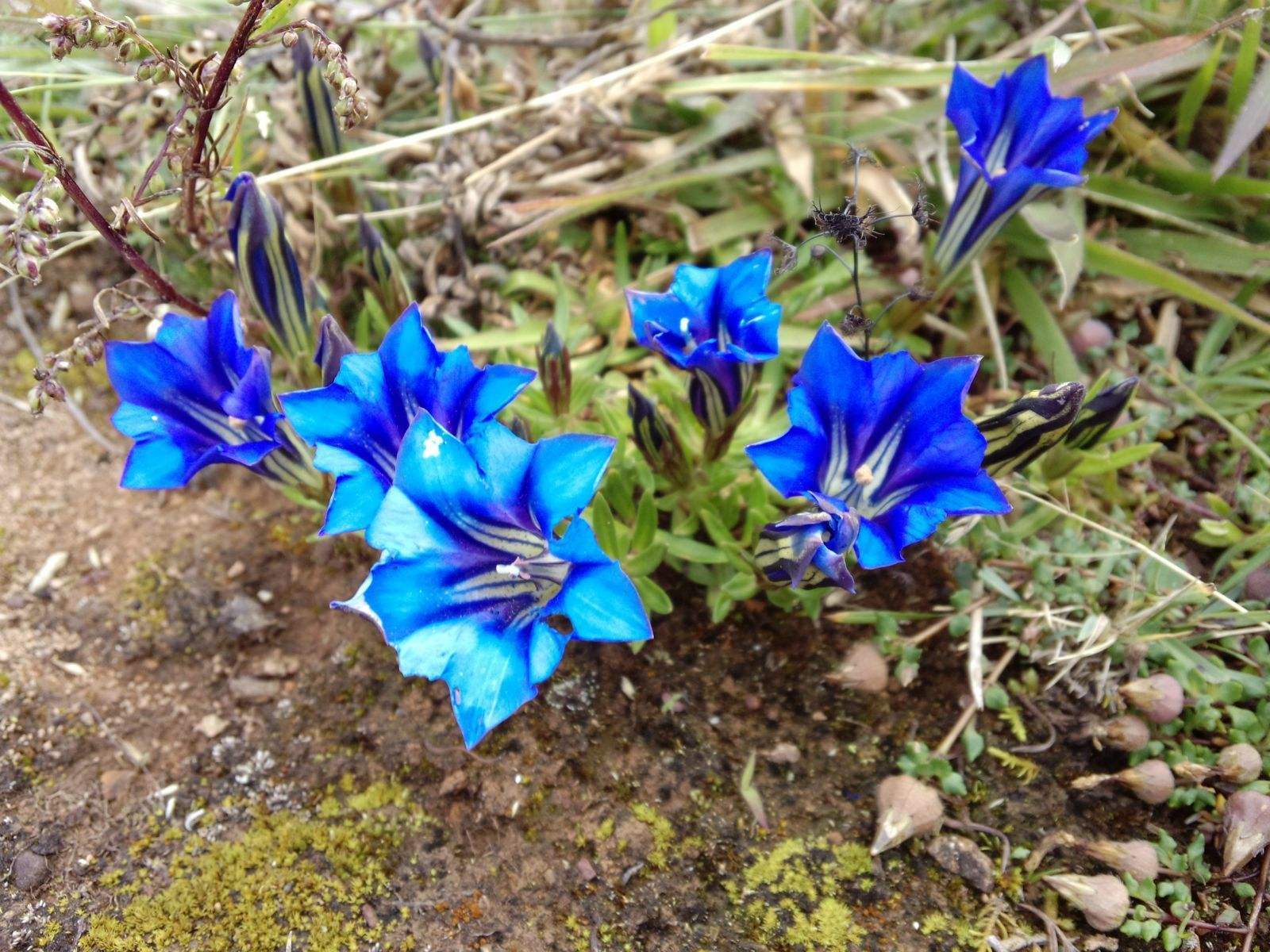
Gentian is a plant of the Gentianaceae family. It is a perennial herb, 30-60 cm tall; the roots are yellow-white, rope-like, more than 20 cm long. The stems are erect, thick, often purplish-brown, and rough. The leaves are opposite, ovate or ovate-lanceolate, 3-7 cm long and 1-2 cm wide, with 3-5 veins, acute or acuminate, sessile, with rough edges and lower midrib. The flowers are clustered at the stem tip or in the leaf axils; the bracts are lanceolate, nearly as long as the calyx; the calyx is bell-shaped, 2.5-3 cm long, with linear-lanceolate lobes nearly as long as the calyx tube; the corolla is tubular-bell-shaped, blue-purple, 4-5 cm long, with ovate, pointed lobes and triangular plicae, rarely two-toothed; there are 5 stamens, with broad wings at the base of the filaments; the style is short, and the stigma is 2-lobed. The capsule is oblong, stalked; the seeds are linear, with winged edges. It is distributed in Korea, the Soviet Union, Japan, and China's Heilongjiang, Jilin, Liaoning, Zhejiang and other places. It grows in meadows, thickets, or forest edges.
Gentian
Growth habits:
Seed germination requires relatively high temperature and humidity, along with appropriate light. At around 25°C, seeds can germinate in one week; below 20°C, germination takes about half a month, and the seed germination rate is 60-80%. Seeds are not suitable for storage and have a short lifespan of 2.5 years, with a usable period of one year. The suitable growth temperature is 20-28°C, with 15°C at night; growth is unfavorable above 30°C. After sowing, it flowers and sets seed in the second year. Initial flowering occurs in early August, the flowering period lasts 50 days, with flowers opening by day and closing at night. It likes sufficient light; the seed germination stage requires full light, the seedling emergence stage requires weak light, and the seedling growth stage requires natural light. Water requirements are moderate, and the suitable soil moisture is 60-80% of field capacity. Maintaining a balance between dry and wet throughout the entire growth period is beneficial for growth and development.
Gentian
Functions and indications:
The root is used as medicine and can clear liver and gallbladder fire. It drains excess fire from the liver and gallbladder and removes damp-heat from the lower jiao. It treats excessive heat in the liver meridian, convulsions and mania, Japanese encephalitis, headache, red eyes, sore throat, jaundice, heat dysentery, carbuncles, swellings, sores and ulcers, swelling and pain of the scrotum, and damp itching of the genital area. It is used for damp-heat jaundice, genital swelling and itching, vaginal discharge, eczema itching, deafness, hypochondriac pain, bitter taste in the mouth, and convulsions.
Gentian
The "Zhenglei Bencao" records that the "Kaishi Bencao" says: "Now according to another edition's note: the leaves resemble Solanum nigrum, and the taste is bitter like bile, hence the name." This is the explanation of the name "gentian." The "Compendium of Materia Medica" also adopts this explanation.
In ancient times, practitioners of the occult arts often made mysterious claims. To show how precious a certain medicine was, they would often refer to dragons and phoenixes, such as "dragon whiskers" and "phoenix tail." The name "gentian" was presumably the same. In fact, it is because its root is very bitter like bile, and its leaves resemble those of Solanum nigrum, so the name "gentian" was formed by taking one feature from each. As for the name "cao longdan" (herbaceous gentian), it was used to indicate that this plant is not the gallbladder of a true dragon, but merely a herbaceous flower.
For more professional agricultural science and technology information, please scan the QR code to follow WeChat: NongXunNET

Please indicate the source when reprinting.