The flower droops as if shy, but there is another reason
Introduction: codonopsis lanceolata (bonnet bellflower) is a perennial twining vine. It is distributed across the provinces of Northeast, North, East and Central-South China, growing in damp, shaded areas beneath shrubs on hillsides. Perennial twining herb, root thick and fleshy, obovate-fusiform, stem round, leaves borne on the stem are relatively small, alternate, with short petioles. Flowers usually solitary at the branch tips; calyx
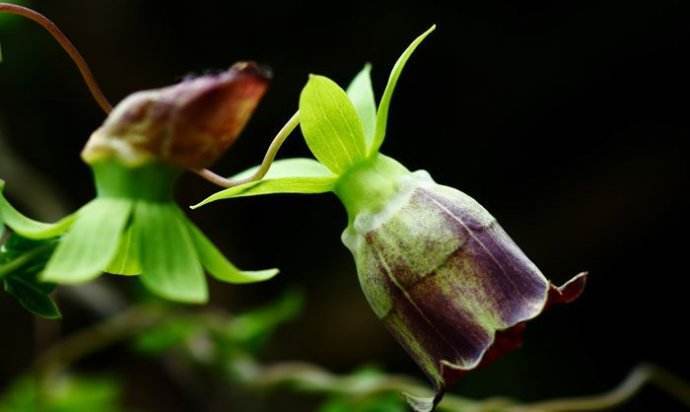
Codonopsis lanceolata is a perennial twining vine. It is distributed across the provinces of Northeast, North, East and Central-South China, growing in damp, shaded areas beneath shrubs on hillsides. Perennial twining herb, root thick and fleshy, obovate-fusiform, stem round, leaves borne on the stem are relatively small, alternate, with short petioles. Flowers usually solitary at the branch tips; calyx 5-lobed, the calyx tube fused with the ovary; corolla blue-green or pale yellow, bell-shaped, stamens 5, filament bases slightly swollen; ovary inferior, 3-locular; style short, stigma 3-lobed. Capsule conical.
Codonopsis lanceolata
Morphological characteristics:
The whole plant is smooth and hairless, or the stem and leaves occasionally sparsely pubescent. The stem base is somewhat nearly conical or cylindrical, its surface bearing numerous tumour-like stem scars; the root is often fleshy, spindle-shaped, with a few fine lateral roots, about 10-20 cm long, 1-6 cm in diameter, surface greyish-yellow, with sparse annular rings on the upper part and sparsely scattered transversely elongated lenticels on the lower part. Stem twining, about 1 m long, 3-4 mm in diameter, often with numerous short slender branches, yellow-green tinged slightly with purple. Leaves on the main stem alternate, lanceolate or rhombic-narrowly ovate, small, 0.8-1.4 cm long, 3-7 mm wide; at the tips of the branchlets usually 2-4 leaves clustered, appearing nearly opposite or whorled, petioles short and small, 1-5 mm long, blades rhombic-ovate, narrowly ovate or elliptic, 3-10 cm long, 1.3-4.5 cm wide, apex acute or obtuse, base gradually narrowed, usually entire or with sparse wavy serrations, green above, greyish-green beneath, veins conspicuous. Flowers solitary or opposite at the tips of the branchlets; pedicels 1-9 cm long; calyx adnate to the middle of the ovary, the tube hemispherical, the sinus of the lobes acute and narrow, or becoming broad and obtuse after flowering, lobes ovate-triangular, 1.3-3 cm long, 0.5-1 cm wide, apex acute, entire; corolla broadly bell-shaped, 2-4 cm long, 2-3.5 cm in diameter, shallowly lobed, lobes triangular, recurved, about 0.5-1 cm long, yellow-green or milky white with purple spots inside; disc fleshy, dark green; filaments subulate, slightly enlarged at the base, about 4-6 mm long, anthers 3-5 mm; ovary inferior. Capsule hemispherical in the lower part, beaked in the upper part, about 2-2.5 cm in diameter. Seeds numerous, ovate, winged, small, brown. Flowering and fruiting period July-August.
Codonopsis lanceolata
Growing environment:
Codonopsis lanceolata prefers a cool climate; if it encounters high temperatures during the growing period, the above-ground parts tend to wither and become susceptible to disease. Seedlings prefer shade, while mature plants prefer ample sunlight.
Distribution range:
Produced in the provinces and regions of Northeast, North, East and Central-South China. Also distributed in the Far East region of the Soviet Union, Korea and Japan. It grows in damp, shaded areas along gullies beneath mountain shrubs or in broad-leaved forests. The type specimen was collected in Japan.
Codonopsis lanceolata
Main value:
Besides being very useful as a medicinal herb, codonopsis lanceolata is also excellent as an ornamental plant. It usually bears several flowers on one stem; the flowers are plain and elegantly coloured, in pink, pale purple and pale yellow, with emerald-green leaves, and the petals are slightly curled outward or backward; the codonopsis lanceolata, whose shape closely resembles a small bell or bronze bell, has a long body and drooping flowers, appearing as if shy.
Alternative names gathered:
Nai shu, nai nai tou, nai jiang luo bo, nai dang shen, dang shen, Ma Ha Li Ge-Cun-Ao Ri Hu Dai, lun ye dang shen, jiao shen, nai ye teng, da ru guo, man shen, gou shen, fu ping shen, Tai shan shen, si ye dang shen, shan hu luo bo, shan di gua, de de ku, bai rou, nai dai, wu gui dang shen, da tou shen, luo bo ke, yang ru shen, chou dang shen, nai shu, nai shen, ru fu ren, yang nai, si ye shen, ru shu, ru tou shu, shan di gua yang, shan hu luo bo, shan hai luo, tong ru cao, yang po nai, tu dang shen, niu nai zi, yang nai shen, gou tou shen, tu sha shen, luo bo dang shen, nai zi shen, bai mang rou, shan hu luo bei.
For more professional agricultural science and technology information, please scan the QR code to follow WeChat: NongXunNET

Please indicate the source when reprinting.