What is the plant with flowers that look like yellow allamanda called?
Introduction: Red allamanda, plant height about 20-40 cm, the whole plant has white sap. Suitable for potted plants or grouped planting in courtyards for beautification, not suitable as a shade shed plant. Leaves opposite, long heart-shaped, smooth on both sides. Flowers from summer to autumn, funnel-shaped, corolla 5-lobed, peach red, flower tube swollen and bright yellow, flower posture and color delicate and gorgeous. It likes high temperatures
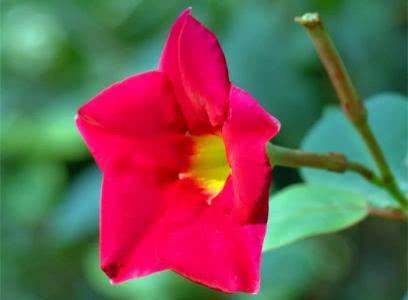
Red allamanda, plant height about 20-40 cm, the whole plant has white sap. Suitable for potted plants or grouped planting in courtyards for beautification, not suitable as a shade shed plant. Leaves opposite, long heart-shaped, smooth on both sides. Flowers from summer to autumn, funnel-shaped, corolla 5-lobed, peach red, flower tube swollen and bright yellow, flower posture and color delicate and gorgeous. It likes high temperatures, with an optimum growing temperature of 22-28 degrees, and in winter it needs warmth and shelter from wind.
Red allamanda
Main varieties:
1, Red Mill double gland vine; it is a hybrid variety that won the 2007 French International Horticultural Flower Gold Award. Characteristics: large flowers with brilliant color, light purple when first opening, deep purple when fully open, flowering period long.
2, Double-petaled double gland vine; it is the double-petaled variety of Red Mill. Characteristics same as above, flowers larger, double-petaled, with higher ornamental value.
3, Purple-flowered double gland vine; characteristics are that the plant is relatively short, the leaves are more densely arranged, the flowers are relatively small, deep purplish red, with a yellow flower throat.
4; Lovely double gland vine; characteristics are emerald green leaf color, narrowly ovate leaves, large flowers, trumpet-shaped, white, yellow throat, strong floral fragrance, flowering period in summer.
5, Yellow-flowered double gland vine; characteristics are soft branches, narrowly ovate leaves, loosely arranged, yellow flowers with a star-shaped ring band in the center, unique appearance, rich floral fragrance.
6, Bolivian double gland vine; characteristics are a relatively short plant shape, dense leaves, white flowers, yellow throat, flowering period all year round.
Red allamanda
Cultivation techniques:
Water and fertilizer management: During the growing period, compound fertilizer can be applied 3-5 times as a top dressing, but the amount of nitrogen fertilizer should be controlled to avoid excessive vegetative growth affecting reproductive growth and reducing flowering. During maintenance, watering should be properly controlled to form a well-developed root system.
Temperature management: The optimum growth temperature is 20-30°C. At 10°C it enters a semi-dormant state, and below 5°C it will be frostbitten, so in winter attention should be paid to warmth and shelter from wind.
Light management: It likes a warm, humid and sunny environment, and can also be placed in a slightly shaded place, but insufficient light reduces flowering.
Red allamanda
Red allamanda has strong stress resistance and is less susceptible to diseases, so during the growing period, spraying a fungicide once a month is enough to prevent diseases.
Propagation methods edit
Cutting propagation can be used, with spring to autumn being the suitable period. Cuttings treated
with rooting agent can increase the rooting rate. Cultivation is best in fertile humus loam, with good drainage and sunlight.
For more professional agricultural science and technology information, please scan the QR code to follow WeChat: NongXunNET

Please indicate the source when reprinting.