What is succulent mutation all about? A detailed explanation of causes and common manifestations
Introduction: BGM: Good Morning and Good Night. Succulent mutations are incredibly fascinating, including fasciation and variegation. Today let's first get to know variegation in succulents~ Succulent variegation - to put it vividly, it means a mutation has occurred, causing gene recombination or mutation that is dominantly expressed in the appearance (stems, leaves
BGM: Good Morning and Good Night
Succulent mutations are incredibly fascinating, including fasciation and variegation,
today let's first get to know variegation in succulents~
Succulent variegation - to put it vividly, it means a mutation has occurred, causing gene recombination or mutation that is dominantly expressed in the appearance (stems, leaves and other parts), resulting in colors different from the original (such as white, yellow, red, etc.), and some even combine multiple colors in one plant, presenting a dazzling array of brilliant hues.
Rainbow (variegated Echeveria 'Perle von Nurnberg')
This is variegation, but note that most variegation mutations do not cause the entire leaf or entire plant to change to the same color, but rather occur on part of the leaves or stem, or in one area of a leaf.
Variegated Echeveria 'Afterglow'
- Variegation patches -
The variegated areas are often called variegation patches. For example, if the succulent was originally green, and then variegation mutation occurs, white or yellow stripes grow from the center or edges of the leaves. With more sun exposure, the variegation patches will turn pink~
Variegated Ceropegia woodii 'String of Hearts' turning pink
Most variegation mutations are not a change of the entire color, but a partial color change on the leaves or stem.
Compared to the original succulent color, the colors after variegation mutation are more numerous and become even more beautiful.
For example, the very popular variegated Echeveria 'Berkeley':
(with soft pink edges)
Variegated Echeveria 'Topsy Turvy':
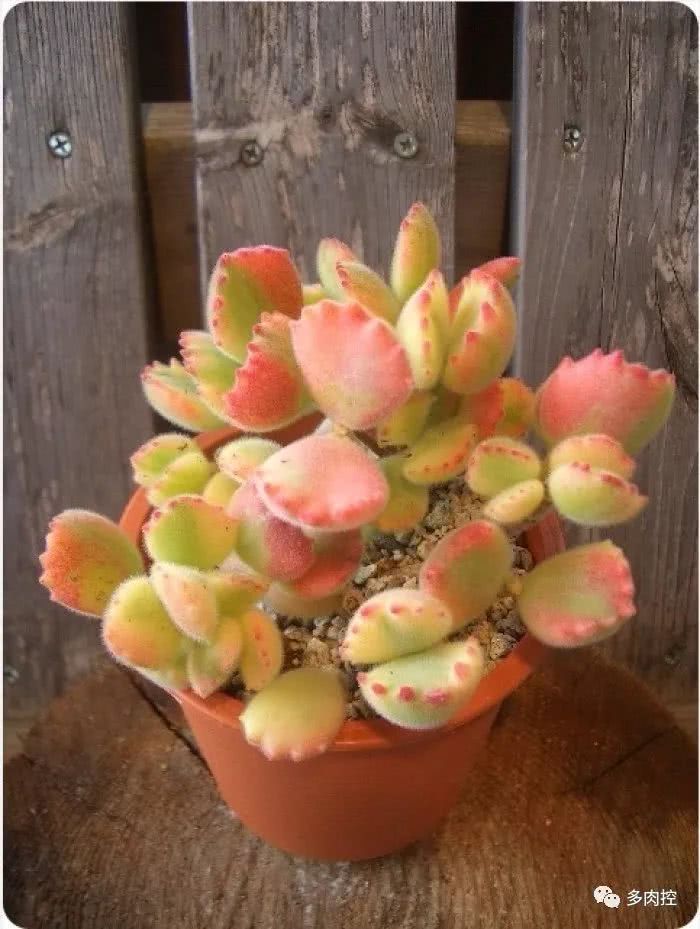
Variegated Cotyledon tomentosa (Bear's Paw) with white variegation:
- Conditions for variegation -
Conditions that trigger mutation:
1. Watering, sunlight, chemicals, climate, etc. can all cause variegation.
2.Genetic factors (leaf cuttings from variegated leaves are very likely to produce variegated offspring too)
Variegated Echeveria 'Little Ball Rose'
- Classification of variegation colors -
- White variegation -
The original color appears as or changes to white,
for example, variegated Cotyledon tomentosa (Bear's Paw) with white variegation, variegated Crassula 'Campfire', and variegated Senecio rowleyanus (String of Pearls).
Variegated Crassula 'Campfire'
Variegated Senecio rowleyanus (String of Pearls)
- Yellow variegation -
The original color appears as or changes to yellow,
for example, variegated Cotyledon tomentosa (Bear's Paw) with yellow variegation, and variegated Aeonium 'Zwartkop'.
Note: Yellow variegation may revert to the original color (variegation reversion).
- Care -
Variegated succulents have another characteristic:
due to reduced chlorophyll, the succulent is not very resistant to sun exposure, but with sun exposure the colors will be richer than ordinary succulents.
More paradoxically, because of this, they need more light than before (since there is less working chlorophyll), their growth rate is much slower than other succulents, and their reproductive capacity is not very high, requiring more effort to care for.
Variegated Crassula 'Cross'
Summary:
Afraid of strong sunlight
Needs more and softer light
Needs more patience waiting for the succulent to grow
PS: Then why not give more water? Because giving too much water to succulents will cause etiolation (leggy growth)!
Variegated Echeveria 'Shichifukujin'
Compared to monotonous green, variegated succulents are quite stunning. Of course, the probability of variegation is relatively low, making them rare and difficult to care for (fully variegated succulents often die because they have no chlorophyll for photosynthesis), hence their high price.
Variegated Cotyledon orbiculata 'Ping Pong' whose value skyrockets after variegation
Some succulents even become completely albino variegated (also called fully variegated), similar to albinism, and may eventually die because the leaves have no chlorophyll to carry out photosynthesis, requiring even more careful care.
Variegated Echeveria 'Topsy Turvy' with some leaves turning completely white
Finally, let's look at some photos of beautiful variegated succulents~
Variegated Echeveria 'Xiu Yan'
Variegated Echeveria 'Nü Chu'
Variegated Echeveria 'Mei Xing'
Variegated Echeveria 'Meini Yuepo'
Variegated Echeveria rusbyi
Variegated Echeveria 'Hua Yue Ye'
Variegated Rhodiola trollii
Variegated Echeveria 'Bing Yu'
Caring for variegated succulents is not so easy, so why do so many people spend big money to get them?
Of course, because variegated succulents are easier to color up and produce richer colors.
For example, making a green Bear's Paw develop pink is easier with a white Bear's Paw (green Bear's Paw with white variegation), making it more popular. Those who like variegated succulents, let's jump into the pit together.
- Review of previous featured posts -
Note: Text and images are partly from the internet. If there is any infringement, please contact us and we will handle it promptly.
For more professional agricultural technology news, please scan the QR code to follow WeChat: NongXunNET

Please indicate the source when reposting.