How I Built a Small Bottom-Sand Tank: The Whole Process from Setup to Finished Aquascape
Intro: Can small all-in-one tanks only keep a few little goldfish? No way. People change their minds all the time, and nobody can guarantee they won't fall for other fish down the road. But what if a cramped room leaves no space for other fish? Set up a small bottom-sand tank on your office desk and keeping tropical fish is so easy. The filter of a small all-in-one tank
Can small all-in-one tanks only keep a few little goldfish? No way. People change their minds all the time, and nobody can guarantee they won't fall for other fish down the road. But what if a cramped room leaves no space for other fish? Set up a small bottom-sand tank on your office desk and keeping tropical fish is so easy. The filter of a small all-in-one tank placed on a desk has only a tiny compartment, so keeping tropical fish or slightly larger fish is a bit difficult, and you worry about the fish all day long. But today I'll show you how to turn an ordinary glass tank into a bottom-sand filter setup for keeping tropical fish.
This kind of square glass tank costs half as much as a regular all-in-one glass tank of the same size. You can also go to a glass shop and have the staff glue one together for you, which saves quite a bit. Prepare water pipes of the right size, pipe cutters, a water pump, filter media for the bottom sand, and filter wool. A separation grid is optional, plus several tee and straight connectors.
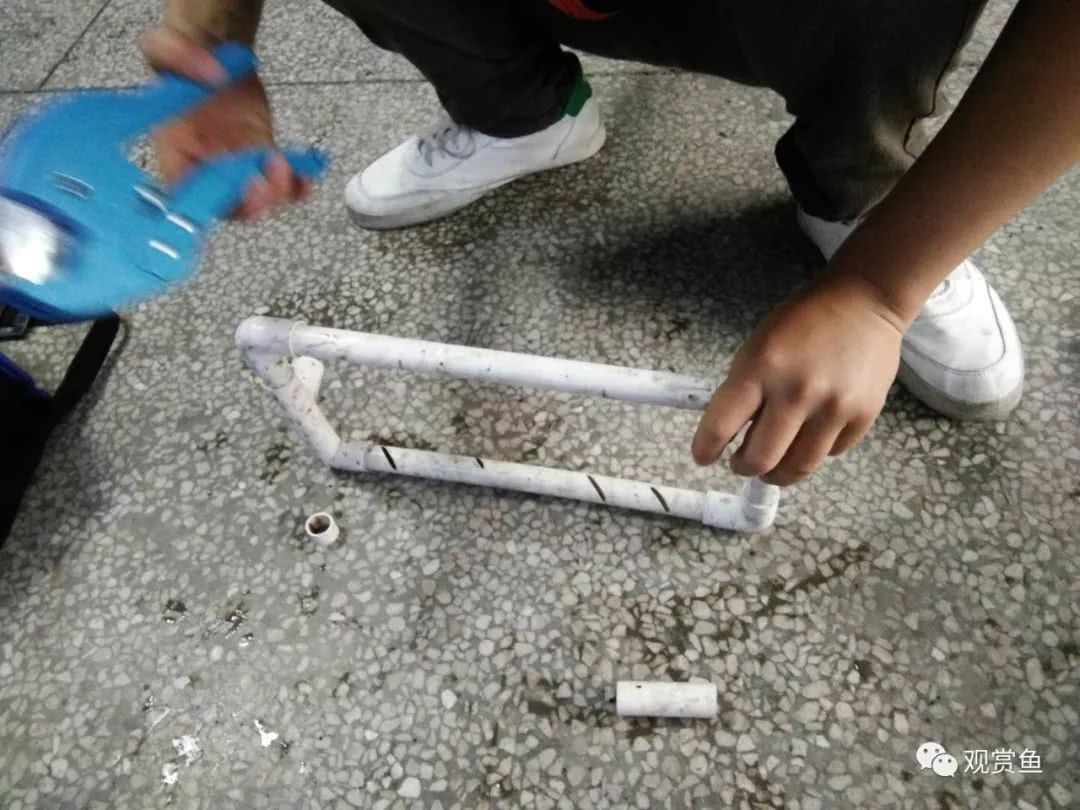
Use the pipe cutters to cut slits in the water pipe about the thickness of a toothpick, as shown below. Connect the middle pipe to a tee connector to hold the water pump.
Place the separation plate on top (optional).
Lay down filter wool. The technician laid two layers of wool in this tank.
Add coral sand for biological filtration. You can also use other stone-based filter media instead, depending on the situation. A layer about 3cm thick is enough (if you want it to look nice, you can add a layer of ornamental stone on top).
Install the aquarium pump on the tee connector pipe. The water pump's pipe opening was a bit small at the time, but that was no problem for our technician: one wrap of electrical tape and it wouldn't budge.
The state before water was added.
After adding water, don't rush to turn on the water pump. Let it settle for a few hours first.
The tank after settling overnight, with the water pump turned on for circulating filtration.
During the water-aging period, add half a bottle cap of nitrifying bacteria to the tank every day, which speeds up the cultivation of nitrifying bacteria in the tank. You can also put a small fish or shrimp in the tank. As long as there are fish in the tank, the bacteria will have food, and adding food promotes their reproduction.
Added yellow powder salt once. The new tank had not yet been cleaned and disinfected, and adding a bit of salt helps sterilize and disinfect it.
Tested the water quality three days later. The technician only tested three things: nitrite levels, pH value, and residual chlorine. The water was aged well, and nothing was detected, so there are no photos.
Put in a test fish to try the water. I suggest that after aging the water, you shouldn't add any beloved or expensive fish right away. To be safe, it's best to put in a test fish for a few days to check the water quality, and only add fish officially if there are no major problems. The test fish was kept for about ten days. It doesn't have to be ten days; there are no hard time limits, 3-5 days is fine too. The main reason it was about ten days was that I hadn't decided what fish to keep, so the test fish stayed for around ten days.
Added a small angelfish named Little Red. When Little Red first entered the tank, it kept hiding by the pipes and didn't dare swim. Sometimes I had to pretend to glance casually just to get a look at it, and I didn't dare press my face against the glass, let alone stare. Slowly, Little Red began swimming near the pipes and even learned to pick up stones to play with. So here I want to tell fellow fish keepers who report that new fish huddle at the bottom of the tank: aside from the fish itself being sick, fish need time to adapt, and the keeper needs to cooperate. Don't get excited about buying a fish and lean in to watch it. During the adaptation period, you need to stay away from it, and don't feed it either. If it hasn't adapted in three to five days, then give it 10 or 15 days. A new bride also needs time to adapt to her new identity and new environment.
In this example, the glass tank is 38cm long, 23cm wide, and 25cm high, with a 15w water pump at 800L/H.
The tank layout is a bit ugly because I think no matter how much effort you put in, someone will always say it's ugly. After all, tastes differ, so I'll just settle for a slightly ugly setup and avoid any arguments. My focus is on the fish; the decor can be whatever.
Thanks to Technician Jiang for the technical and physical support above.
For more professional agricultural science and technology news, please scan the QR code to follow WeChat: NongXunNET

Please cite the source when reposting.