The flower language of the red spider lily is unforeseen death and desperate love.
Introduction: Bleeding heart, native to China, Siberia and Japan, prefers a semi-shaded environment with ample scattered light and is relatively cold-hardy. A perennial herb, 30-60cm tall. The above-ground stem is erect, cylindrical, purplish-red, the rhizome is fleshy, the leaflets are usually entire, green on the surface, with a white powdery coating on the underside, and veins are distinct on both sides.
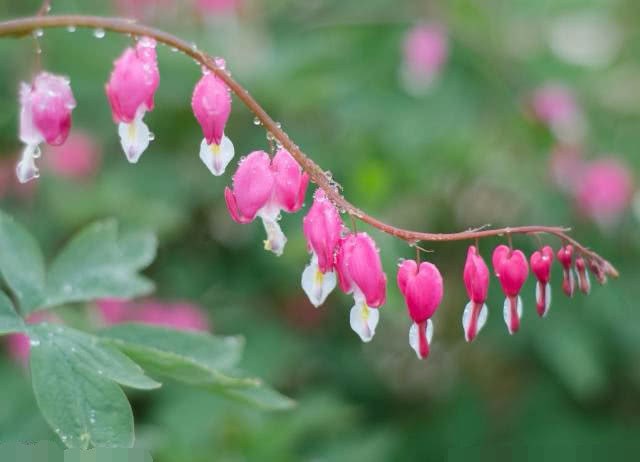
Bleeding heart, native to China, Siberia and Japan, prefers a semi-shaded environment with ample scattered light and is relatively cold-hardy. A perennial herb, 30-60cm tall. The above-ground stem is erect, cylindrical, purplish-red, the rhizome is fleshy, the leaflets are usually entire, green on the surface, with a white powdery coating on the underside, and veins are distinct on both sides; the petiole is about 10 cm long, resembling that of Angelica sinensis.
Bleeding heart
Growth habits:
It is cold-hardy but not tolerant of high temperatures, prefers a semi-shaded habitat, and goes dormant in hot summers. It is not drought-tolerant and prefers moist, well-drained, fertile sandy loam.
Distribution range:
It is found in northern China (north to Liaoning), and distributed in Hebei, Gansu, Sichuan and Yunnan, growing in moist grasslands and hillsides at altitudes of 780-2800 m. It is also distributed in Japan, Korea and Russia.
Landscape value:
The bleeding heart has beautiful foliage and delicate flowers shaped like a pouch, with brilliant colors. It is a good material for potted plants and cut flowers, and is also suitable for flower borders and for mass planting in moist spots at the edges of groves and lawns, with excellent landscape effects.
Medicinal value:
The whole plant is used as medicine, with effects such as pain relief, antispasmodic, diuretic, regulating menstruation, dispersing blood, harmonizing blood, dispelling wind, and eliminating sores and toxins. It is cultivated in gardens for ornamental purposes.
Bleeding heart
Legend:
In ancient times, about 200 li southeast of Luoyang City, there was a prefecture named Ruzhou, and to the west of the prefecture was a small town named Miaoxia. Surrounded by mountains and with pleasant scenery, it also had a wonderful custom: once a young man and woman were engaged, the woman had to personally send the man a pouch embroidered with mandarin ducks, the meaning of which was self-evident. If the engagement was arranged in childhood, the woman's sister-in-law or the married elder sisters in the neighborhood had to embroider one on her behalf and send it as a token for life.
In the town lived a beautiful girl named Yunu. Yunu was eighteen years old, clever and deft, naturally intelligent, and highly skilled in embroidery and weaving. In particular, the various floral patterns she embroidered on pouches often attracted bees and butterflies to land on them, showing the depth of her skill. With such a fine girl, suitors naturally crowded her doorstep, but they were all politely declined one by one by the girl's family. It turned out that the girl already had a man she loved, and her family had tacitly accepted it. Unfortunately, the young man had been serving in the army beyond the frontier for two years already, with no news, and had never received a pouch. Yunu waited day after day and thought of him night after night. In her bitter longing, she embroidered a pouch every month to express her yearning, and hung them one by one on the peony branches before her window. Over time, the pouches formed strings and became what people called the "bleeding heart".
Bleeding heart
For more professional agricultural science and technology news, please scan the QR code to follow WeChat: NongXunNET

Please indicate the source when reprinting.