Which succulent varieties are easy to grow and readily form dense clumps? A rundown of the most notable succulents
Succulents, as everyone knows, are easy to grow and have long been loved by gardeners everywhere, but do you know which succulents clump up easily? Which look the best? Which are the easiest to keep alive? Today I will tell you about the succulents I consider to be the most notable...
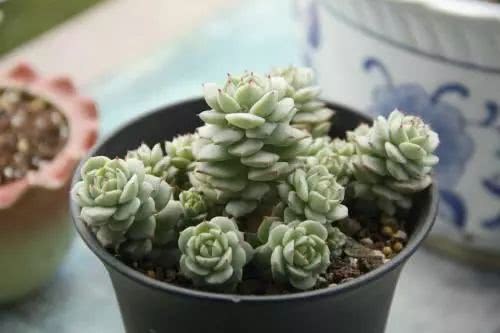
Succulents, as everyone knows, are easy to grow and have long been loved by gardeners everywhere, but do you know which succulents clump up easily? Which look the best? Which are the easiest to keep alive? Today I will tell you about the succulents I consider to be the most notable of all!
1. The easiest succulent to keep alive
Echeveria derenbergii 'Tiny' is very easy to grow and very prone to branching into offsets; pluck a leaf at random and it will take root. In an environment with ample sunlight and a large temperature difference, the leaf edges turn pink to orange-red.
Growing method: Taking cuttings from its side shoots is the fastest way to propagate it. It naturally likes a dry, well-ventilated spot with ample light; during the hottest part of summer it needs some shade and less watering.
2. The best-looking succulent
For a potted Sedum multiceps (also known as the "small pine" sedum), I always feel this kind of potted plant is extremely easy to pair with anything; the leaves are emerald green, and the leaf tips are faintly reddish, very beautiful.
Growing method: It has a certain tolerance for dryness; just water it thoroughly, pay attention to ventilation and shading in summer, and give it plenty of sunlight in the other seasons.
3. The succulent that clumps up easily
Here we have to mention Sedum dasyphyllum (also known as "Jixing Meiren"): if you so much as look away for a moment, it fills a whole big pot. Do not be fooled by its tiny size, for once it grows up it becomes quite something.
Growing method: Sedum dasyphyllum is fairly drought-tolerant; even if you never fertilize it for a long time there is no problem, but if conditions allow, it is best to apply a dilute phosphorus-potassium liquid fertilizer once every 1-2 months. In summer, it is best to water once a month, and just water it thoroughly.
4. The cutest succulent
The "cute rose" succulent looks a bit like a rose, but without the rose's sexiness; instead it is somewhat small and cute, just like the little sister next door.
Growing method: It is not hard to grow; the main thing is that the light must be ample, since insufficient light makes it grow leggy. Avoid a stuffy, hot environment, avoid long-term damp potting soil, and avoid water accumulating in the leaf center.
5. The most valuable succulent
The "neon light" Haworthia cooperi has dark green leaves that are as dazzling as gemstones, but it is extremely difficult to grow: it cannot be exposed to the sun or it will get sunburned, and it cannot be kept in the shade or it will grow leggy.
Growing method: It is best kept on a windowsill in filtered light; under no circumstances should it be in direct sunlight, and when watering, do not pour water on the leaves, as they sunburn easily.
6. The strangest succulent
Why is the "square tower" (Crassula 'Buddha's Temple') called strange? Because its leaves are four-pointed stars stacked layer upon layer, a bit like ancient pagodas. The first time I saw one, I always thought it looked like potato chips.
Growing method: Crassula 'Buddha's Temple' actually grows in spring and autumn, and its demands for water and sunlight are not great; it can be grown in partial shade, watered about 4 times a month, as long as the plant's root system is kept from becoming too dry.
For more professional agricultural science and technology information, please scan the QR code to follow WeChat: NongXunNET

Please indicate the source when reposting.