Overcare harms orchids instead; the deeper the love, the deeper the harm
Introduction: Promote Chinese orchid culture, spread orchid knowledge. Many orchid growers always attach great importance to fertilizing, thinking about fertilizing their orchids almost every day. In fact, fertilizing must be restrained. Without rational fertilization, it will only harm the orchids and cause the consequence of pulling up seedlings to help them grow. Orchids are not fertilizer-loving plants, and their fertilizer needs are limited. Moreover
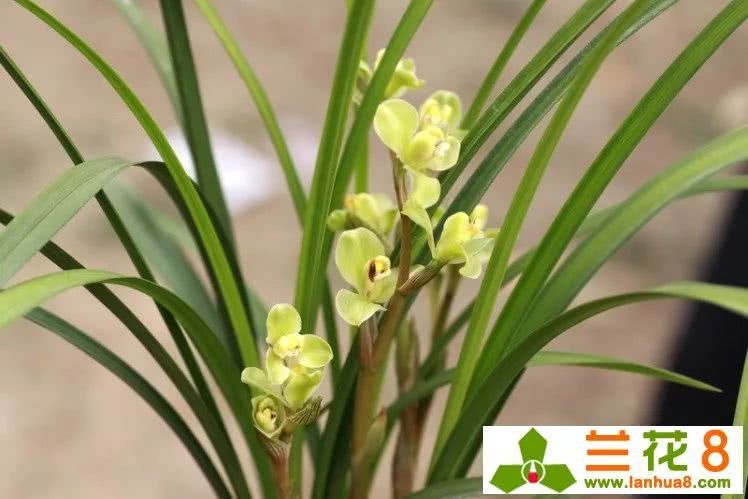
Promote Chinese orchid culture, spread orchid knowledge
Many orchid growers always attach great importance to fertilizing, thinking about fertilizing their orchids almost every day. In fact, fertilizing must be restrained. Without rational fertilization, it will only harm the orchids and cause the consequence of pulling up seedlings to help them grow.
Orchids are not fertilizer-loving plants, and their fertilizer needs are limited. Moreover, orchids also need certain conditions to absorb fertilizer; they cannot absorb fertilizer at just any time. Let me talk about several necessary conditions for fertilizing in my personal view:
1. Suitable temperature: under normal circumstances, the generally accepted temperature is that absorption can begin only above 15 degrees, and the range of 15-25 degrees is the best time for fertilizing. In practice, I personally feel that fertilizing should begin when the temperature stabilizes at 15 degrees, while the real peak of fertilizer absorption should be between 20-30 degrees. Within this temperature range, orchids grow fastest and absorb more fertilizer. Above this temperature, too much fertilizing easily causes excessive vegetative growth. When fertilizing below 15 degrees, the orchid root system is simply soaked in fertilizer water and absorbs very little, doing a hundred harms and no good. The commonly seen situation is that the crystal tips turn black and rot;
2. Sufficient light: without light, photosynthesis cannot occur; with insufficient light, photosynthesis is also weak. Under such conditions, absorption is slow, and the absorbed fertilizer cannot be transformed, just like indigestion in people. Therefore, fertilizing also needs the cooperation of light. In the plum rain season, if you blindly fertilize, stem rot and soft rot come one after another. This is also the consequence of blind fertilizing.
This year in our area, the continuous rainy weather for more than a month with very little sunlight, and the examples of many growers suffering losses to varying degrees because of this, can explain it. The reason is that we habitually use slow-release fertilizer, and in the plum rain season there is a lot of moisture and the temperature is also suitable for the release of slow-release fertilizer. But because there is no sunlight, the fertilizer cannot be absorbed, thus causing such consequences. Therefore, in the plum rain season, when there is sunlight, it is better to apply quick-acting water-soluble fertilizer;
3. Strong seedlings: orchid growers in the past already pointed out: fertilized orchids should not remain thin for long, and thin orchids should not be suddenly heavily fertilized. This means that strong seedlings should be fertilized accordingly, while weak orchid seedlings should be fertilized lightly, that is, apply thin fertilizer frequently and proceed step by step slowly;
4. Complete root system: for orchids just repotted not long ago, rushing to fertilize is very unfavorable to orchid growth. Because for orchids just repotted, the root system has not yet completely recovered. Fertilizing at this time means the old root tips cannot absorb, and the new root tips have not yet grown out, so the damage is not shallow. Books in the past often emphasized starting fertilization only after three months. Although conservative, it is not unreasonable. According to observation, under very suitable conditions, new roots grow well in at least 20 days at the fastest. But in reality, how many hobbyists' cultivation conditions can reach that kind of condition? Of course, under the currently popular soilless cultivation conditions, appropriately applying a little Magamp when repotting still has a decent effect;
5. Sufficient water supply: the absorption of fertilizer needs the assistance of water to be completed. Without enough water supply, after fertilizing, the water evaporates, the fertilizer concentration increases, and root burn is unavoidable.
The above points do not include foliar topdressing. In my view, foliar topdressing is only suitable for old, weak seedlings with poor root systems, just like giving a person an IV drip to supplement nutrition. Strong plants do not need foliar topdressing; excessive foliar topdressing will cause root system degeneration. Moreover, if the concentration of foliar topdressing is not well controlled, it easily causes fertilizer damage to new shoots, leaving irreversible, permanent white fertilizer-damage scars.
Orchid Bar, your good teacher on the road of orchid growing
For more professional agricultural science and technology information, please scan the QR code to follow WeChat: NongXunNET

Please indicate the source when reprinting.