Pure love, talent, boldness, feminine beauty
Introduction: Dianthus (also known as Xing'an dianthus, northern dianthus, drilled-leaf dianthus, Mongolian dianthus, thread-leaf dianthus, alpine dianthus, Liaodong dianthus, long-calyx dianthus, long-bract dianthus, forest dianthus, three-veined dianthus), Latin name: DianthuschinensisL. A perennial herb of the family Caryophyllaceae (pink family) and genus Dianthus, height 30
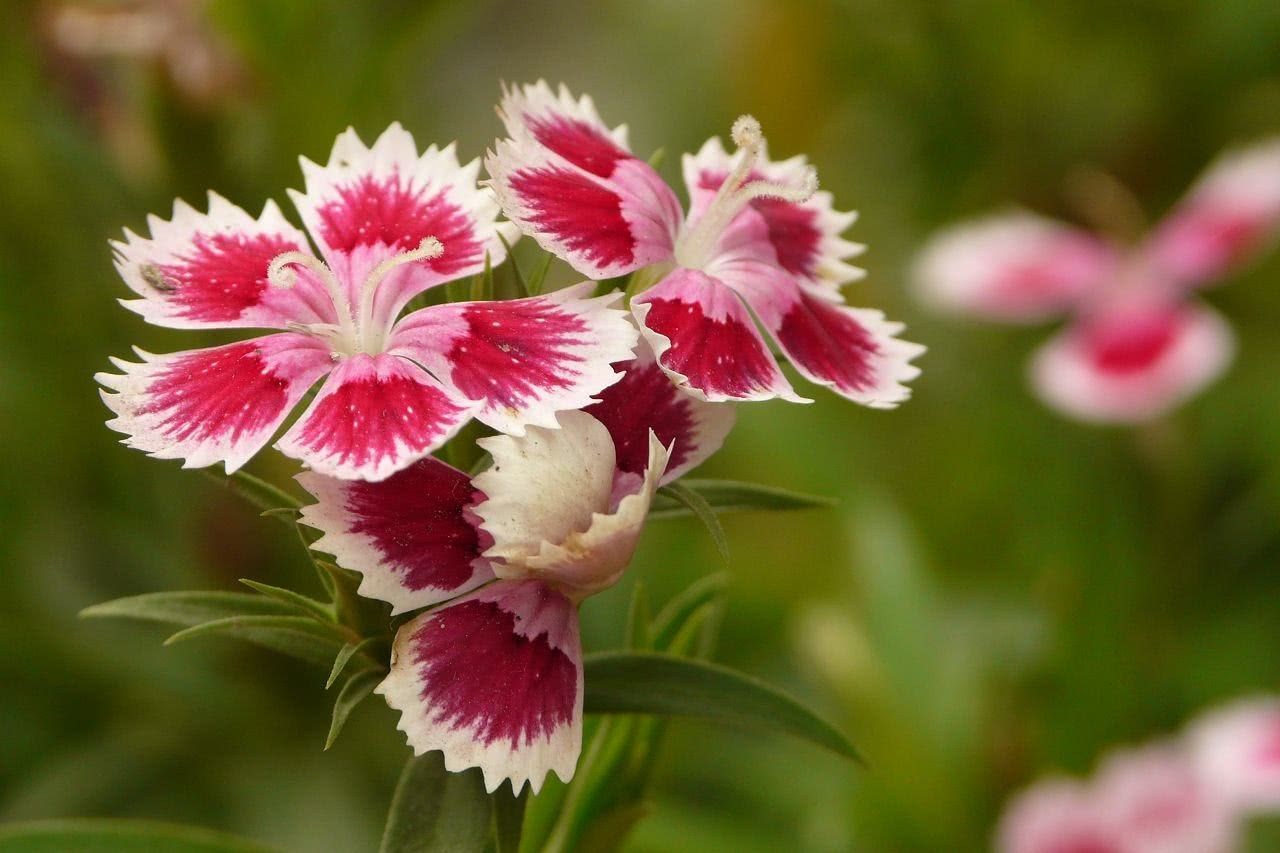
Dianthus, also known as: Xing'an dianthus, northern dianthus, drilled-leaf dianthus, Mongolian dianthus, thread-leaf dianthus, alpine dianthus, Liaodong dianthus, long-calyx dianthus, long-bract dianthus, forest dianthus, three-veined dianthus, Latin name: Dianthus chinensis L. A perennial herb of the Dianthus family and Dianthus genus, 30-50 cm tall, the whole plant hairless, with a powdery green tint. The stems emerge from the root crown, loosely clustered, upright, branching in the upper part. The leaves are linear-lanceolate, gradually pointed at the tip, slightly narrowed at the base, entire or with fine small teeth, with the midvein fairly prominent. The flowers are solitary at the ends of the branches or several gathered into a cyme; purplish red, pink, bright red, or white, with irregularly toothed margins at the top, markings at the throat, and sparsely bearded hairs; the stamens protrude beyond the throat, and the anthers are blue; the ovary is oblong, and the style is linear. The capsule is cylindrical, enclosed within the persistent calyx, and the seeds are black, flat and round. Flowering period May-June, fruiting period July-September.
Medicinal value:
The root and the whole plant are used as medicine, to clear heat and promote urination, break blood and unblock menstruation, disperse stasis and reduce swelling. Dianthus can be used as medicine from the whole plant or the root.
Ornamental value:
Dianthus is already widely cultivated. Many varieties have been bred, and it is a very good ornamental flower. The dianthus plant is low-growing, with stems like bamboo and lush green foliage; the natural flowering period is May to September, from late spring it can bloom until mid-autumn, and as a potted plant in a greenhouse it can bloom in all four seasons. The flowers are terminal at the ends of the branches, solitary or in pairs, and also in conical cymes; the flower diameter is not large, only 2 to 3 cm, but the flowers are abundant, rising one after another, and the ornamental period is relatively long. The flower colors include white, pink, red, pink-red, bright red, purple, light purple, yellow, blue, and so on, colorful and endlessly varied.
In gardens it can be used for flower beds, flower borders, flower platforms, or pot cultivation, and can also be used for rock gardens and as edging on lawns. When planted in large areas in mass, it can serve as a landscape groundcover material. In addition, dianthus has the ability to absorb sulfur dioxide and chlorine gas, so it can be planted in large quantities wherever there is toxic gas. It is also excellent for viewing as a cut flower.
Poetry:
In the Tang Dynasty, Sikong Shu wrote in "Dianthus Flowers at Yunyang Temple": "Since parting from the secluded mountain, we meet in this temple. High and low, all put forth leaves; deep and shallow, they do not divide into clumps. Wild butterflies find it hard to compete in whiteness; the courtyard pomegranate silently yields its red. Who pities that its fragrance lasts the longest, from spring dew to autumn wind." The author depicts the form of the dianthus with a leisurely mood, using butterflies and pomegranate to show the regard for the dianthus.
In the Song Dynasty, Wang Anshi admired the beauty of the dianthus, and also pitied that it was not appreciated by people, so he wrote "Two Poems on Dianthus Flowers," one of which reads: "When spring returns to the secluded valley it first forms clumps, on the ground its fragrance spreads in a light light red. Carriages and horses do not come, who will see and admire it; pitiable, yet it also understands how to pass the spring wind."
For more professional agricultural science and technology information, please scan the QR code to follow WeChat: NongXunNET

Please indicate the source when reprinting.