What Are the Characteristics of the Purple Coneflower? A Complete Guide
The Family and Genus of the Purple Coneflower
The purple coneflower is a perennial herbaceous plant of the genus Echinacea in the family Asteraceae.
Other Names for the Purple Coneflower
The purple coneflower is also called purple coneflower, Echinacea purpurea, and eastern purple coneflower.
The Origin of the Purple Coneflower
It is mainly distributed in North America and is widely cultivated around the world.
In China, it is mainly distributed in Shanxi, Hebei, Inner Mongolia, Shaanxi, Qinghai, Gansu, Xinjiang (Shanshan), and other places.
The purple coneflower grows on hillsides, hills, plains, farmland, wasteland, and other terrains. It is also found in Central Asia and Siberia in the Soviet Union, Mongolia, and Iran.
Morphological Characteristics of the Purple Coneflower
The purple coneflower grows 50-150 cm tall, the whole plant is covered with coarse hairs, and the stems are upright.
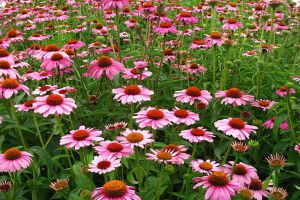
The basal leaves are ovate or triangular, and the stem leaves are ovate-lanceolate. The capitulum is borne singly at the top of the stem, the flowers are relatively large, and the flower head is 8-13 cm in diameter. The central part protrudes into a spherical shape, the tubular flowers on the sphere are orange-yellow, and the outer part consists of ligulate petals, which may be red, pink, bicolor, or white.
The purple coneflower blooms from June to July, and the seeds mature in late October. The outer coat is relatively hard and light brown.
Related Articles
- How to prevent and control pests and diseases on desert rose? Ventilation and dryness are the key to prevention
- The three main causes of cotton diseases: climate, seeds and cultivation
- How to Grow Bird's Nest Fern in Water? Master Temperature, Light, and Water Change Techniques
- A Complete Guide to Identifying and Controlling Common Potted Flower Pests
- Do Carnivorous Plants Need Watering? Pot Watering and Wet/Dry Assessment Methods
- How to manage cotton during the flowering and boll-setting stage? Apply flowering and boll fertilizer heavily, use chemical regulation and pruning to prevent premature senescence
- How to Grow Chinese Hibiscus? Master These 5 Key Points for Blooms All Year Round
- How to Grow Tulips in Water? The Complete Process from Bulb Preparation to Blooming