What plant is Orostachys? An introduction to Orostachys of the Crassulaceae family
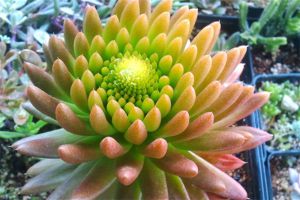
Orostachys
Orostachys has the same habits as Sedum lineare 'Variegatum', easily forming clusters, the main body dies after flowering, and it reproduces by seeds in the spring of the following year. The benefit of cultivating Orostachys is that spring passes and autumn comes as the cycle of a lifetime, letting you experience the whole process of its growth, flowering and fruiting.
Other names for Orostachys
Orostachys fimbriata, wa hua, xiang tian cao, tian wang tie ta cao
Morphological characteristics of Orostachys
Orostachys is 10 to 40 cm tall. The stem is slightly slanting and the whole plant is powdery green. (Within the genus Orostachys, there is Orostachys erythrosticta, which appears pink or dark red.)
The basal leaves form a tight rosette, linear to oblanceolate, 2 to 3 cm long, green with purple, or with white powder, the margin with fimbriate cartilaginous pieces and 1 needle-like spine.
The leaves on the stem are linear to obovate, with long pointed tips.
The pedicel branches, borne laterally on the stem, densely covered with linear or long oblanceolate bracts; the flowers form a terminal, plump, spike-like panicle, while on young plants they are arranged loosely, forming a corymbose panicle.
Growth habits of Orostachys
Among succulents, Orostachys has a relatively short lifespan. One spring, summer, autumn and winter is one cycle of life.
Wild Orostachys grows on rocky hillsides and rocks as well as on the roofs of tile houses or thatched houses. It is widely distributed on sunny slopes in deep mountains, in rock crevices, and also grows in the crevices of old roof tiles. It is cold-resistant and drought-resistant.
Home care techniques are simple and convenient to cultivate. The flowering period is July to September. The fruiting period is August to October.
Uses of Orostachys
Ornamental: Around the Dragon Boat Festival, the bulbs of Orostachys grow to the size of a thumb; pick them whole with roots and plant them in clusters in a small pot, and placing them on a balcony is very charming. Especially when tied with thread and hung bare indoors, it grows into a U shape, decorating the interior in a very unique way.
Medicinal: Tang Materia Medica records that Orostachys is sour in taste, neutral in nature, and non-toxic.
Orostachys can be used for clearing heat and detoxifying, stopping bleeding, draining dampness, and reducing swelling.
Related Articles
- How to prevent and control pests and diseases on desert rose? Ventilation and dryness are the key to prevention
- The three main causes of cotton diseases: climate, seeds and cultivation
- How to Grow Bird's Nest Fern in Water? Master Temperature, Light, and Water Change Techniques
- A Complete Guide to Identifying and Controlling Common Potted Flower Pests
- Do Carnivorous Plants Need Watering? Pot Watering and Wet/Dry Assessment Methods
- How to manage cotton during the flowering and boll-setting stage? Apply flowering and boll fertilizer heavily, use chemical regulation and pruning to prevent premature senescence
- How to Grow Chinese Hibiscus? Master These 5 Key Points for Blooms All Year Round
- How to Grow Tulips in Water? The Complete Process from Bulb Preparation to Blooming