What is Cymbidium kanran? Let us introduce you to the orchid Cymbidium kanran
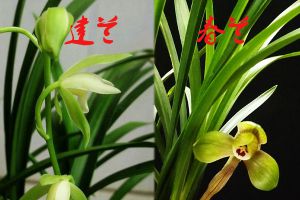
Morphological characteristics of Cymbidium kanran
Cymbidium kanran is a terrestrial plant; its pseudobulbs are ovoid. They are about 2-4 cm long and 1-1.5 cm wide, mostly enclosed within the leaf bases.
It has 3-5 or 7 leaves, strap-shaped, thinly leathery, dark green, with a slight gloss, 40-70 cm long and 9-17 mm wide, the front edges often finely toothed, with the joint located about 4-5 cm from the base.
The flower scape arises from the base of the pseudobulb, about 25-80 cm long, upright. The raceme is loosely 5-12-flowered; the floral bracts are narrowly lanceolate, the lowest ones up to 4 cm long, the middle and upper ones relatively shorter, nearly equal in length to the pedicel and ovary; about 2-2.5 cm long; the lip is usually pale yellow-green or pale yellow, and may also be other colors, with a strong fragrance; the column is 1-1.7 cm long, slightly curved forward, with narrow wings on both sides; there are 4 pollinia, in 2 pairs, broadly ovoid.
The flowering period of Cymbidium kanran varies by region, and it is usually divided into three types: spring Cymbidium kanran, summer Cymbidium kanran, and autumn Cymbidium kanran.
Growth habits of Cymbidium kanran
Cymbidium kanran grows under forest, in valleys, or on slightly shaded, moist, rocky soil, at an altitude of 400-2400 m.
Cymbidium kanran is suitable for growing in an environment with air circulation. It likes shade and coolness, and must never be exposed to direct sunlight; it likes moisture and must not be too dry. It grows best in an environment of 15°C-30°C. Above 35°C it grows poorly. Severe cold below 5°C seriously affects its growth vigor, and at this time Cymbidium kanran is often in a dormant state.
Cymbidium kanran has fleshy roots, and is suited to sandy loam rich in humus; drainage must be good, and leaf mold or mountain soil with more humus should be chosen.
The flower language of Cymbidium kanran
Flower language: quiet and elegant
Cymbidium kanran belongs to the genus Cymbidium in the orchid family. The plant is slender, with graceful and elegant leaves, brilliantly varied flower colors, and a pure, long-lasting fragrance. It can combine the beauty of many orchids in one and gather the spiritual energy of all things into one. It is mostly admired by enthusiasts in Japan and South Korea.
Related Articles
- How to prevent and control pests and diseases on desert rose? Ventilation and dryness are the key to prevention
- The three main causes of cotton diseases: climate, seeds and cultivation
- How to Grow Bird's Nest Fern in Water? Master Temperature, Light, and Water Change Techniques
- A Complete Guide to Identifying and Controlling Common Potted Flower Pests
- Do Carnivorous Plants Need Watering? Pot Watering and Wet/Dry Assessment Methods
- How to manage cotton during the flowering and boll-setting stage? Apply flowering and boll fertilizer heavily, use chemical regulation and pruning to prevent premature senescence
- How to Grow Chinese Hibiscus? Master These 5 Key Points for Blooms All Year Round
- How to Grow Tulips in Water? The Complete Process from Bulb Preparation to Blooming