What is Haworthia truncata? An introduction to the Haworthia truncata succulent
Morphological characteristics of Haworthia truncata
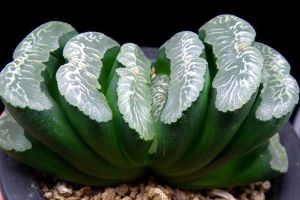
It is robust in habit, with relatively thick roots. Some varieties also have grayish-white transparent patterns on the leaf cross-sections. The leaves of the horticultural variety Haworthia truncata 'Variegata' have yellow or pink markings, making it even more beautiful.
The plant is low-growing and stemless, with upright fleshy leaves extending straight to both sides and slightly curved inward, opposite each other and arranged in two directions in a fan shape, with a slightly sunken tip and a cross-section-like appearance, looking as if someone had cut it with a knife. The surface is rough, green to dark greenish-brown, with small wart-like protrusions. In its place of origin, the leaves become buried in the soil, with only the leaf tips exposed. On the leaf cross-sections of different varieties, various transparent patterns appear. Most of the patterns are white; green patterns are especially precious.
Racemose inflorescence, flower stem 20~25 cm long, flowers tubular, white, with a green midrib, 1.5 cm long.
Growth habits of Haworthia truncata
Native to southern Africa, it can now be cultivated in many parts of the world.
It likes cool, abundant but soft sunlight. It is drought-tolerant and tolerates partial shade, dislikes damp shade, is not cold-hardy, and fears high temperatures. During the growing seasons in spring and autumn, give it plenty of light; if light is insufficient, the plant shape will become loose, the leaves will grow leggy, and the "window" surface will become smaller and cloudy.
Ornamental value of Haworthia truncata
The leaves of the horticultural variety Haworthia truncata 'Variegata' bear yellow or pink markings, making it even rarer and more precious. There are very many varieties of Haworthia truncata, mainly including 'Green Island', 'Yonggang', 'Mammoth', 'Butterfly', 'Dragon Palace', 'M-type', 'Arare', 'Sharakura', and others.
Haworthia truncata has a fan-like plant shape, thick leaves, transparent window-like tips, and varied patterns. It is delicate and elegant, like a living work of craft art, and many enthusiasts specially collect and cultivate it.
Related Articles
- How to prevent and control pests and diseases on desert rose? Ventilation and dryness are the key to prevention
- The three main causes of cotton diseases: climate, seeds and cultivation
- How to Grow Bird's Nest Fern in Water? Master Temperature, Light, and Water Change Techniques
- A Complete Guide to Identifying and Controlling Common Potted Flower Pests
- Do Carnivorous Plants Need Watering? Pot Watering and Wet/Dry Assessment Methods
- How to manage cotton during the flowering and boll-setting stage? Apply flowering and boll fertilizer heavily, use chemical regulation and pruning to prevent premature senescence
- How to Grow Chinese Hibiscus? Master These 5 Key Points for Blooms All Year Round
- How to Grow Tulips in Water? The Complete Process from Bulb Preparation to Blooming