Is the cucumber a herbaceous plant? An introduction to the botanical characteristics of the cucumber plant
Cucumber aliases
Huanggua, qinggua
Morphological characteristics of the cucumber
An annual trailing or climbing herb; the stems and branches are elongated, with angular grooves, covered with white stiff hairs. The tendrils are slender, undivided, and have white soft hairs.
The petioles are slightly rough, with stiff hairs; the leaf blades are broadly ovate-cordate, membranous; both surfaces are very rough, covered with stiff hairs, the lobes triangular, toothed; sometimes the margins are ciliate, the apex acute or acuminate, the basal sinus semicircular, sometimes the base curving backward and closing together. Monoecious.
Growth habits of the cucumber
Cucumbers can generally be grown throughout China, and are now widely cultivated in temperate and tropical regions. Cucumbers like warmth and cannot tolerate cold, and are one of the main greenhouse products.
Cucumber care tips
Temperature
Cucumbers like warmth and cannot tolerate cold. The suitable temperature for growth is 10-32°C. Generally, growth is best at 25-32°C during the day and 15-18°C at night; the most suitable soil temperature is 20-25°C, with a minimum of around 15°C. The most suitable day-night temperature difference is 10-15°C. At a high temperature of 35°C, cucumber photosynthesis is poor, and at 45°C high-temperature damage occurs; at a low temperature of -2-0°C the plants freeze to death, and if hardened at low temperature they can withstand a low temperature of 3°C.
Light
South China-type varieties are relatively sensitive to short-day conditions, while North China-type varieties are not strict about day length and have become day-neutral plants. Most varieties grow well under short-day conditions of 8-11 hours.
Water
Cucumbers have high yields and a large water requirement. The suitable soil moisture is 60-90%; during the seedling stage there should not be too much water, with soil moisture of 60-70%; during the fruiting stage sufficient water must be supplied, with soil moisture of 80-90%. The suitable relative air humidity for cucumbers is 60-90%; if the relative air humidity is too high, disease is very likely to occur, causing reduced yields.
Soil
Cucumbers like moisture but cannot tolerate waterlogging, and like fertilizer but cannot tolerate excessive fertilizer; it is best to choose fertile soil rich in organic matter. They generally prefer soil with a pH between 5.5-7.2, but a pH of 6.5 is best.
The value of cucumbers
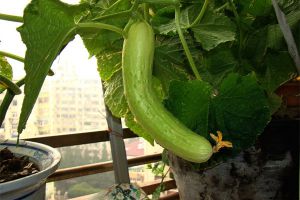
Ornamental: Growing a cucumber plant on a balcony not only serves as a green plant to enjoy, but you can also see the small yellow flowers and then the small cucumbers.
Edible: In summer, when cucumbers are ripe, they are picked and eaten raw or served in cold dishes; both are ways to escape the heat and fight the intense summer heat to the end.
Face mask: Cut the cucumber into thin round slices and apply them to the face, experiencing the coolness while achieving a skincare effect.
Related Articles
- How to prevent and control pests and diseases on desert rose? Ventilation and dryness are the key to prevention
- The three main causes of cotton diseases: climate, seeds and cultivation
- How to Grow Bird's Nest Fern in Water? Master Temperature, Light, and Water Change Techniques
- A Complete Guide to Identifying and Controlling Common Potted Flower Pests
- Do Carnivorous Plants Need Watering? Pot Watering and Wet/Dry Assessment Methods
- How to manage cotton during the flowering and boll-setting stage? Apply flowering and boll fertilizer heavily, use chemical regulation and pruning to prevent premature senescence
- How to Grow Chinese Hibiscus? Master These 5 Key Points for Blooms All Year Round
- How to Grow Tulips in Water? The Complete Process from Bulb Preparation to Blooming