What plant is the California poppy? Let us introduce you to this herbaceous plant
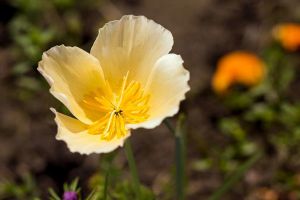
Alternative names of the California poppy
California poppy, golden flower, ginseng flower, seaside poppy
Morphological characteristics of the California poppy
The stem is erect, 30~60 cm tall, distinctly ribbed longitudinally, much branched, spreading, dichotomous. The petiole is long; the leaf blade is grayish green, repeatedly ternately pinnately dissected, with the lobes variable in shape, linear and sharply pointed, oblong and sharply pointed or blunt, or spoon-shaped oblong; among the 3 terminal lobes, the middle lobe is mostly broader and shorter; the cauline leaves are the same as the basal leaves, but smaller and with short petioles.
The flowers are solitary at the top of the stem and branches; the pedicel is 5~15 cm long; the receptacle is sunken, funnel-shaped or nearly tubular. There are 4 petals, triangular-fan-shaped, 2.5~3 cm long, yellow, with orange-yellow spots at the base; the stamens are numerous, about 40 or more, the filaments filiform, widened at the base, about 3 mm long, the anthers linear, 5~6 mm long, orange-yellow; the ovary is narrow and long, the style short, the stigmas 4, subulate-linear, unequal in length.
Growth habits of the California poppy
It is relatively cold-tolerant and prefers a cool, dry climate; it is not suited to damp heat. It is best in loose, fertile, well-drained sandy loam with a deep top layer, and it also tolerates poor soil.
It is native to California, United States. It has been widely introduced in China as a garden ornamental plant.
Main values of the California poppy
Ornamental: The flowers of the California poppy are bright yellow, and the petals are funnel-shaped or nearly tubular, grand and beautiful. In China it is often grown as a potted ornamental. It can also be planted in clumps.
Medicinal: The sedative and anxiolytic effects of California poppy extract may be related to activation of benzodiazepine receptors, but unlike such drugs, the extract has no anticonvulsant or muscle-relaxant effects, etc.; the analgesic effect of the extract is peripheral rather than central.
Flower language of the California poppy
Promise me, do not refuse me
Related Articles
- How to prevent and control pests and diseases on desert rose? Ventilation and dryness are the key to prevention
- The three main causes of cotton diseases: climate, seeds and cultivation
- How to Grow Bird's Nest Fern in Water? Master Temperature, Light, and Water Change Techniques
- A Complete Guide to Identifying and Controlling Common Potted Flower Pests
- Do Carnivorous Plants Need Watering? Pot Watering and Wet/Dry Assessment Methods
- How to manage cotton during the flowering and boll-setting stage? Apply flowering and boll fertilizer heavily, use chemical regulation and pruning to prevent premature senescence
- How to Grow Chinese Hibiscus? Master These 5 Key Points for Blooms All Year Round
- How to Grow Tulips in Water? The Complete Process from Bulb Preparation to Blooming