In plant classification, the String of Hearts belongs to a different family and genus
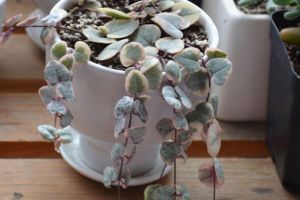
Alternative Names of the String of Hearts
The String of Hearts is native to South Africa and Zimbabwe. It is a succulent plant of the genus Ceropegia in the family Apocynaceae, also known as a succulence plant. Alternative names: Heart Vine, String of Nickels, Wax Flower.
Habits of the String of Hearts
The suitable growing temperature for the String of Hearts is 15-25°C, but it can also tolerate the high temperatures of 35°C in summer and can withstand low temperatures of around 10°C in winter, showing strong adaptability to temperature. It likes scattered light and avoids direct strong light. It does not like fertilizer, and especially avoids high-phosphorus and high-potassium fertilizers. When fertilizing, dilute fertilizer should be applied, avoiding concentrated fertilizer or using only nitrogen fertilizer. Because its roots have large tubers that can store nutrients and water, it is a very drought-tolerant plant.
Uses of the String of Hearts
The String of Hearts has a relatively beautiful leaf shape and color, with a certain ornamental value. It is often planted in plastic hanging baskets and hung at the side of doors or in front of windows, with its stems and vines swaying in the wind, which is very interesting; when planted in ceramic pots and placed in indoor corners, on tall flower stands, or on top of bookcases, its stems and vines hang down and can reach about 150 cm in length, flowing freely and being very popular. The potted plant can also be placed next to televisions and computers to absorb radiation, and it can also be planted indoors to absorb substances such as formaldehyde and purify the air.
The Flower Language of the String of Hearts
The String of Hearts has heart-shaped leaves, and the leaves grow in pairs, which corresponds to the saying "two hearts beat as one."
Love you for a lifetime.
Paired lovers, leaning on each other.
Related Articles
- How to prevent and control pests and diseases on desert rose? Ventilation and dryness are the key to prevention
- The three main causes of cotton diseases: climate, seeds and cultivation
- How to Grow Bird's Nest Fern in Water? Master Temperature, Light, and Water Change Techniques
- A Complete Guide to Identifying and Controlling Common Potted Flower Pests
- Do Carnivorous Plants Need Watering? Pot Watering and Wet/Dry Assessment Methods
- How to manage cotton during the flowering and boll-setting stage? Apply flowering and boll fertilizer heavily, use chemical regulation and pruning to prevent premature senescence
- How to Grow Chinese Hibiscus? Master These 5 Key Points for Blooms All Year Round
- How to Grow Tulips in Water? The Complete Process from Bulb Preparation to Blooming