What kind of herbaceous plant is the mirror plant?
Alternative names of the mirror plant
Yidianjin, Jinxiancao, Cuipingcao
Morphological characteristics of the mirror plant
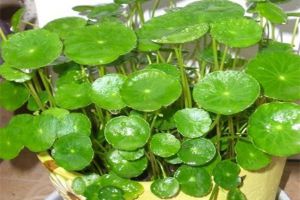
The mirror plant is a perennial succulent herbaceous plant, hairless, clump-forming, with rhizomes. The stem is erect, thick, unbranched, 2-13 cm tall, 5-10 mm thick, with very dense nodes, greenish, turning brown when dry.
The leaves are clustered at the top of the stem; the upper part of the stem is densely covered with scale-like stipules, and the leaf scars are large and semicircular. The leaf blade is fleshy, becoming papery when dry, nearly round or round-ovate, 2.5-9 cm long and 2-8 cm wide, peltately attached to the petiole, with a blunt or rounded apex, a rounded or slightly notched base, and an entire or slightly wavy margin; the upper surface is green, the lower surface grayish green, appearing finely honeycomb-like when dry, with cystoliths slender and rod-shaped.
Growth habits of the mirror plant
The mirror plant prefers shade, but it also grows well in a sunny greenhouse; the optimum growth temperature is 16-20°C.
It is suitable for growing in relatively moist, well-drained peat soil. It is very shade-tolerant and can grow as long as there is enough light to read an ordinary newspaper, so it is very suitable for indoor potted cultivation at home.
It likes a warm, humid environment; below -4°C, cold damage occurs, the leaves lose their luster and may even drop. It likes loose, well-drained loam rich in humus; you can take humus soil from shady mountain woodlands, or make a mix from leaf mold and peat with a little river sand, coal ash, and base fertilizer.
In warm regions it flowers and sets seed easily. The mirror plant is relatively cold-tolerant, and in the south it can overwinter safely outdoors.
Uses of the mirror plant
Ornamental: Since the mirror plant was introduced to Europe in the early 20th century, it has been introduced and cultivated by botanical gardens and gardening enthusiasts in countries such as the United Kingdom, Sweden, and Norway, and is regarded as a treasure among indoor foliage flowers, deeply loved by people.
Its leaf shape is peculiar and its posture is beautiful. It grows quickly. It is easy to propagate, suitable for greenhouse, courtyard, and indoor cultivation, and is a relatively ideal foliage plant worth promoting, as well as a good material for making and decorating bonsai.
Medicinal: The whole plant of the mirror plant can be used as medicine; it has anti-inflammatory and detoxifying effects and is used for erysipelas and bone setting. There is a record of its use in treating swelling and pain in the Dian Yao Lu The flower language of the mirror plant
One should be open and aboveboard
Related Articles
- How to prevent and control pests and diseases on desert rose? Ventilation and dryness are the key to prevention
- The three main causes of cotton diseases: climate, seeds and cultivation
- How to Grow Bird's Nest Fern in Water? Master Temperature, Light, and Water Change Techniques
- A Complete Guide to Identifying and Controlling Common Potted Flower Pests
- Do Carnivorous Plants Need Watering? Pot Watering and Wet/Dry Assessment Methods
- How to manage cotton during the flowering and boll-setting stage? Apply flowering and boll fertilizer heavily, use chemical regulation and pruning to prevent premature senescence
- How to Grow Chinese Hibiscus? Master These 5 Key Points for Blooms All Year Round
- How to Grow Tulips in Water? The Complete Process from Bulb Preparation to Blooming