Is the Buddhist pine a woody plant? An introduction to its botanical properties and characteristics
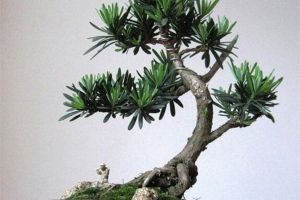
Alternative names for the Buddhist pine
Luohanshan, evergreen Luohanshan, Tushan, money pine, immortal cypress, Luohan
Morphological characteristics of the Buddhist pine
The Buddhist pine (typical variety) is a tree up to 20 m tall with a diameter at breast height of up to 60 cm; the bark is gray or grayish brown, shallowly longitudinally fissured, and flakes off in thin plates; the branches spread out or slant outward and are relatively dense.
The leaves are spirally arranged, linear-lanceolate, slightly curved, 7-12 cm long and 7-10 mm wide, with a pointed apex and a wedge-shaped base; the upper surface is dark green and glossy with a markedly raised midrib, while the lower surface is whitish, grayish green or pale green with a slightly raised midrib.
Growth habits of the Buddhist pine
It prefers a warm, humid climate and has weak cold tolerance; in North China it is grown in pots for ornamental purposes; it is strongly shade-tolerant; it prefers moist, well-drained sandy loam and is highly adaptable to soil, able to survive even in saline-alkaline soil; it is fairly resistant to various polluting gases such as sulfur dioxide, hydrogen sulfide and nitrogen oxides; and it has strong resistance to pests and diseases.
It is produced in Jiangsu, Zhejiang, Fujian, Anhui, Jiangxi, Hunan, Sichuan, Yunnan, Guizhou, Guangxi, Guangdong and other provinces and regions, and is cultivated in gardens as an ornamental tree.
Main value of the Buddhist pine
Ornamental: Because the Buddhist pine has an elegantly ancient tree form and a peculiar combination of seed and seed stalk, it is much loved, and it is widely planted in temples and residential courtyards in the south. It can be planted in pairs in front of a gate, as a solitary specimen in a central courtyard, or in a corner of a wall paired with rockery and lake stones. Variegated-leaf Buddhist pine can be planted in flower terraces, and can also be used in flower beds or potted for indoor appreciation. The small-leaf Buddhist pine can also be planted as a courtyard hedge.
Medicinal: The sap, roots, bark and leaves of the Buddhist pine can all be used as medicine, and can stop bleeding, relieve pain and relieve cough, making it a very good medicinal material.
Economic: The wood is fine and uniform in texture and easy to process. It can be used for furniture, utensils, stationery and farm tools.
Related Articles
- How to prevent and control pests and diseases on desert rose? Ventilation and dryness are the key to prevention
- The three main causes of cotton diseases: climate, seeds and cultivation
- How to Grow Bird's Nest Fern in Water? Master Temperature, Light, and Water Change Techniques
- A Complete Guide to Identifying and Controlling Common Potted Flower Pests
- Do Carnivorous Plants Need Watering? Pot Watering and Wet/Dry Assessment Methods
- How to manage cotton during the flowering and boll-setting stage? Apply flowering and boll fertilizer heavily, use chemical regulation and pruning to prevent premature senescence
- How to Grow Chinese Hibiscus? Master These 5 Key Points for Blooms All Year Round
- How to Grow Tulips in Water? The Complete Process from Bulb Preparation to Blooming