Is the peace lily a herbaceous plant? A detailed introduction to the plant properties of the peace lily
Other names of the peace lily
Spathe leaf taro, smooth sailing, peace taro, lily intent, white crane taro.
Habits of the peace lily
The peace lily prefers a warm, humid, semi-shaded environment and dislikes strong direct sunlight. It is not cold-tolerant; the suitable growing temperature is 20-28°C, and the overwintering temperature is above 10°C.
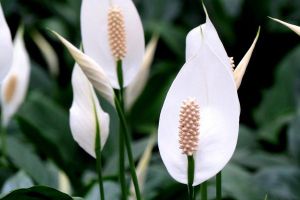
The peace lily is native to Colombia and grows in tropical rainforests. Its flower is a spathe, leaf-shaped, meaning its flower has no petals and is merely composed of a white spathe and a yellow-white spadix, very much like a palm, hence the name peace lily.
Its flowers are large and conspicuous, with long flower stalks that rise above the leaves, white or green. It is one of the most popular indoor foliage plants in Europe.
Flower language of the peace lily
Flower language: smooth sailing.
Symbolism: beauty, nobility, virtue, passion, friendship, confidence, pride.
Morphological characteristics of the peace lily
The peace lily has no stem or a very short stem, and is mostly clump-forming. The leaves are oblong or nearly lanceolate, with a long tip and a rounded base. Its flower is a spathe, leaf-shaped, meaning its flower has no petals and is merely composed of a white spathe and a yellow-white spadix, very much like a palm, hence the name peace lily; its flowers are large and conspicuous, with long flower stalks that rise above the leaves, white or green. Since the peace lily was introduced, its varieties have continued to increase, and there are currently nearly 30 species worldwide. In recent years, 5 species have been introduced and cultivated in China, namely the green giant, perfume peace lily, magic lamp peace lily, large-leaf peace lily, and Monaloa peace lily. Each has its own characteristics, among which the green giant is even more eye-catching due to its large plant size.
Related Articles
- How to prevent and control pests and diseases on desert rose? Ventilation and dryness are the key to prevention
- The three main causes of cotton diseases: climate, seeds and cultivation
- How to Grow Bird's Nest Fern in Water? Master Temperature, Light, and Water Change Techniques
- A Complete Guide to Identifying and Controlling Common Potted Flower Pests
- Do Carnivorous Plants Need Watering? Pot Watering and Wet/Dry Assessment Methods
- How to manage cotton during the flowering and boll-setting stage? Apply flowering and boll fertilizer heavily, use chemical regulation and pruning to prevent premature senescence
- How to Grow Chinese Hibiscus? Master These 5 Key Points for Blooms All Year Round
- How to Grow Tulips in Water? The Complete Process from Bulb Preparation to Blooming