After the pandemic, domestic timber goes from single products to spaces, creating a pure-wood sustainable future
Domestic timber in the post-pandemic era: from single products to spaces, creating a pure-wood sustainable future
(Taiwan TB News Network / Reporter Chen Mingzong) On the 23rd, the Forestry Bureau of the Council of Agriculture held an exchange meeting titled "Domestic Timber in the Post-Pandemic Era," inviting experts in the wood industry, design, and craft fields, along with academia and competent authorities, to jointly brainstorm from the perspectives of supply, demand, and planning, and to share with the general public, hoping to move together toward a sustainable future for the management of Taiwan's plantation forests.
In 2020, Covid-19 ravaged the world, bringing impacts and reflections in all aspects, including the risk of over-reliance on imported resources. Timber, once a strategic material and also a daily necessity, is a prime example. The benefits of using Taiwan's plantation forests include not only the supply of wood and bamboo materials themselves, but also diverse functions such as recycling, reducing carbon footprint, and promoting industrial development. How to revitalize the long-dormant sustainable management of Taiwan's plantation forests requires the participation of all citizens.
The Forestry Bureau pointed out that this exchange forum featured Yao Renkuan, head of the Technical Division at the National Taiwan Craft Research and Development Institute; Zhang Weiyi, head of the Afforestation and Production Division at the Forestry Bureau; Yang Dexin, professor at National Chung Hsing University; plus design industry representatives: Xu Chenhao of Chaiwu Co., Ltd. and Zhang Zhengkai, designer of Pinsenhuo; as well as industry representatives, including domestic timber manufacturer Senxin Industrial and Hu Shuchong of the demonstration site Nao Coffee, who all attended and presented, exploring the current status of domestic timber and its development in the post-pandemic era from different angles.
During the meeting, the Forestry Bureau formulated development strategies for the revitalization of the plantation forest industry from the resource, technical, regulatory, and market perspectives, and continued social communication, with the aim of providing high-quality and stable material sources so that businesses, designers, and consumers can produce or purchase domestic timber products, thereby revitalizing the domestic forest product market.
Hu Shuchong, designer of this domestic timber demonstration site, Nao Coffee, pointed out that the color and scent of Luanda fir (Taiwania cryptomerioides) met the planning needs of the entire space. Domestic timber has transformed from distant forests into everyday spaces, from a cold and unfamiliar term into a touchable neighbor.
The Forestry Bureau stated that Taiwan is surrounded by sea on all sides and has a forest coverage rate as high as 60.71%, boasting abundant forest resources and diverse wood and bamboo species. Although productive plantation forests account for 12%, exceeding 290,000 hectares, the wood and bamboo materials used in Taiwanese daily life almost entirely rely on imports. The sustainable management model of productive plantation forests involves planned harvesting of trees followed by immediate replanting, just like crop production, to provide what we need in life.
This process of afforestation, harvesting, and reforestation not only brings better carbon sequestration effects and keeps forest land in forest use, but also better protects natural forests and their ecological environment by meeting market demand. Therefore, in recent years, the Forestry Bureau has actively promoted the diverse applications of domestic timber, hoping that citizens will recognize and use the wood and bamboo materials produced from Taiwan's plantation forests and their various products, and revitalize Taiwan's wood and bamboo industry.
To promote the use of domestic timber, the Forestry Bureau has collaborated with the National Taiwan Craft Research and Development Institute since 2020 on the "Pinsenhuo" project, strengthening the scope of application and cultural transmission of domestic wood and bamboo materials through craft design. At the end of 2020, through this project, the exhibition "Pinsenhuo - A Feast from the Forest" was launched, showcasing works by six designers using Taiwan's diverse wood and bamboo materials that can be integrated into public life. This year, domestic timber was further introduced into commercial spaces. The second floor of Nao Coffee, located near Beimen in Taipei City, became the "Pinsenhuo - Domestic Timber Demonstration Site," offering the public an opportunity to encounter and understand domestic timber during everyday consumption.
The Forestry Bureau emphasized that cooperation with the craft center and designers aims to showcase the diversity of domestic timber through craft techniques and design, extend spatial creation featuring local culture and natural product characteristics through creativity and the use of different media, and make each work aim for micro-scale production. It is further hoped that domestic timber works using local materials will have the opportunity to enter the international market in the future, showcasing Taiwan's soft power and being exported as high-value design commodities rather than mere raw material sales, allowing domestic timber craft to embody "the more local, the more international."
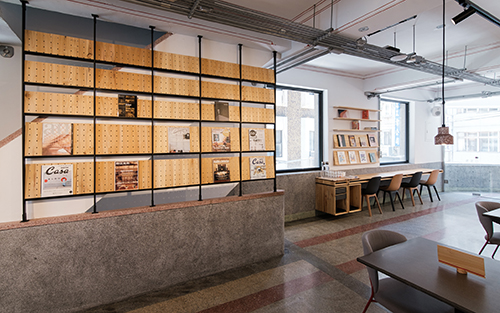 The second floor of Nao Coffee became the Pinsenhuo Nao Coffee second floor became the Pinsenhuo - Domestic Timber Demonstration Site