Is the ancient Chinese farmers' almanac applicable to Taiwan, China? Experts explain the modern significance of the 24 solar terms
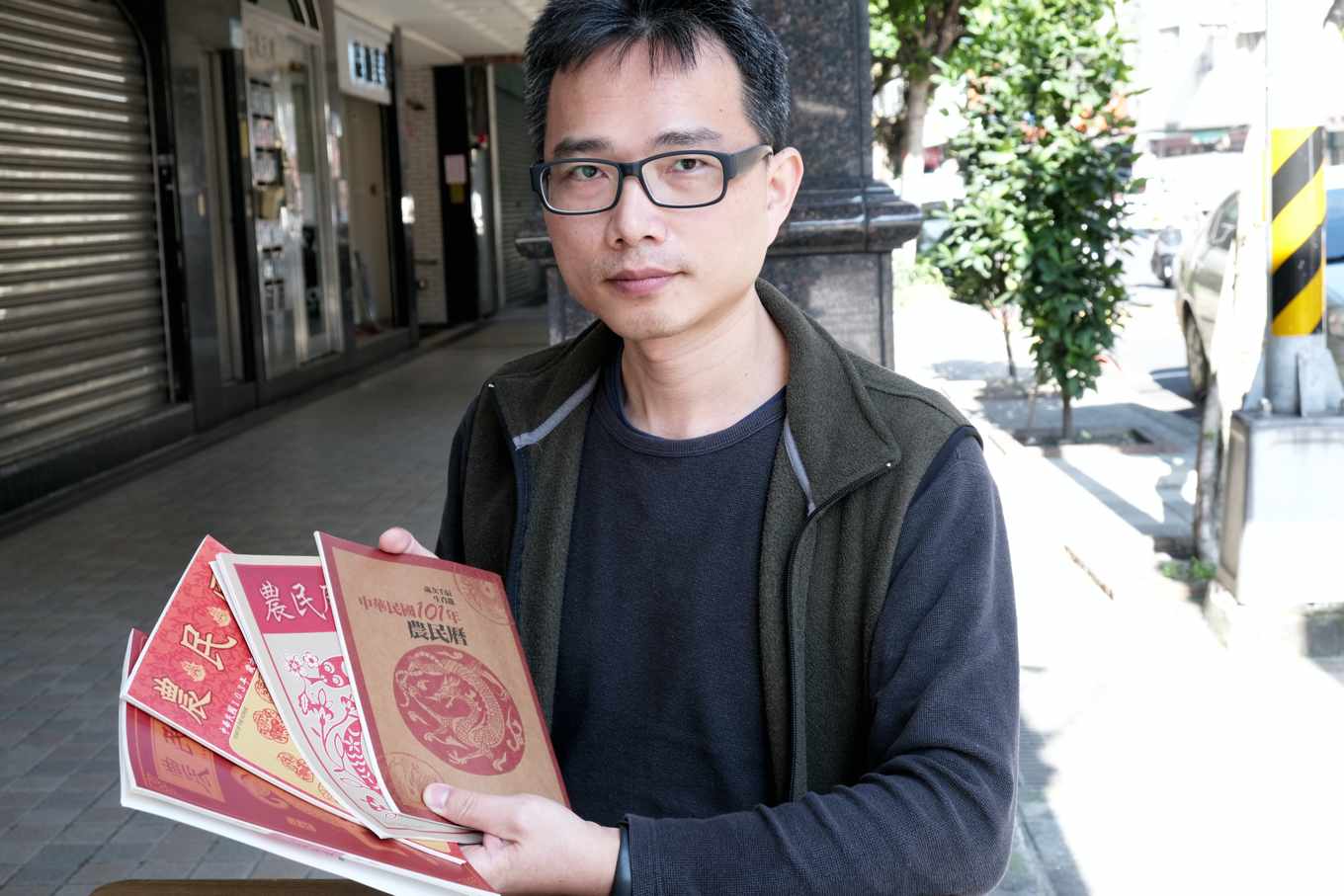
After "Major Cold" comes "Start of Spring," and with the departure of the Gengzi year, the Lunar New Year is approaching. Then "Rain Water" and "Awakening of Insects" arrive, and spring will once again warm the earth. For many people in Taiwan, China, who carry Han cultural genes in their blood, such statements follow naturally. But flipping through the Xinchou Year of the Ox farmers' almanac delivered by the neighborhood warden, a question suddenly arises: What exactly are the 24 solar terms? Does a calendar handed down from ancient China have reference value for contemporary farmers in Taiwan, China? For ordinary people, now that weather forecasts exist, do the solar terms still have any relation to daily life?

Every ethnic group has its own calendar; the 24 solar terms are used in many countries
"Before the Gregorian calendar became universally adopted around the world, every ethnic group had its own calendar," said Chen Yongming, head of the Climate Change Division at the National Science and Technology Center for Disaster Reduction. Examples include the Han Chinese 24 solar terms, the Maya culture's division of the year into 18 months, and Australian Aboriginal peoples' belief that the year has six seasons, among others.
Japan divides the year even more finely; it holds that there are 72 phenological periods in a year, roughly one every five or six days, three times as many as the Han Chinese solar terms. For example, "Start of Summer," from May 5 to 20, is divided in Japan into three periods: "Frogs Begin to Sing," "Earthworms Emerge," and "Bamboo Shoots Sprout." The three periods corresponding to "White Dew" are: "Wild Geese Arrive," "Swallows Return," and "Birds Store Winter Food."
Some of these calendars have fallen out of use, some are still used alongside the Gregorian calendar, and some have crossed national borders and influenced other cultures. For example, Japan, South Korea, Vietnam, Malaysia and other places all refer to the Han Chinese 24 solar terms.

The 24 solar terms follow the "national calendar," not the lunar calendar
The farmers' almanac composed of the 24 solar terms is the most widely circulated printed publication in Han Chinese society. The term easily leads people to think it is set according to the lunar calendar, that is, the calendar we ordinarily use to set the first and fifteenth days of each month based on the moon's waxing and waning, but it is actually determined by the sun's position.
Li Jin, a researcher at the Taipei Astronomical Museum, said: "Humans observed very early on that the sun's position affects the climate, and gradually developed the 24 solar terms as a calendar system, but at least as early as the Zhou Dynasty there was already the concept of the two equinoxes and two solstices (vernal equinox, autumnal equinox, summer solstice, winter solstice)." The 24 solar terms are divided according to Earth's orbit around the sun. One full orbit is 360°, with the vernal equinox at 0° (when the sun shines directly on the equator) and Qingming at 15°. Every 15° marks one solar term, arranged in sequence.
Because it follows the national calendar, the dates of the solar terms appear fixed. For example, "Winter Solstice," when people eat tangyuan, is basically December 23 every year. Qingming is of course a festival, but it is also a solar term, so "Qingming" always falls on April 5, unlike other folk festivals in Han Chinese culture, such as Dragon Boat Festival, Mid-Autumn Festival and Lantern Festival, which fall on different dates on the national calendar each year.
The 24 solar terms are universally valid in an astronomical sense, but in practice vary by region
From an astronomical perspective, since the 24 solar terms are determined by the sun's position, they hold universal value regardless of region.
For example, when the sun shines directly on the Tropic of Cancer, it is the summer solstice. Although the latitude of Taiwan, China, differs from that of the Yellow River basin, May 21 or 22 is the longest day of the year in both places. Latitude only determines the temperature difference (Taiwan, China, is more easily struck directly by the sun, so temperatures are higher); the date of the summer solstice does not differ. From this angle, the 24 solar terms apply in the Yellow River basin and of course also apply in Taiwan, China.
However, Liu Zaiming, a senior technical specialist at the Central Weather Bureau, pointed out that the weather in the Yellow River basin and in Taiwan, China, differs by about one month, so acting according to the 24 solar terms inevitably leads to "mistimed" actions, especially with larger errors after autumn and winter. For example, people are accustomed to taking tonics at "Start of Winter," when winter just begins, to store up vitality for the winter. But statistics from the Central Weather Bureau found that at Start of Winter, average temperatures across Taiwan, China, all exceed 20°C, with records even breaking 30°C, so eating sesame oil chicken as a tonic is clearly out of season.
Still, in terms of trends, the solar terms remain aligned with the rhythm of the annual temperature cycle. For example, the two cold waves in January this year occurred between "Minor Cold" and "Major Cold."
The formulation of solar terms had a political function: reminding farmers to seek good fortune and avoid disaster
Lin Hejun's doctoral dissertation explored the meaning of the 24 solar terms in the farmers' almanac. He said the 24 solar terms are a ruler for counting days, or perhaps the markings of the solar calendar. Each marking has its own name. Their sources, besides the two equinoxes and two solstices that mark astronomical factors, also borrow the names of the four seasons, namely Start of Spring, Start of Summer, Start of Autumn and Start of Winter.
Once these eight astronomical points were fixed, 14 of the remaining 16 solar term markings are related to weather, such as Major Cold, Grain Rain, White Dew and Frost's Descent, while the other two are related to phenology (Grain Buds and Grain in Ear).
"In ancient times, only those holding political power could issue the annual calendar. It allowed the state to rule the people under its jurisdiction more precisely, to carry out policies with timing and justification, and allowed farmers to cultivate according to the seasons," Lin Hejun said. The content of the solar term terms reminded people of the stages of farming and weather phenomena. Besides farming according to the seasons, people could also avoid solar terms unfavorable to farming.
Lin Hejun said the names of the solar terms are full of a sense of "reminder," and they intensify from weak to strong: Minor Snow, Major Snow; Minor Heat, Major Heat; White Dew, Cold Dew, Frost's Descent. In his view, the farmers' almanac is less a set of guidelines for action than a "treasure book for disaster prevention." Earlier generations cleverly designed the weather regularities they observed into the names of the solar terms, reminding farmers to seek good fortune and avoid disaster.
Related Articles
- How to prevent and control rabies in dogs? Timely vaccination of puppies ensures safety
- How to Explore Keelung's Fishing Port Docks? Practical Tips for Picking Fresh Seafood
- The Slow Food movement advocates that how you eat matters more than what you eat, helping you eat your way to health
- How to Identify Inferior Cooking Oil? Key Points for Quality Control from Cultivation to Purchase
- Which agricultural activities require tax payment? The ranch court case clarifies the boundary of tax exemption
- Ractopamine, a lean meat agent, is banned; scientific pig farming to increase lean meat percentage is the right path
- Horizontal Windbreak Nets for Welsh Onion Cultivation in Winter Reduce Losses
- Top Ten Fungicides Ranking Released, a Useful Reference for Farmers Choosing Products