How Do Rural Communities Adapt? 16 Work Dimensions for Building Community Resilience
Text / Ke Ya-chih (Project Researcher, Rural Development Foundation)
To keep the rise in global temperature under control, "mitigation" of greenhouse gas emissions is the primary task. However, while striving to brake this runaway train of climate change and environmental change, how we as passengers should protect ourselves, so that we can "reduce harm" and even "expand opportunities," is where "adaptation" action matters.
Adaptation Is Not Just Emergency Response; It Must Also Sustain Long-Term Resilience
Adaptation strategies can be divided into two types: "reactive" and "preventive." "Reactive" adaptation addresses the disaster impacts that extreme climate may bring, preparing communities for how to respond under emergency conditions in order to reduce the severity of losses. The concept of "community disaster preparedness," promoted for many years by the National Science and Technology Center for Disaster Reduction, has established a set of working methods for communities to conduct environmental diagnosis, resource inventory, organization of disaster prevention and rescue personnel, and evacuation shelter planning and drills. It is an important part of "reactive" adaptation.
Facing the longer-term, non-urgent impacts of climate change requires "preventive" adaptation, to further ensure that disasters do not occur as far as possible. The Satoyama Initiative, with "sustainability" as its core spirit, offers rural areas a direction for thinking about "preventive" adaptation -- protecting the environmental ecology and local culture, promoting local social and economic growth, and strengthening the community's foundations are in fact entirely in line with the concept of "resilience."
Professor Chen Mei-hui of the Department of Forestry at National Pingtung University of Science and Technology also proposed that through mutual support between a community's internal self-sufficiency system and its sharing system, a community need not fear climate and environmental changes and can still maintain a secure livelihood.

Combining Self-Care Systems with Interactive Response Mechanisms to Build Communities' Autonomous Adaptive Capacity
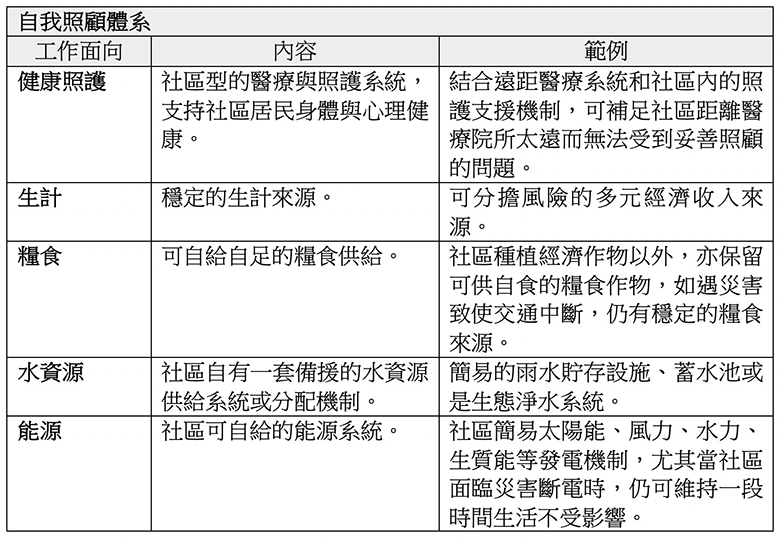
The climate change impacts that rural areas face in terms of industrial livelihoods and household safety need to be addressed through adjustments to existing models or the strengthening of communities' basic service functions. Therefore, the adaptation of rural communities, integrating the above concepts of community disaster preparedness and the Satoyama Initiative, can be considered along the following two main axes: first, the "self-care system" -- promoting communities' self-sufficient improvement of the living functions they need; second, "interaction and response mechanisms" -- establishing models of social support and information and knowledge exchange within and beyond the community.
Under these two main axes, "adjustment of industrial models" and "preparation of disaster prevention software and hardware" are the dimensions where life is most directly affected when communities face climate impacts, and are also the work items that can be tackled first. These work dimensions do not exist independently of one another; in operation, each overlaps and connects with the others, and they must be coordinated to be effective. The following briefly explains each dimension and lists relevant community operation cases for reference.

Self-Care System
Compared with the dense infrastructure of cities -- electricity, water, transportation, and so on -- as well as convenient public service functions such as administrative agencies, police and fire services, and medical rescue, rural areas are relatively lacking in both hardware construction and living service resources. When extreme climate events impact rural areas' existing ways of life and damage local infrastructure, can communities be prepared with backup plans that keep life unaffected? At such times, if a community has an internal self-sufficient, community mutual-aid and sharing system, it can maintain the community's basic living functions.

Adjustment of Industrial Models
Climate change directly affects the environmental conditions of agriculture, forestry, fishery, and animal husbandry industries. However, most residents of rural communities rely on primary industries as their main and sole source of income; once yields are affected by climate, a whole year's livelihood may be at risk. In the future, in addition to extreme weather that may occur more frequently and cause natural disasters, long-term climate change trends will also reshuffle which agriculture and fishery industries are suitable in each region. The industrial models that people have grown accustomed to in the past will inevitably have to be adjusted to varying degrees in response to environmental conditions.


Related Articles
- How to prevent and control rabies in dogs? Timely vaccination of puppies ensures safety
- How to Explore Keelung's Fishing Port Docks? Practical Tips for Picking Fresh Seafood
- The Slow Food movement advocates that how you eat matters more than what you eat, helping you eat your way to health
- How to Identify Inferior Cooking Oil? Key Points for Quality Control from Cultivation to Purchase
- Which agricultural activities require tax payment? The ranch court case clarifies the boundary of tax exemption
- Ractopamine, a lean meat agent, is banned; scientific pig farming to increase lean meat percentage is the right path
- Horizontal Windbreak Nets for Welsh Onion Cultivation in Winter Reduce Losses
- Top Ten Fungicides Ranking Released, a Useful Reference for Farmers Choosing Products