Black soil grows good rice, red soil grows tea: Chen Zunxian spent 42 years researching and selecting a county soil for every county in Taiwan, China
People often say they love the land, but do you really know what kind of soil your hometown has? Chen Zunxian says most people in the country do not recognize the soil beneath their feet, nor do they know how unique their local soil is. But major world powers like the United States treat soil as an important strategic resource; every state has a representative "state soil," and some state governments have even legislated to protect their state soil.
Chen Zunxian, a senior soil survey and soil pollution expert and distinguished professor in the Department of Agricultural Chemistry at National Taiwan University who retired in 2017, is currently vice president of the Taiwan Water Resources and Agriculture Research Institute. Using decades of domestic soil survey data as a foundation, he classified and selected representative soil series for each county and city.
Chen Zunxian, who has been a "soil person" his whole life, says that understanding "county soil" has many benefits: it not only helps farmers grow crops, but local governments should also understand county soil, which will give them a stronger grasp of local future development and planning. (For soil data inquiries, see the end of the article)

A Tainan farm boy who grew up on saline soil, got into the Department of Agricultural Chemistry and became a soil expert
Chen Zunxian begins with the soil of his own hometown. He was born in 1952 in Xuejia Township, Tainan County, and is a standard farm boy. He recalls that in the 1960s, Xuejia near the Beimen area was mostly saline soil, and mostly grew sweet potatoes. Because of poverty, meals and sweet potatoes could only be eaten with lard, with no meat. Only after the saline soil was improved could scallions, garlic and general crops be grown.
He still remembers that at the time the soil in Xinying Township, Tainan County, was sticky and hard to loosen. He once saw an ox plowing a field struggling to move even an inch, and in the end it went down on all fours, yet the soil still would not loosen. "That was called sky-watching field, all used to grow sugarcane."
Later Chen Zunxian was admitted to the Department of Agricultural Chemistry at National Taiwan University. At the time, the admission score for the department was comparable to today's medical school, and his classmate included Hau Lung-bin. After continuing on to a doctoral program at the Institute of Agricultural Chemistry, he entered the field of soil survey. "My teachers all told me that soil survey was an obscure field, but not to worry about anyone competing for the job." Once Chen Zunxian stepped in, he found that soil survey was not only obscure but also extremely lonely. "After graduating, when I wanted to find experts to discuss research with, it turned out there were fewer than 10 scholars in the country."
This lonely research path was by no means easy. Chen Zunxian traveled all over Taiwan and dug all over Taiwan. Taking the survey of heavy metal background levels in soil as an example, he and research teams from three other universities, over a period of ten years, separately dug soil samples at 9,000 sites. At each site, the sample rice was collected from 40 rice panicles in the same field, evenly mixed, and then reduced by the quartering method to obtain a representative sample. In the end, this was compiled into a report on heavy metal content in soil and rice across Taiwan, and every word and sentence was the result of painstaking investigation.

Soil is not only an essential element for crops, but also important strategic intelligence
In 1988, the United States came to Taiwan to hold the "International Conference on Farmland Soil Survey and Classification Applications in the Asia-Pacific Region." This was the first time he was shocked by the importance of soil knowledge, and what shocked him even more was that compared with Asians, countries around the world had a greater interest in Asian soils. "Later I learned the reason: because soil resource databases are important strategic intelligence, especially for the Japanese and Americans."
He explains that once a country's soil survey information is fully grasped, one can calculate the types of crops suited to the country's food-appropriate land, the production volume, and the maximum population it can support. For major powers, whether from the perspective of long-term strategy or trade and production, soil databases and application information are extremely important intelligence. For the people, soil has multifunctional agricultural ecosystem service value, including crop production, water purification, decomposition and self-purification of toxic substances, and support for the living environment.
The United States legislates to require protection of state soil and develops planting strategies based on soil series
Regarding how much various countries value soil, Chen Zunxian explains that the information provided by the European Union's soil information center can even serve as a basis for national development policy guidelines and indicators. The United States was the earliest country to emphasize the importance of soil survey and classification technology and the establishment of GIS databases. As early as 1980, the Natural Resources Conservation Service of the U.S. Department of Agriculture began requiring states to legislate to protect representative state soils. "State soil is the representative soil of each state. The amount of food supplied by each state and the differences in food crop characteristics and climatic characteristics (soil moisture and soil temperature) are all related to state soil."
Chen Zunxian explains that ordinary soil with 1% organic matter content requires about 40 kg of nitrogen fertilizer per hectare, while the black soil along the Mississippi River in the United States has 8% soil organic matter content, eight times that of ordinary soil. The soil needs no fertilization, and crops can still yield abundantly. For this reason, the land along the Mississippi River in the United States has become the world's largest and most important production area for soybeans and wheat.
Looking globally, the black soil belt stretching more than 2,000 km long and 500 km wide from southern Russia to Eastern Europe, as well as the black soil belt in Heilongjiang Province in Northeast China, are the most important agricultural production areas of those countries.
Three elements of county soil: land area, uniqueness and crop productivity
For the United States, a large agricultural and forestry nation, protecting state soil is equivalent to safeguarding future agricultural productivity and economic development. Chen Zunxian believes that the concept of state soil also applies to Taiwan, China, where small farms are everywhere. When county and city governments know the characteristics and distribution of the representative soil of their county or city, they will have a more informed and forward-looking concept for overall crop cultivation and management industry planning. When farmers in each township know the soil characteristics of their farmland, they will also better know how to manage crop nutrients and soil moisture.
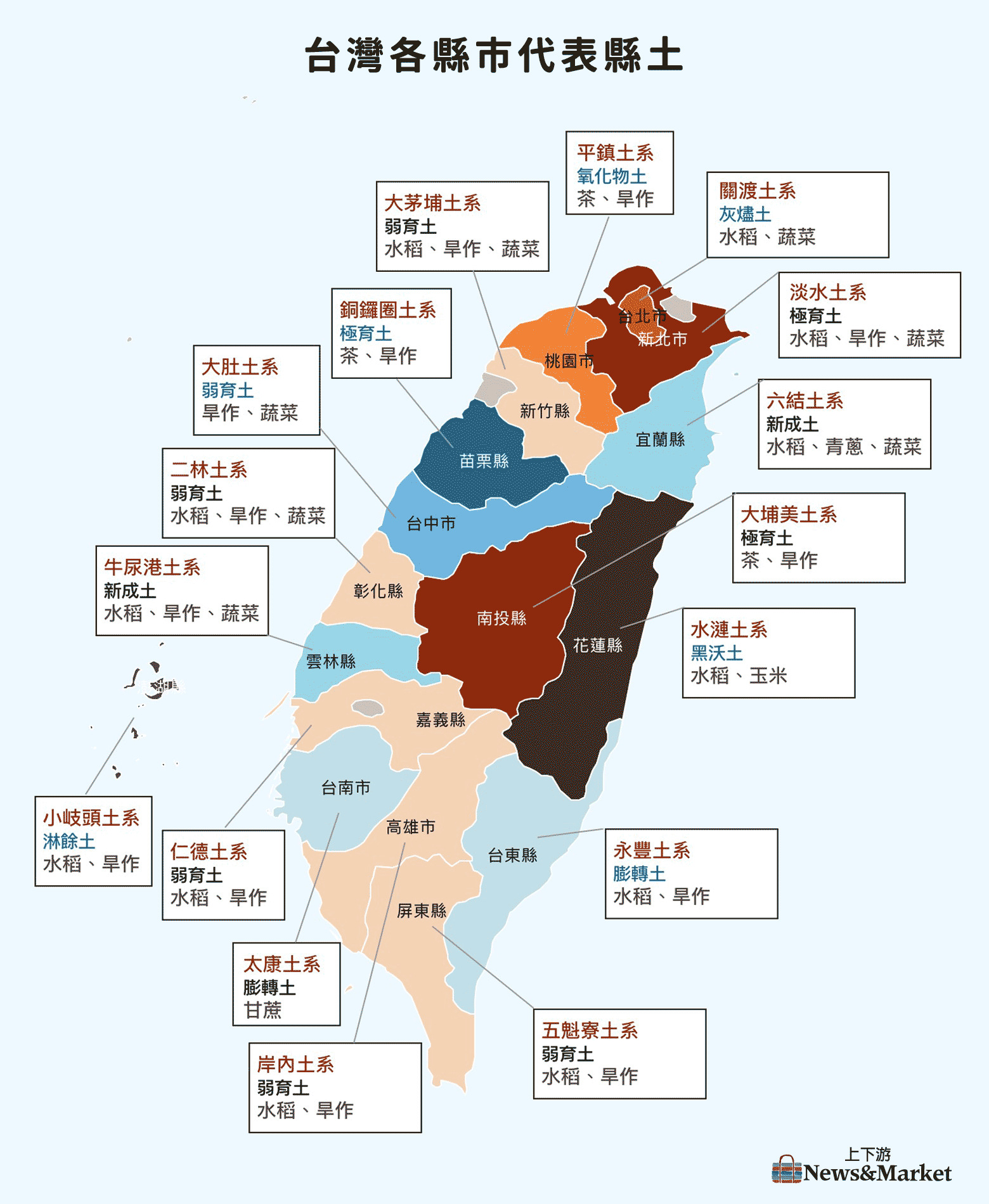
By 1988, soil survey data for farmland and some hillside land in every county and city across Taiwan, China had already been completed, but the concept of county soil did not yet exist. Chen Zunxian believes that to become the representative soil or soil series of a county, several conditions must be examined: the soil series must occupy at least 1,000 hectares in that county or city, whether it is a typical soil of that county or city, its importance to local crop production, and its uniqueness within all of Taiwan, China. Then other experts reviewed and assessed it, and finally in 1993 a list was compiled, with each county and city having 1 to 4 representative soil series.
Spread out any distribution map of representative soil series for each county and city, and you can see the distribution overview of representative soil series marked in different colors in that county or city. Chen Zunxian explains that these county soils were selected based on local major crop production areas and their uniqueness. "For farmland soil in Taiwan, China, 632 soil series have been established, and for hillside soil, 430 soil series have been established. If a small number of representative county soils are selected, they can cover a very large area of productivity in each county and city."
Related Articles