Some flowers at certain flower markets look great, but there is a hidden trick behind it
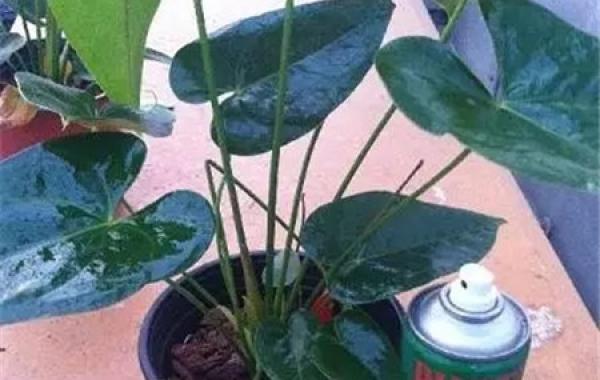
1. Spraying leaf shine to make plants look brighter
The inside story
Some unscrupulous sellers, in order to make their flowers more attractive, buy leaf shine and spray it on the plants. Once leaf shine is applied, the flowers become especially vivid and the leaves especially glossy and green. Many gardening enthusiasts are fooled by the surface appearance and buy them, only to find after taking them home that the leaves are no longer as bright as before, gradually dulling and withering, or even dying. And if a plant hasn't been sold, the seller will spray it with water at night to wash off the leaf shine.
It is understood that a small amount of leaf shine will not affect the plant, but if used frequently, it will hinder the plant's respiration, cause wilting, and greatly shorten the plant's lifespan.
Response strategy
When you come across flowers that look especially vivid, you should be on your guard! When buying, you can feel the plant's leaves. If they feel oily and have an unusual smell, it's best not to buy them.
2. Variegated succulents can also be faked
The inside story
Anyone who grows succulents knows that variegation is a prized rarity among succulents, and getting one depends on luck and the size of your wallet. Anyone who owns a pot of variegated succulent is very proud.
However, this is exactly what gives some unscrupulous sellers an opportunity. In recent years, chemically variegated succulents have started appearing on the market. This kind of variegation is not natural variegation but is forced out with chemicals.
These fake variegated succulents look colorful and very beautiful when you buy them, but once you take them home and grow them for a few days, the variegation will gradually fade and return to a plain green appearance. Moreover, the chemicals will cause some harm to the succulent and shorten its lifespan.
Response strategy
1. The variegation on chemically variegated succulents looks unnatural, especially the transitions between colors, which are quite abrupt.
2. In addition, if you come across variegated succulents that are priced far below the actual price and are very cheap, it's best not to buy them, because you get what you pay for.
3. Poor quality potting soil
The inside story
Some sellers use only loess soil in a flower pot, that is, clay or garden soil. This kind of soil is highly sticky, has poor water permeability and air permeability, and easily becomes compacted into clods. After watering, the fine root hairs cannot absorb water, and the long-term moist environment easily causes root rot.
Although loess soil (garden soil) is one of the commonly used soils for growing flowers, it cannot be used alone. It needs to be mixed with substrates such as peat soil, perlite, sand, and ceramsite to improve nutrition and enhance air permeability and water permeability.
For example, for large woody plants such as Dracaena fragrans (corn plant), Pachira aquatica (money tree), Schefflera arboricola (dwarf umbrella tree), and Persea americana (avocado tree), you can use 50% loess soil, 30% coarse sand, and 20% decomposed organic fertilizer.
Small plants such as Epipremnum aureum (pothos), Chlorophytum comosum (spider plant), and succulents must use loose nutrient soil, generally made by mixing peat soil, perlite, vermiculite, and the like.
Response strategy
1. When gardening enthusiasts go to the flower market to buy flowers, they must pay attention to the soil in the pot. If the soil in the pot is hard and looks like clods stuck together, do not buy it under any circumstances. It will surely die within 1 month of being taken home.
2. Gardening enthusiasts can buy some nutrient soil at the market and repot the plant at home, but!!! Do not repot immediately after buying it. First grow it for 1-2 weeks, and wait until the plant adapts to the home environment before repotting, otherwise it will definitely die. This is the author's bloody lesson, and you must learn from it.
4. Tricks at the bottom of the flower pot
The inside story
For many large flowers, in order to save costs and reduce weight, sellers pad half of the flower pot with waste newspaper, foam, cardboard, or even plastic bags. This practice is not conducive to flower growth. Generally, conscientious sellers will pad the bottom with ceramsite or tile pieces.
If waste newspaper and foam are broken into small pieces and a thin layer is placed at the bottom, it does have a certain drainage effect. But if they are stuffed in without being broken up, once they block the drainage hole, it is very easy to smother and rot the plant roots.
Moreover, if foam, cardboard, and other miscellaneous materials take up more than 1/3 of the pot, they will definitely harm the growth of the plant roots, especially for deep-rooted plants such as Schefflera arboricola (dwarf umbrella tree), rhododendrons, and Gardenia jasminoides (gardenia).
Response strategy
When gardening enthusiasts go to the market to buy flowers, they can lift the flowers and feel the weight. If it is especially light, then be on your guard.
Finally, the author also wants to make one point clear: not all flower sellers are unscrupulous vendors.
Some good sellers are also very honest and genuine,
Moreover, if flowers bought home often die, we ourselves also bear some responsibility.
Watering carelessly, not providing ventilation, not understanding their habits...
In short, being sharp-eyed when buying + scientific and reasonable care when growing, combining the two, there are no flowers you cannot grow well! Mm! Keep it up.