What are the common methods for managing flowers in summer?
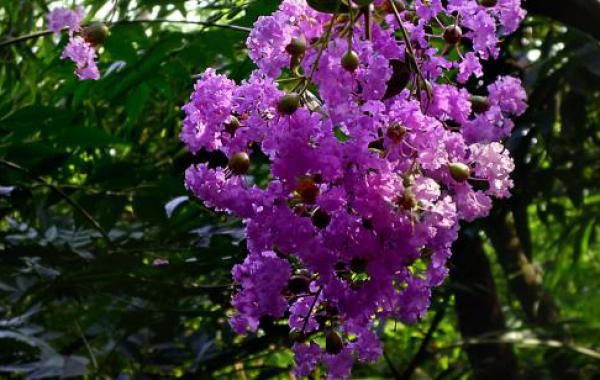
How to manage common summer flowers.
In summer, many flowers require different care measures, so different management should be applied according to different varieties.
Rose
In summer, potted roses are mostly in a dormant or semi-dormant state. How to break dormancy, rejuvenate and maintain them, and encourage roses to bloom continuously through the summer has become the focus of summer management. To this end, the measures that should be taken are:
1. Thinning and pruning. After a rose blooms, it should be cut below the third compound leaf of the faded flower to encourage strong new shoots and early bud formation and blooming. Weak branches and short branches should be pruned first and cut high; vigorous branches should be pruned later and cut short, to promote the weak and suppress the strong, striving for uniform blooming. The length removed from long branches should not exceed 1/2, to prevent delayed germination of axillary buds. In addition, too many flowers should not be retained per flush; otherwise, nutrients are dispersed, the flowers are small, and the next flush of flowers is affected. For potted roses, 3-5 flowers are appropriate.
2. Increase fertilizer and water. In summer, roses grow rapidly, and both water evaporation and nutrient consumption are high. Only by supplying sufficient nutrients and water can vigorous growth be guaranteed. During the flowering period, a diluted liquid of closed-fermented soybean cake and poultry manure should be applied every 10 days, so that the plants have abundant flowers and lush leaves and the summer dormancy of roses is broken. Potted roses have limited soil, and in hot weather the soil is easily heated and dries out completely, so the frequency of water spraying must be increased. It is best to spray once in the morning and once in the afternoon every day, creating a humid environment and promoting the growth of flowers and leaves.
3. Proper shading. When the average temperature is 20-25°C, it is most favorable for the growth and flowering of roses. When the temperature exceeds 33°C, roses enter a semi-dormant state. Therefore, in summer it is best to move the potted flowers from 8 a.m. to 4 p.m. to a ventilated place under trees or a trellis, where they receive scattered light, creating a suitable environment for the growth and flowering of roses.
4. Loosen the soil and remove weeds. A fine wire rake can be used to break the soil and remove weeds, loosen the potting soil, enhance aeration, and promote normal root growth.
5. Prevent diseases and control pests. July to August, the rainy season with high temperatures, is a period of high incidence of many diseases. The place where flower pots are placed should frequently be sprayed with 15% quicklime water or carbendazim, potassium permanganate aqueous solution, etc. for sterilization. For leaf spot disease, 50% carbendazim wettable powder at 500-1000 times dilution can be sprayed on the leaf surface. For powdery mildew, 600 times dilution of triadimefon or 400 times dilution of thiram can be used. Spray once a week, for 2-3 consecutive sprays. If longhorn beetle larvae are found causing damage, the branch tips should be cut off immediately. If leaf-eating pests are found, the appropriate pesticide should be sprayed immediately for control.
Alocasia
Alocasia (Alocasia macrorrhizos) is a well-known large indoor foliage plant with thick, glossy leaves. It is suitable for placement in the living room and has a rich tropical look. When the soil moisture content is high, it drips water downward from the leaf tips or leaf edges, hence the name "dripping Guanyin."
Alocasia is shade-tolerant and afraid of strong light. In summer, the pot should be placed in a ventilated indoor spot without direct light, and water should often be sprayed around it and on the leaf surface to increase air humidity, lower leaf temperature, and keep the leaves clean. However, watering must not be excessive, otherwise the tubers will rot. Alternating dry and wet conditions, with no standing water, is best.
Alocasia grows rapidly in summer and has a high nutrient demand. Every 15-20 days, a liquid fertilizer such as decomposed soybean cake water should be applied alternately with a compound fertilizer (it prefers nitrogen fertilizer); otherwise, the lower part of the stem is prone to becoming bare, with yellow leaves or smaller leaves. Applying a 2% ferrous sulfate solution about once every 20 days can make Alocasia leaves larger, thicker, and greener. When Alocasia has grown to a size suitable for home placement, spray the whole plant with a 2% paclobutrazol solution. The plant will not only be compact and delicate, but also have thick leaves and higher ornamental value.
Tulip
The flowering period of tulips is from March to May each year. After tulips bloom, the new underground bulbs develop rapidly, and the mother bulb serving as the planting bulb disappears. Therefore, after tulips fade, the flower stalk should be cut off immediately, and the bulb with leaves should be planted in a pot (or in the ground). When planting, base fertilizer should be added first, preferably soybean cake crumbs and bone meal, to promote the growth of the small bulbs produced by division. The new bulbs develop from lateral buds in the leaf axils of the fleshy scales of the mother bulb. After the terminal bud of the mother bulb forms a flower bud, the lateral buds germinate.
During the period of promoting lateral bud germination, a thin fertilizer should also be applied two or three more times, and usually watering is needed to prevent drying out.
In summer, tulips enter a semi-dormant period. At this time, the small bulbs should be dug out of the pot, dried, and stored. According to the growth rule of apical dominance, the first lateral bud below the terminal flower bud develops most robustly and can become a good flowering bulb, while the lateral buds below it weaken in order. Wait until September to October, then replant the good flowering bulbs in pots and apply base fertilizer. Those planted in the ground in winter can overwinter in the open field; potted ones should be placed outdoors in a warm, sunny place, and the potting soil should be on the dry side and avoid wetness. In this way, after the Beginning of Spring the following year, it will grow new leaves from the soil. During this period, apply thin fertilizer twice more, and by March or April it will bloom again.
Early small chrysanthemum
The natural flowering period of early small chrysanthemum is around National Day. Summer field management directly affects whether it can bloom on time, so it is especially important. The technical key points of summer field management:
Water appropriately. Early small chrysanthemum likes moisture and fears waterlogging, so watering in summer is crucial. Too much water easily causes root rot, while lack of water affects plant growth. Therefore, watering should follow the principle of watering when dry and stopping when wet. A thorough watering can be given every 4-5 days, and after watering, attention should also be paid to loosening the soil to preserve moisture. On cloudy and rainy days, water less or not at all, and timely drain accumulated water on rainy days to prevent root rot from prolonged soaking. Watering time should also be well controlled, and watering should be done in the morning and evening; never water at noon. Reasonable pinching. Reasonable pinching can make early small chrysanthemum plants fuller and produce more flower buds. Pinching should begin when the chrysanthemum seedlings grow 6 leaves, and afterward, pinch once every time 6 more leaves grow. Generally, pinching 3 to 4 times before flowering is sufficient.
Fertilize appropriately. Summer is the vigorous growth season for early small chrysanthemum, so appropriate fertilization is very necessary, but the amount of fertilizer should be determined according to the plant's growth condition. Plants growing vigorously should be fertilized less, and those growing poorly should be fertilized more. The fertilization interval should be about 20 days. The fertilizer applied should mainly be a compound fertilizer containing the three elements, and fertilization should stop after flowering.
Prevent and control diseases and pests. The main diseases and pests of early small chrysanthemum include gray leaf spot, black spot, gray mold, aphids, scale insects, and cutworms. If they occur, 50% carbendazim at 500 times dilution or 75% chlorothalonil wettable powder at 800 times dilution can be sprayed to control gray leaf spot, black spot, and gray mold; 40% omethoate emulsifiable concentrate at 1000 times dilution can be sprayed to kill scale insects and aphids; to control cutworms, 50% phoxim at 1500 times dilution can be poured around the plant roots, with a dosage of 300 milliliters per plant, and this can also be combined with watering.
1. Thinning and pruning. After a rose blooms, it should be cut below the third compound leaf of the faded flower to encourage strong new shoots and early bud formation and blooming. Weak branches and short branches should be pruned first and cut high; vigorous branches should be pruned later and cut short, to promote the weak and suppress the strong, striving for uniform blooming. The length removed from long branches should not exceed 1/2, to prevent delayed germination of axillary buds. In addition, too many flowers should not be retained per flush; otherwise, nutrients are dispersed, the flowers are small, and the next flush of flowers is affected. For potted roses, 3-5 flowers are appropriate.
2. Increase fertilizer and water. In summer, roses grow rapidly, and both water evaporation and nutrient consumption are high. Only by supplying sufficient nutrients and water can vigorous growth be guaranteed. During the flowering period, a diluted liquid of closed-fermented soybean cake and poultry manure should be applied every 10 days, so that the plants have abundant flowers and lush leaves and the summer dormancy of roses is broken. Potted roses have limited soil, and in hot weather the soil is easily heated and dries out completely, so the frequency of water spraying must be increased. It is best to spray once in the morning and once in the afternoon every day, creating a humid environment and promoting the growth of flowers and leaves.
3. Proper shading. When the average temperature is 20-25°C, it is most favorable for the growth and flowering of roses. When the temperature exceeds 33°C, roses enter a semi-dormant state. Therefore, in summer it is best to move the potted flowers from 8 a.m. to 4 p.m. to a ventilated place under trees or a trellis, where they receive scattered light, creating a suitable environment for the growth and flowering of roses.
4. Loosen the soil and remove weeds. A fine wire rake can be used to break the soil and remove weeds, loosen the potting soil, enhance aeration, and promote normal root growth.
5. Prevent diseases and control pests. July to August, the rainy season with high temperatures, is a period of high incidence of many diseases. The place where flower pots are placed should frequently be sprayed with 15% quicklime water or carbendazim, potassium permanganate aqueous solution, etc. for sterilization. For leaf spot disease, 50% carbendazim wettable powder at 500-1000 times dilution can be sprayed on the leaf surface. For powdery mildew, 600 times dilution of triadimefon or 400 times dilution of thiram can be used. Spray once a week, for 2-3 consecutive sprays. If longhorn beetle larvae are found causing damage, the branch tips should be cut off immediately. If leaf-eating pests are found, the appropriate pesticide should be sprayed immediately for control.