What flower insecticides are there, and how to make flower insecticides at home
With the rapid development of our country's economy, people's pursuit of quality of life has also been increasing. Growing flowers can not only purify the air, but also beautify the environment and improve people's living environment, attracting many people to take part. However, in the process of growing flowers, pests seriously affect the growth of flowers. Therefore, using chemical products such as flower insecticides for control has become basic knowledge that must be understood. Below, let us learn together about what flower insecticides there are, how to make flower insecticides at home, and related knowledge:
Common flower pests
Scale insects
Damage: For potted ornamental plants placed in greenhouses, due to limited ventilation, insufficient light and high humidity, scale insects are still the main pest group. For example, Chloropulvinaria aurantii on kumquat, Pseudococcus on yew, Phenacoccus on hibiscus, Pseudococcus on clivia, Ceroplastes japonicus and Ceroplastes rubens on camellia, Ceroplastes on holly, Saissetia and Lepidosaphes on cycad, Aonidiella on rose, Pseudaulacaspis on Michelia figo and Michelia alba, Pseudaulacaspis on finger citron, Lepidosaphes on orchid, Pseudaulacaspis on palm bamboo, Aspidiotus on ivy, Aspidiotus on areca palm, Unaspis on Osmanthus fragrans, etc. The species of scale insects on each kind of flower are very different.
Aphids
Damage: When the temperature rises and watering increases, aphid damage on indoor ornamental plants also becomes more serious. Aphids pierce and suck the sap of new shoots and leaves, which affects the normal growth of the plants after early spring.
Whiteflies
Damage: Mainly greenhouse whitefly, harming cineraria, hibiscus, rose, nasturtium, lantern flower, etc.; secondly citrus spiny whitefly, harming kumquat, Jindou, Daidai, finger citron, rose, Michelia alba, Milan, etc. Their harmfulness should not be underestimated.
Commonly used flower insecticides
1. Trichlorfon is a highly effective and low-toxicity organophosphorus preparation with fast insecticidal action. The original solution is commonly used as a 1000-1500 times dilution spray to control pests such as rose sawfly, large bagworm, Atractomorpha sinensis, cotton leaf roller, inchworm, leafhopper, and black cutworm. Trichlorfon must not be mixed with alkaline agents.
2. Metolcarb has contact, systemic and fumigant action, acts quickly, and generally remains effective for only 2-3 days. A 25% wettable powder at 200-400 times dilution, or a 20% emulsifiable concentrate at 1000-1500 times dilution, is commonly used as a spray to control pests such as leafhoppers, aphids, whiteflies and scale insects. It must not be mixed with alkaline pesticides.
3. Omethoate has contact, systemic and stomach-poison action, and can control many piercing-sucking and chewing mouthpart pests. It has relatively high acute oral toxicity to humans and animals. A 40% emulsifiable concentrate at 1000-1500 times dilution is commonly used as a spray to control pests such as scale insects, aphids, whiteflies, Tetranychus cinnabarinus, green plant bug, thrips, leafhoppers and citrus leaf miner. It must not be mixed with alkaline agents.
4. Dichlorvos is a highly effective and low-toxicity organophosphorus preparation with strong contact, fumigant and stomach-poison action. It has a wide insecticidal range, fast action and a short residual period. What about residual toxicity? A 50% emulsifiable concentrate at 1000 times dilution or an 80% emulsifiable concentrate at 1500 times dilution is commonly used as a spray to control pests such as whiteflies, spider mites, green plant bug, aphids, scale insects and pomegranate noctuid. Note that it must not be mixed with alkaline agents. Dichlorvos emulsifiable concentrate volatilizes easily, so the bottle cap must be closed tightly after taking the pesticide. At high concentrations, it easily causes phytotoxicity to cherry and plum blossom.
5. Malathion has contact, stomach-poison and fumigant action, high efficacy, a wide insecticidal range, and a residual effect period of generally about one week. It has low toxicity to humans and animals and is relatively safe. A 50% emulsifiable concentrate at 1000-2000 times dilution is commonly used as a spray to control pests such as aphids, red spiders, leafhoppers, thrips, scale insects and scarab beetles. Malathion has relatively poor stability and its efficacy does not last very long. It must not be mixed with alkaline or strongly acidic pesticides.
6. Dimethoate is a highly effective and low-toxicity broad-spectrum organophosphorus pesticide with contact, systemic and stomach-poison action. Generally, a 40% emulsifiable concentrate at 1000-1500 times dilution or a 60% wettable powder at 3000-5000 times dilution is used as a spray to control pests such as aphids, red spiders, leafhoppers, leaf miners and whiteflies. It can also be used by adding 20-40 g of water to 1 g of the pesticide, then mixing with 400-500 g of seed to control underground pests such as mole crickets. Plum blossom and cherry are sensitive to dimethoate, so it should be used with caution. It must not be mixed with alkaline agents.
7. Fenitrothion is a broad-spectrum insecticide with contact and stomach-poison action, or it kills boring pests, and its efficacy generally lasts 3-4 days. Generally, a 50% emulsifiable concentrate at 1000-2000 times dilution is used to control pests such as aphids, nettle caterpillars, leafhoppers, fruit borers, scale insects, thrips and spider mites. It can also be applied as a 2% powder by dusting, generally at 1-3 g per sq m. It easily causes phytotoxicity to cruciferous plants and must not be mixed with alkaline pesticides.
Homemade flower insecticide methods
1. Garlic juice
Take 250 g of purple-skinned garlic, add water and soak for a moment, mash it and take out the juice, then dilute with water 10-20 times and spray. It can control pests such as aphids, red spiders and scale insects, and also has a good effect on controlling powdery mildew and gray mold. Pouring this liquid into potting soil can control nematodes, earthworms, etc.
2. Boiled chili water
Take 50 g of red dried chilies, add 1000 g of clean water and boil for a quarter of an hour. After filtering, take the supernatant and spray it. It can control pests such as whiteflies, aphids, red spiders and stink bugs.
3. Soaked tobacco leaves
Take 50 g of tobacco leaves (if using tobacco stems or cigarettes, the amount needs to be doubled), add 1500 g of clean water, soak for a day and a night, rub repeatedly by hand and then filter. Then add 0.1%-0.2% neutral laundry detergent and spray. It can control aphids, red spiders, leafhoppers, whiteflies, thrips, stink bugs, leaf rollers and various other leaf-eating pests.
4. Boiled sweet wormwood water
Take 500 g of sweet wormwood, add 2500 g-4000 g of clean water and boil for half an hour. After filtering, pour it on the plants. It can control underground pests such as black cutworm, and can also control damping-off. A 10-times dilution of boiled sweet wormwood water can control aphids, red spiders and soft-bodied pests.
5. Soapy water
Take ordinary soapy water or leftover soap scraps or thin slices, dissolve them in hot water, add water at a ratio of 1:60, and spray after cooling. It can control aphids and red spiders. If cigarette butts are soaked in the soapy water (after removing the ash), besides improving the control effect on aphids and red spiders, it can also control thrips, whiteflies and leafhoppers at the same time. However, soapy water must not be used for a long time, otherwise it will cause the potting soil to become alkaline.
6. Laundry detergent solution
It has relatively strong contact action on pests. Laundry detergent solution can dissolve the waxy layer on the pest's body surface and penetrate into the pest body, blocking the air pores on the pest's body surface and causing it to suffocate to death. Usage: a 200-300 times dilution can control leafhoppers. A 600-800 times dilution can control red spiders, aphids and scale insects. Neutral laundry detergent should be selected for use.
7. Ginger juice
Take ginger and mash it into a paste, add water at 20 times the amount and soak for 12 hours. After filtering, spray the filtrate to control leaf spot, sooty mold, rot and black spot, and it can also control aphids, red spiders and leaf miners.
8. Baking soda solution
Take 5 g of baking soda (also known as sodium bicarbonate), first dissolve it with a small amount of alcohol, then add about 1000 g of water to make a 0.5% concentration solution, and spray the plants. It can control powdery mildew.
9. Citrus peel liquid
Take 50 g of citrus peel, add 500 g of water and soak for 24 hours. After filtering, take the filtrate and spray the leaf surfaces to control aphids, red spiders and leaf miners, and pour it into the soil to control nematodes. In addition, take 1 part citrus seeds and add 5 parts clean water, soak for 4-5 days, then soak flower seeds in this liquid for 10 minutes, which can control many kinds of pests.
10. Sichuan pepper water and vinegar
Take 50 g of Sichuan pepper, add about 500 g of water and heat and boil in a pot, reducing it to 250 g of medicinal liquid. When using, add water at 6-7 times the amount and spray to control whiteflies, aphids and scale insects.
Rice vinegar contains abundant organic acids and has a good inhibitory effect on pathogens. Spray a rice vinegar solution diluted 150-200 times on leaf surfaces, once every 7 days or so, for 3-4 consecutive sprays, to control powdery mildew, black spot, downy mildew, etc.
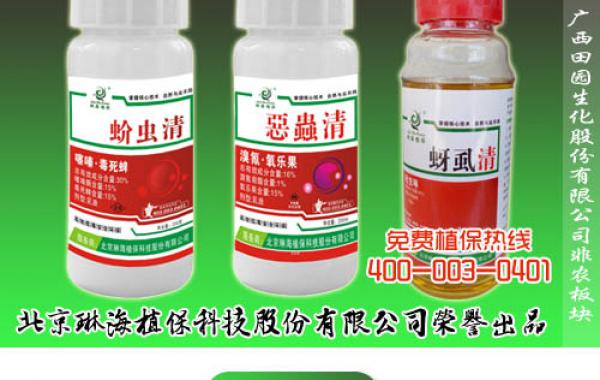
Beijing Linhai Plant Protection Technology Co., Ltd. is the first enterprise in China with high-efficiency garden plant protection technology. Its advanced R&D and production capacity have kept the company at the forefront of the industry. The company provides free technical guidance and training externally,
Garden and lawn technical guidance (free): 400-003-0401.