Master the methods of flower-period regulation for bonsai and potted flowers, so blooms open according to people's wishes
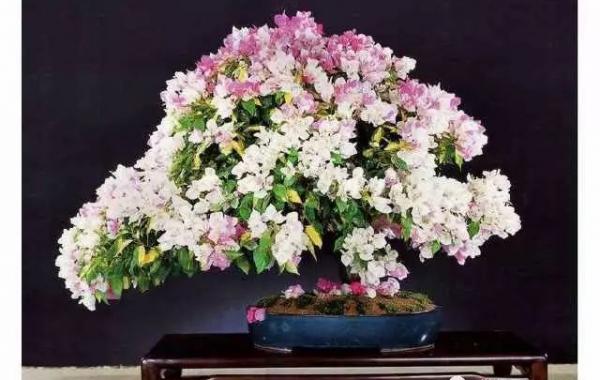
Flowering-period control means taking artificial measures so that flowering bonsai bloom at set times according to people's wishes, outside their natural flowering period. To meet the needs of holiday displays or bonsai appraisal exhibitions, forcing or delaying the flowering period becomes an ideal cultivation technique.
(1) Light regulation In order for bougainvillea to bloom on National Day, flower-bud differentiation can only occur under short-day conditions, so the daily light period should be shortened to less than 10 hours 40-50 days in advance. Of course, bougainvillea bonsai treated this way must have completed vegetative growth, with normal branch length and plump, full axillary and terminal buds. For short-day plants such as small chrysanthemum bonsai, to delay their flowering period, long-day treatment can be applied: artificial supplementary lighting starts in early September and stops on October 10, and they bloom successively from mid-December to supply the New Year's Day market.
(2) Temperature regulation If azaleas and camellias are placed in a greenhouse before winter begins, they can generally bloom earlier. When the room temperature rises to 20-25oC and the relative humidity reaches above 80%, azaleas need 40-50 days to bloom. Before the temperature warms up in early spring, giving spring-flowering azaleas, wisteria and the like that are in dormancy a low-temperature treatment of 1-4oC extends the dormancy period and also extends the flowering period, delaying flowering by more than 7 months.
(3) Growth hormone regulation Treating azaleas and cherry blossoms with 200-4000mg/L gibberellin is effective for breaking dormancy. Dropping 500-1000mg./L onto peony flower buds causes them to begin sprouting in 4-7 days; dropped onto camellia flower buds twice a week, after half a month the flower buds differentiate and grow rapidly, and they can bloom that same year. For small chrysanthemums, treatment with 50mg/L naphthalene acetic acid in mid-August, once every 3 days for a total of 50 days, can delay flowering by 10-14 days.
(4) Regulation through cultivation and management measures Continuous blooming of bonsai can be achieved through pruning. Immediately after rose flowers fade, the flowering branches should be cut back short, which can make them send out new flowering branches and bloom continuously. After crape myrtle blooms in summer, the flowering branches should be cut off immediately so that it does not set fruit, and at the same time fertilizer and water management should be strengthened, so that it can bloom a second time in autumn. If the leaves of flowering almond are removed on September 8-10, the flowering period advances to late September to early October. By artificially controlling water to make the plant shed its leaves and enter dormancy, and then supplying water at an appropriate time, dormancy can be broken, and the plant will sprout, grow and bloom; bonsai such as lilac and plum blossom can be made to bloom on "National Day" by this method.