Fact-check on glufosinate: Council of Agriculture distorts EU regulations, French researcher warns of neurotoxicity
From opening up imports of ractopamine pork to promoting glufosinate as a defoliant for adzuki beans, the government has repeatedly said its decision-making process is in line with international standards. However, in its fact-checking, News&Market found that the Council of Agriculture has misrepresented international regulations and cited literature improperly.
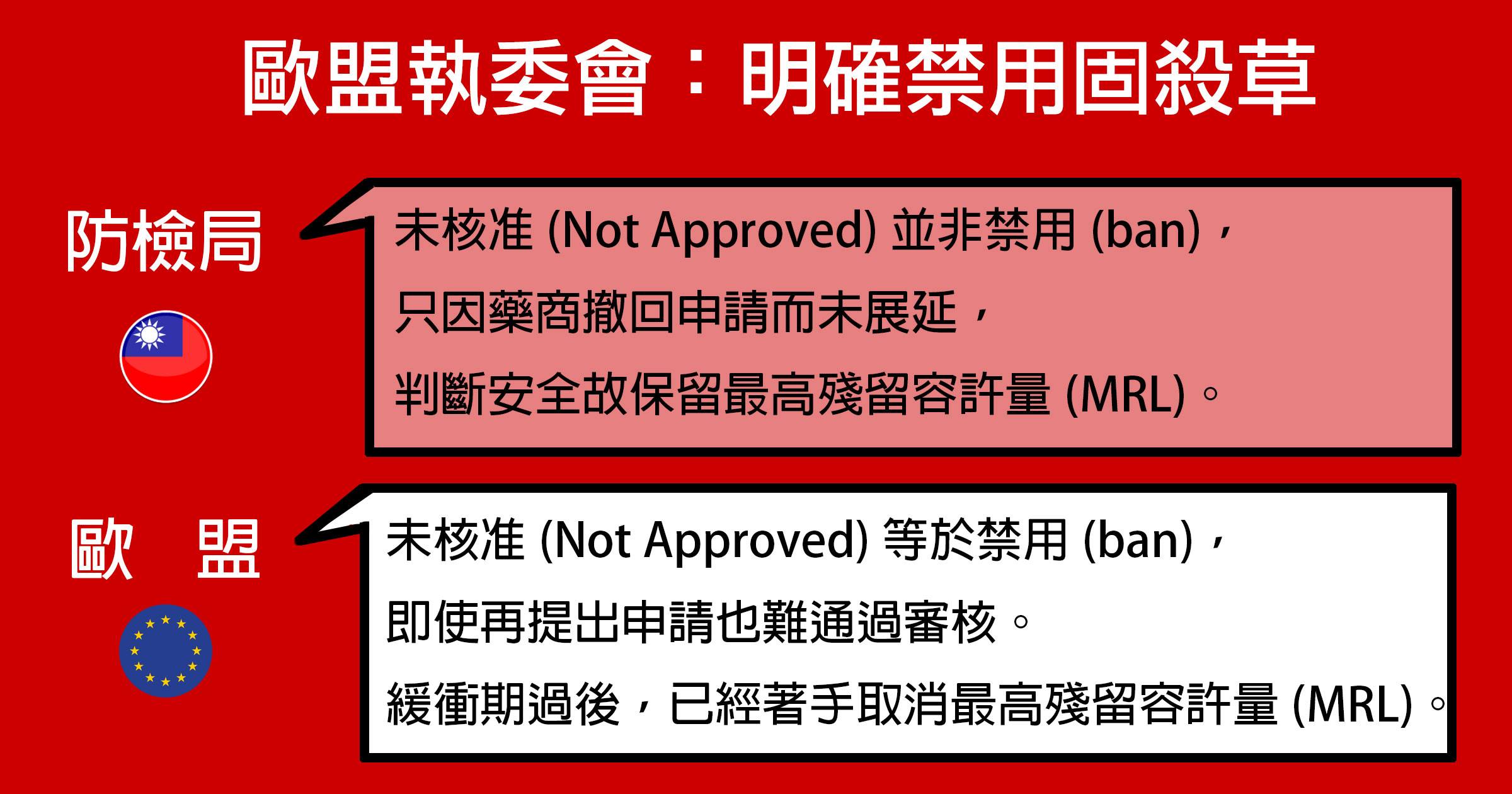
The Council of Agriculture claims the EU has not "banned" glufosinate, only "not approved" it. But this claim was denied by the European Commission, which pointed out that "not approved means banned."
The Council of Agriculture has also repeatedly assured that the risks of glufosinate have been carefully assessed, yet the international materials it cites lean heavily on a single study from 14 years ago funded by a major pesticide company. News&Market's correspondent in Europe specifically examined the European Food Safety Authority (EFSA) pesticide review process and further interviewed French researcher Anthony Laugeray, whose research shows that low doses of glufosinate ingested by mother rats are enough to harm embryos and young offspring.
The Council of Agriculture, which claims glufosinate is safe, says that only when the mother is exposed to high doses does the rate of pre- and post-implantation embryo loss increase. But when News&Market's reporter asked Laugeray about this claim, he warned with concern: this statement is too one-sided and does not fully understand the risks of glufosinate. "The impact of glufosinate on neural development goes far beyond causing embryo death."
EFSA: Cannot rely solely on Good Laboratory Practice; all the latest research must be included
At the "Open Forum" public sentiment ran high against allowing glufosinate to be used in adzuki bean harvest, and many adzuki bean farmers also do not want to return to relying on a questionable herbicide desiccant. Although consumers and producers stand on the same side against glufosinate, the Council of Agriculture continues to go to the countryside for forums and persuasion.
The Council of Agriculture repeatedly emphasizes that using glufosinate as a desiccant for adzuki beans follows international standards and has undergone a careful assessment process. Yet in expert meetings and numerous press conferences, the Council of Agriculture leans heavily on a report funded by the pesticide company Bayer, which was not peer-reviewed and was published as a supplement in 2006, when Bayer was applying to the EU for approval of glufosinate, raising concerns of a conflict of interest.
Taiwan's Council of Agriculture points out that Bayer's research is important because it follows Good Laboratory Practice (GLP). However, overemphasizing studies conducted under Good Laboratory Practice may well omit many reports from universities and research institutions, because they may not be able to afford the expensive GLP certification costs.
The European Food Safety Authority (EFSA), which is responsible for scientific review of pesticides, explained to News&Market's reporter that, taking the EU as an example, studies submitted by an applicant for an active substance must be conducted in accordance with GLP. However, the applicant must also provide all relevant publicly published studies, data and analyses from the past ten years, and this part of the material is not necessarily produced in GLP-certified laboratories.
The European Food Safety Authority also said that during the review process, if any data or information is insufficient, the applicant must submit supplementary materials until EU requirements are met. "Very importantly, all review procedures are transparent, the relevant documents are made public, and the public can participate in them."

Not only reproductive toxicity, but also neurotoxicity: France was the first to ban glufosinate
Even if the Bayer-funded report cited by the Council of Agriculture has its importance, it is already literature from 14 years ago. According to documents obtained by News&Market, when Bayer updated its glufosinate license in France, it submitted new data, but after review, the French Agency for Food, Environmental and Occupational Health & Safety (ANSES) stated in August 2017:
"The health risk of glufosinate to sprayers is too high, and even workers entering the field after application, nearby residents and children are also exposed to the risk. In addition, harm to mammals in the fields cannot be ruled out, and the residue data for crops such as green beans, grapes, potatoes, citrus and cherries are also insufficient." And before the EU ban, it became the first to ban glufosinate.
France's ban shows that, beyond food safety at the dinner table, glufosinate also endangers occupational safety in the fields and the health of people living and moving nearby. Moreover, not only is reproductive toxicity concerning, but there is also neurotoxicity, and vulnerable fetuses and children bear the brunt.
Is there a problem with the French study? Researcher responds: the careful experimental design is closer to the human exposure pattern
A previous News&Market report cited research by French scholar Laugeray and others showing that pregnant mother rats ingesting low doses of glufosinate during pregnancy and lactation is enough to harm embryos and young offspring. But the Council of Agriculture denies these risk issues, first claiming the experiment poured the agent into the animals' mouths and noses, and later saying "glufosinate was directly dripped onto the animals' mouths and noses, which is greatly different from human behavioral patterns."
However, Taiwan's Council of Agriculture actually misunderstood the ingenuity of the experimental design. Laugeray carefully explained to News&Market that, in order to explore the effects of airborne exposure to glufosinate and simulate the consequences of nasal inhalation, about 6 to 13 µL of the agent in total was dripped into each mouse's nasal cavity in three to five sessions, averaging only 3 to 5 µL each time.
To avoid breathing difficulty affecting the quality of the experiment, it was dripped into only one nostril, and three times a week, not every day. He said: "The purpose of the experimental design was to minimize stress on the mice."
Laugeray admits that animal experimental design is hard to make perfect, but if one followed Taiwan's Council of Agriculture's speculation and mimicked human behavioral patterns by spraying glufosinate into the air for mice to inhale, there would instead be bias. "This design seems most like human behavior, but it ignores the fact that mice lick their own and their companions' fur, resulting in overexposure and imprecise data." Laugeray said humorously, "After all, we humans don't have the habit of licking our skin."
Laugeray's experimental results carry an extremely serious warning. He said: "When the embryo is still at an early stage, even if the mother's chronic inhalation dose is very low, it is enough to cause neural developmental defects in the embryo." However, many people underestimate the impact of Developmental NeuroToxicity (DNT), because not only can the active ingredient of glufosinate cause problems, but the glufosinate degradation product PPO remaining in the environment can also affect the process of neurogenesis, and the multiple toxic substance residues in modern life also have a cocktail effect.

Council of Agriculture downplays glufosinate risks, gives one-sided explanation of toxicity mechanism
However, the Council of Agriculture, which claims glufosinate is safe, says that only when the mother is exposed to high doses does the rate of pre- and post-implantation embryo loss increase, and points out that the toxicity mechanism of glufosinate is inhibiting the activity of glutamine synthetase. Because glutamate is extremely important for embryo survival, and the embryo's main nutrition comes from maternal amino acids, when it is significantly reduced, embryo mortality increases.
Hearing this interpretation of glufosinate risks by the Council of Agriculture, Laugeray said, "This is quite concerning. Although the statement is not wrong, it is one-sided and does not fully understand the risks of glufosinate. The impact of glufosinate on neural development goes far beyond causing embryo death."
He said the effects of developmental neurotoxicity are very subtle and may affect one or more biological mechanisms, such as glutamate homeostasis, which after long-term exposure may trigger nervous system diseases. More importantly, when there is no effect on the adult brain, one cannot infer from this that there is no effect on children. The scientific literature has already clearly pointed out that the still-developing brain is far more sensitive and vulnerable than the already mature brain, let alone the developing embryo.
Consumers and producers alike oppose glufosinate as a desiccant for adzuki beans, and everyone has a lingering question mark in their hearts about for whom and why it is being opened up. The Council of Agriculture repeatedly soothes the public, assuring that the review process is rigorous and aligned with international standards. But News&Market's fact-checking found that the Council of Agriculture distorts the meaning of the EU ban, exaggerates the importance of Good Laboratory Practice, and downplays the risks of glufosinate. The more it explains, the more question marks everyone has.
Series reading: "Herbicide glufosinate as adzuki bean defoliant" series reports
