What varieties of potted flowers are suitable for indoor growing in winter and spring
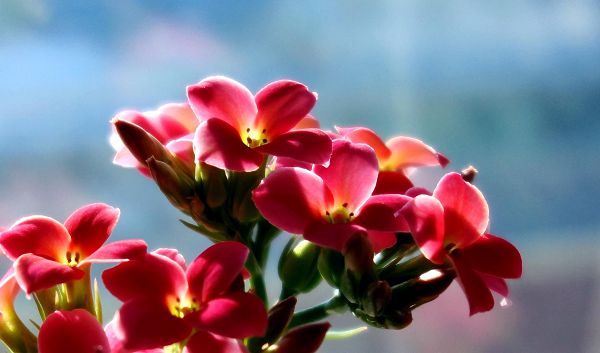
Kalanchoe blossfeldiana, because its flowering period is close to Christmas and the flowering period is long, has become a "holiday flower" people use to set off the festive atmosphere. This flower has high ornamental value; even when it is not blooming, its leaves can be appreciated, making it a very ideal indoor potted flower. The plant is small and delicate, with a compact form, emerald green leaves and dense flowers. It is an ideal indoor potted flower for winter and spring.
Its flowering period coincides with Christmas, New Year's Day and the Spring Festival, making it very suitable for decorating windowsills, desks and table tops. Used for flower beds, display windows and halls in public places, its overall ornamental effect is excellent. Because its common name is "longevity," giving a pot of Kalanchoe blossfeldiana to relatives and friends during festivals is also very appropriate, auspicious and promising a long life, and it is very likable.
Below, let us explain the propagation methods and cultivation techniques of Kalanchoe blossfeldiana.
Propagation methods
Cuttings
It works best when done in May-June or September-October. Choose slightly mature fleshy stems, cut 5-6 cm long, insert them into a sand bed, water them and cover with plastic film, keep the room temperature at 15-20°C; after insertion they root in 15-18 days and can be potted in 30 days. A 10 cm pot is commonly used. If there are not many seedlings, leaf cuttings can be used. Cut healthy, plump leaves from the petiole, wait until the cut surface is slightly dry, then insert them obliquely or lay them flat on the sand bed, maintain humidity, and after about 10-15 days they can root from the leaf base and grow new plants.[2]
Tissue culture
In the United States and France, from the late 1970s, the stem tips, leaves, stems, flower buds and flowers of Kalanchoe blossfeldiana were used as explants, with MS medium plus 2 mg/L kinetin and 0.1 mg/L naphthaleneacetic acid to induce adventitious buds. Then 1/2 MS medium plus 1 mg/L indolebutyric acid was used to induce rooting. At room temperature of 25-27°C and 16 hours of light, small plantlets can grow in 4-6 weeks.[2]
Cultivation techniques
After potting, it grows more vigorously in a slightly humid environment, and pale red aerial roots continuously grow from the internodes. If it is too dry or the temperature is on the low side, growth slows, the leaves turn red, and the flowering period is delayed. In midsummer, watering should be controlled and ventilation should be noted; if it is hot and humid, the leaves are prone to rot and fall off. During the growing period, fertilize once every half month, or use "Huizhi" 15-15-30 special fertilizer for potted flowers. In order to control plant height, pinch the tips 1-2 times to encourage more branching and more flowering. After Kalanchoe blossfeldiana is planted, spray once with 0.2% daminozide 2 weeks later, and spray once more when the plant height is 12 cm. This can effectively control plant height and achieve the effect of a beautiful plant, green leaves and many flowers. During the process of flower bud formation in autumn, 1-2 additional applications of phosphorus and potassium fertilizer can be made.
At the same time, during the cultivation of Kalanchoe blossfeldiana, short-day treatment can be used to regulate the flowering period, achieving the goal of supplying potted flowers throughout the year.