How do you manage greenhouse flowers? Common planting problems and countermeasures
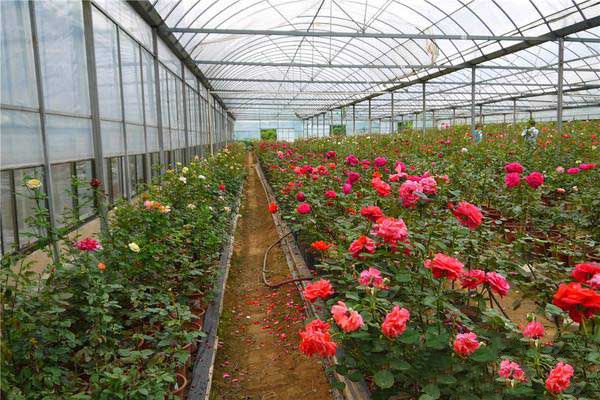
At present, greenhouse flower planting has already become a good industry. Some people manage it well and plant hundreds of mu or even thousands of mu. Others plant very little. It mainly still depends on your business approach and management methods. Next, let us take a look at the common problems and countermeasures in greenhouse flower planting.
I. Analysis of common problems in flower planting
1.1 Water
The growth of flowers mainly depends on soil moisture, and a large amount of water is consumed through transpiration. During the flower growth period, if the water absorbed is greater than the water consumed, problems will occur in plant growth, and drought resistance will gradually decrease, while flower buds will be stimulated and drop prematurely. In severe cases, root rot may even occur due to excessive water. When the water absorbed by flowers is less than the water consumed, dehydration is likely to occur, and normal growth and development cannot be ensured.
1.2 Temperature
During the flower growth period, flowers have a certain heat tolerance. If the temperature is too high and the heat exceeds the physiological tolerance range of the flowers, the growth of the flowers will be seriously threatened. If the temperature is too low, the growth efficiency of the flowers will decrease.
1.3 Nutrient elements
If nutrient elements are insufficient during flower development, the growth rate of the plants will slow down, and it will be difficult to improve resistance to pests and diseases. Usually, during flower planting, a targeted fertilizer application plan must be formulated according to actual nutritional needs to promote vigorous growth of the plants. If fertilization cannot be carried out reasonably, the overall development of the plants will be affected. First, if sufficient nitrogen fertilizer cannot be applied, the plants will wither, the stems and leaves will split, and the number of flowers will be small. Second, if sufficient phosphorus fertilizer cannot be applied, the plants will appear dark green, and the growth rate will slow down, the leaf veins in the lower part of the plants will begin to turn yellow, showing typical symptoms of nutritional deficiency. Third, if potassium fertilizer cannot be applied reasonably, disease spots will appear on the leaves of the plants, and the leaf tips will begin to wither and turn yellow, with the dead areas gradually expanding. Fourth, in the case of magnesium deficiency, the lower part of the plants will turn yellow, and under the influence of dead spots, the growth efficiency of the flowers will decrease. Fifth, in the case of calcium deficiency, the young leaves of the plants will become deformed.
1.4 Analysis of fertilization problems
Fertilizer during the flower growth period is the main element ensuring normal plant growth, but at present some flower growers cannot use fertilizer reasonably according to soil conditions during flower planting, and cannot adopt scientific fertilizer supplementation methods to solve problems, which to a certain extent causes flower growth to be seriously affected. At the same time, flower growers cannot choose fertilizers according to the growth characteristics and needs of the flowers, and in the actual planting process, serious problems often occur under the influence of various factors. In addition, during the flower planting process, topdressing work cannot be carried out reasonably according to the growth characteristics and needs of the plants, making it difficult to create a diversified management mechanism and unable to meet the current flower growth needs.
II. Analysis of countermeasures for flower planting problems
2.1 Scientifically control water temperature
In flower planting work, it is necessary to clarify the characteristics and requirements of nutrient absorption by the plants, use reasonable methods to maintain stable water absorption, and after understanding the characteristics of water, comprehensively grasp and analyze the types of flowers. First, drought-tolerant flowers can continue to survive in dry soil, for example: roses. Water must be strictly controlled, and the frequency of watering should be controlled at about 5 times per year, with management carried out according to specific growth characteristics to avoid affecting good flower growth. Second, semi-drought-tolerant flowers have weaker drought resistance than drought-tolerant flowers, and water should be strictly controlled according to the growth characteristics of the flowers to avoid affecting normal flower growth. Third, neutral flowers can be irrigated according to soil moisture requirements, but cannot grow in fully wet soil, to avoid affecting good survival of the flowers. Finally, moisture-tolerant flowers require the soil to remain moist to avoid affecting good flower growth. Usually, the water temperature should be controlled at about 5°C. When watering, it is best that the difference between soil temperature and water temperature does not exceed 5°C, and the moisture content should be about 70%, to avoid freezing damage.
2.2 Strictly control temperature
During the flower growth period, environmental temperature must be strictly managed and controlled, the temperature requirements of different flowers must be clarified, and management work must be carried out using reasonable methods. For flowers with strong heat tolerance, it is necessary to clarify the environmental temperature control requirements and, in combination with local climate characteristics, formulate a complete management plan. During this period, management should also be carried out according to flowers with lower heat tolerance, problems in temperature control should be discovered in a timely manner, reasonable measures should be taken to solve the problems, management content and measures should be innovated, and the level of flower temperature control should be gradually improved. During this period, cooling methods should also be combined to solve problems. If the temperature is too high, ventilation should be carried out in a timely manner, and water can also be sprayed on the leaf surface to achieve the good purpose of cooling. In temperature management work, the principle of 15-26°C during the day and 12-16°C at night should be followed.
2.3 Fertilizer control measures
The application of flower fertilizer must follow diversified management principles, clarify the content and requirements of fertilizer application, use reasonable methods to solve problems, and innovate forms of management work. First, fertilizer should be applied in every growth season of the flowers. Especially in spring and winter, which are peak periods of flower growth, the amount of fertilizer must be reasonably controlled. Second, the principles of appropriateness and proper amount must be followed to ensure the scientific and reasonable application of fertilizer and promote good flower growth. The fertilization ratio is N:P:K=1:1:2 or 1:1:3.
2.4 Pest and disease control
During the growth process, roses are very prone to powdery mildew, downy mildew, and red spider mites. Powdery mildew can be treated by spraying with 41% carbendazim sulfur suspension concentrate at 500 times dilution; downy mildew can be prevented and controlled by spraying with DuPont Curzate at 500 times dilution, Previcur at 700 times dilution, and Anchor manganese zinc at 700 times dilution; red spider mites can be controlled with 3000 times dilution of insect mite light.
2.5 Measures for dealing with freezing damage
In the actual cultivation process, pay attention to weather changes at all times, and make corresponding response measures according to the weather forecast, such as adding plastic film inside the greenhouse or using heating stoves to raise the temperature or smoking to prevent frost, so as to reduce the occurrence of freezing damage. After freezing damage occurs, in combination with the current actual work situation, flowers that suffered more serious freezing damage should be handled, so as to improve flower quality.
2.6 Reasonably plan the flowering period
Usually, strict calculation and planning must be carried out for the flowering periods of different varieties, and water and fertilizer must be controlled to ensure that there is no shortage of stock during peak sales seasons or holidays. During this period, pruning and branch pressing at intervals can be used to strictly manage the flowering period and improve the economic benefits of the flowers.
In the process of flower planting, temperature and moisture must be strictly managed and controlled, and the relationship among fertilizers must be coordinated, while nutrient elements must be added well. In the process of using fertilizer, the principles of timely application and proper amount must be followed to ensure appropriate fertilizer addition, thereby improving the effect of nutritional management and maintaining normal flower growth.