The opening of US pork imports cannot be reversed. What should we do?
For a long time, every time there has been a food safety incident, from blended oils, formula milk powder, toxic agricultural products, to agricultural imports legalized for political reasons, such as US beef imported from mad cow disease epidemic areas, US beef containing leanness-enhancing drugs, and today's US pork containing leanness-enhancing drugs, each time we see farmers hit hard, ordinary consumers panicking, the opposition party angry, and the ruling party helpless... but after each issue passes, what is the result? List of food safety incidents in Taiwan, China
This time I am not just talking, I am proposing a thorough solution, which is that every food item must be traceable, and the method that can be implemented immediately is to use the [Youxin Traceability Platform (https://www.taft.com.tw/taft/)]. I will explain in detail later the benefits, convenience and fairness of using the traceability platform. First, let me explain why this should be done and what the current situation is.
Many people will say, the government has already done it! How is this different from the Youxin Traceability Platform? Let me explain to everyone several traceability platforms currently used by the government. Everyone can find these platforms from the Ministry of Health and Welfare's [Food Information System Portal]
The Ministry of Health and Welfare's Non-Trace-Able:
Official description:
- Since 2014, the Food and Drug Administration of the Ministry of Health and Welfare has implemented the "Non-Trace-Able" traceability system, requiring food businesses to declare the sources of "raw materials, semi-finished products and finished products," and to keep transaction documents for 5 years for inspection.
Plain-language explanation of the problems:
- Not transparent or public: based oncommercial secretsandnational secretsthese two levels of secrecy, all of this system's traceability data, fromraw material productionorimport, raw materials fromlarge, medium and small distributorstoprocessing plantsin theprocess, the production of final productsand so on, can only be seen by "specific government personnel,"
- When a problem occurs: "specific government personnel" quickly go onto the platform to trace and handle it, and promptly notify the manufacturer to handle it in time, minimizing the impact of the food safety problem, in order to protect the rights and interests of manufacturers and consumers, and then carry out news broadcasts to show the government's determination to crack down on food safety issues.
- Only the label information attached to food is public and transparent:
 Consumer inquiry
 Taking edible oil and fat products as an example
Please click into any oil product at random and see what it presents: product name, packaging specifications, product category, company name, product traceability system connection code (only specific government personnel can see it, ordinary people cannot), place of origin (here it usually says Taiwan, China, but the raw materials may be imported), warnings, features, packaging labeling (usually nutrition labeling is placed here), content labeling, inspection reports.
- These are all just product introduction pages: this information is all information that can already be seen on the label when buying this bottle of oil. Why publicly announce (advertise) it for them again? And thetraceability dataon raw material production or import, the process of raw materials going from large, medium and small distributors to processing plants, and the production of final products, is completely invisible. How can this be seen as having anything to do with traceability?
The Ministry of Education's Campus Food Ingredient Registration Platform:
Official description:
- In order to maintain campus food safety, the Ministry of Education, in coordination with the Executive Yuan's Food Cloud project, promotes ingredient traceability and tracking at schools at all levels, and has established the Campus Food Ingredient Registration Platform to provide transparent school meal information.
Plain-language explanation of the problems:
- Not transparent or public: based oncommercial secretsandnational secretsthese two levels of secrecy, this system can only let you know who the final product was bought from. Allproductionorimport、of raw materials, raw materials from large, medium and small distributorstogroup meal factoriesin theprocess traceability datasimply cannot be seen by anyone from this system alone, and to match it with Non-Trace-Able, only "specific government personnel" can see it.
- When a problem occurs: you can only immediately find the final supplier. If the problem is not with this supplier, then follow the Non-Trace-Able model, with "specific government personnel" quickly going onto the platform to trace and handle it, and promptly notify the manufacturer to handle it in time, minimizing the impact of the food safety problem, in order to protect the rights and interests of manufacturers and consumers, and then carry out news broadcasts to show the government's determination to crack down on food safety issues.
- Only the final supplier's information is public and transparent:

- [Inquiry] is the school information presented when entering the website at the moment
- [Advanced Inquiry] can inquire about any school that has registered in the system
Taking the current school inquiry as an example, 2020-09-01 Taipei City Shilin District Sanyu Elementary School


Taking our curry pork as an example, then clicking to the FDA to the right of the diced meat, what we see is this pork's supplier, but we cannot see whether this pork is imported or domestic? Even lesscan we seethispork's rearing information、slaughter date、distribution process manufacturersand theweightdelivered to this school, and other confidential information.
- Our children's nutrition lunch information should be more transparent: if Non-Trace-Able information is a national secret, then nutrition lunch is a meal subsidized by the state, why should there be any secrecy? If we treat our own children this way, then when they grow up in the future, why should they pay taxes to support us old people?
The Council of Agriculture's Taiwan Agricultural Product Production Traceability System
Official description:
- Encourage agricultural product producers and operators to proactively disclose production information and conduct comprehensive independent quality management, to enhance consumers' trust in the agricultural products they purchase.
Plain-language explanation of the problems:
- Only the source is public and transparent: this system can only let you know who produced the agricultural product, but after it is sold to the wholesale market, thelarge, medium and small distributorstorestaurantsorprocessing plantsin theprocess traceabilitydatasimply cannot be seen by anyonefrom this system alone, and much of it cannot even be seen through Non-Trace-Able, because the circulation of agricultural products sometimes does not need to go onto Non-Trace-Able at all. In addition, after agricultural products reach the wholesale market, wholesalers may gather different source farms of the same agricultural product at once, such as cabbage.
- When a problem occurs: you can only find the sticker from the basket holding the agricultural product, but if someone mixes goods in the process, then the farmer is just a scapegoat.
- You can only say source traceability, not process traceability: you only see the farmer of this agricultural product (but is it really this farmer?),you cannot see the distribution process manufacturers, andthe weightdelivered to each restaurantorprocessing plant, and other confidential information. How can this be seen ashaving anything to do with traceability? Moreover, some manufacturers may do this,buy 1 kg and take source information, and mix the other 999 kg with imports, because the system does not present weight.


Scanning the QRCODE on agricultural product packaging, or clicking into farmer information online, you can only see: name, contact phone, EMAIL, region, agricultural product name,the agricultural product distribution process is completely invisible。
The Council of Agriculture's Traceable Agricultural Products Information Network
Official description:
- Traceable agricultural products are a voluntary agricultural product verification system. Only products that pass verification may claim to be "traceable agricultural products," and relevant rights and interests are protected by law. To understand traceable agricultural products, you can understand them from three directions at the institutional level: "publicly available and traceable information," "Taiwan Good Agricultural Practice (TGAP)," and "third-party verification system."
Plain-language explanation of the problems:
- The rearing and cultivation process is fully public and transparent: this system is currently the government's system for verified processes, including from production, processing or slaughter, presenting the whole process transparently.

By scanning the traceable agricultural product QRCODE on agricultural product packaging, taking Taichuan Zhen Pork as an example, or entering the traceability number online, you can see the product name, agricultural product operator, abbreviation, producer name, place of origin, packaging date, verification body, as well as the livestock farm name, livestock owner, registration certificate number, contract veterinarian, address, and also that batch of pork's production records, processing information, etc.
- Currently verification is limited only to farmers and units with factory registration:If it is a wholesaler, distributor, or restaurant, because there are no verification regulations, it cannot be traced, and if the chain is broken in the middle, it is futile even if the final processing plant can be verified.
- Information on distribution processes without verification is not transparent or public: apart from the last verified farmer or manufacturer, if this goods passes through large, medium and small distributors, information such as weight and batch number is all non-transparent.
The above are several current government traceability platforms, but none can avoid the problems of goods being mixed in the process and US pork being legally presented as originating from Taiwan, China. I think the urgent task is to solve the problem of non-transparent sources and processes in the Ministry of Education's Campus Food Ingredient Registration Platform. No matter how hard things are, we must not make our children suffer!
So I propose a solution
The Youxin Traceability Platform guided by the Council of Agriculture (hereinafter referred to as the Traceability Platform)
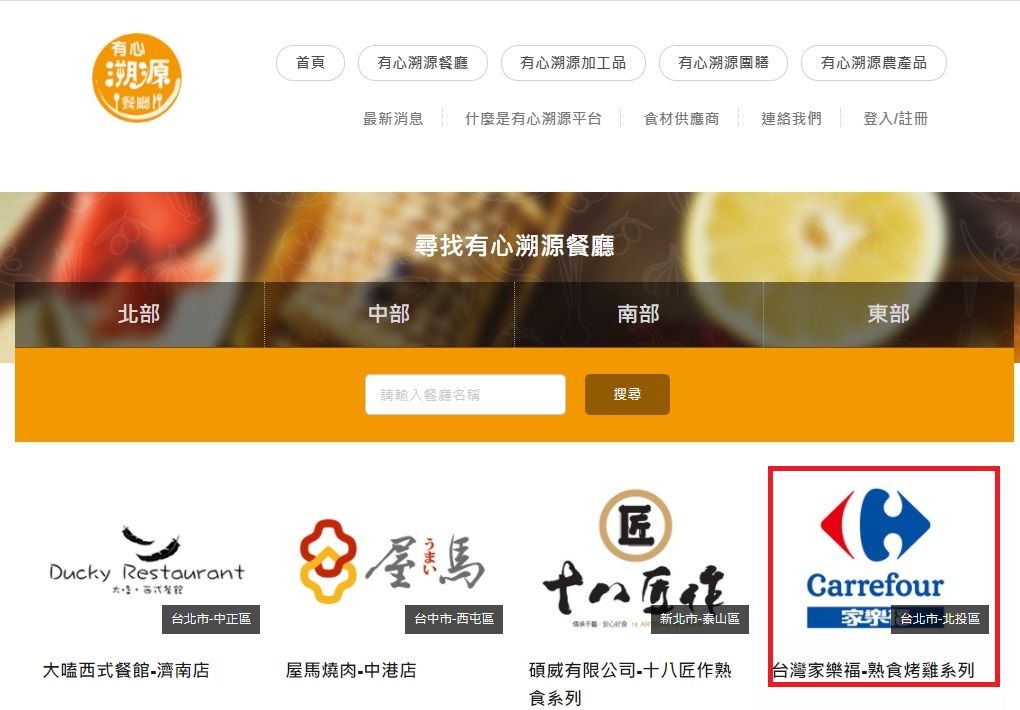
Youxin Traceability Restaurant Platform (the entire process from production area to dining table is public and transparent):
- Traceable agricultural products: we connect to the Council of Agriculture's traceable agricultural products website. That website presents related information such as farmers, cultivation or rearing processes, processing manufacturers, and processing processes. After reaching the Traceability Platform, we presenteach distribution process'smanufacturer, product, batch number, date, weightand other information, so that each one can be truly presented.
- Domestic agricultural products: agricultural products from farmers, processing, each distribution stage, to the final restaurant, all must enter into the Traceability Platformdistributed domestic agricultural products, batch number, date, weightand other information, so that each process can be truly presented.
- Imported agricultural products: agricultural product importers enter the Traceability Platform,enter the importing country, agricultural product name, batch number, date, weightand other information, and for the subsequent distribution process to restaurants, each manufacturer also needs to enter the platform and input it.
- Avoid the situation of buying one kilogram of domestic product while using imported ones for the rest.