Parents worry about ractopamine-fed US pork entering schools; Ministry of Education: legislative amendment needed for enforcement
Since President Tsai Ing-wen announced the opening of imports of pork containing ractopamine (hereafter "ractopamine pork") starting next New Year's Day, doubts have arisen across all sectors. Parents worry that cheap ractopamine pork will be widely adopted by school catering contractors, affecting schoolchildren's health. The Ministry of Education recently issued a press release stating that school catering shall uniformly use domestic pork, but current regulations can only recommend "priority use." Whether ractopamine pork will enter campuses in the future remains unknown.
Catering contractors and dietitians believe that the probability of schoolchildren directly consuming ractopamine pork in the future is not high, but the long-term impact of ractopamine pork on school catering is worth observing and attention.

Unless the law is amended, the Ministry of Education has no authority to require school group meals to "must" use domestic pork
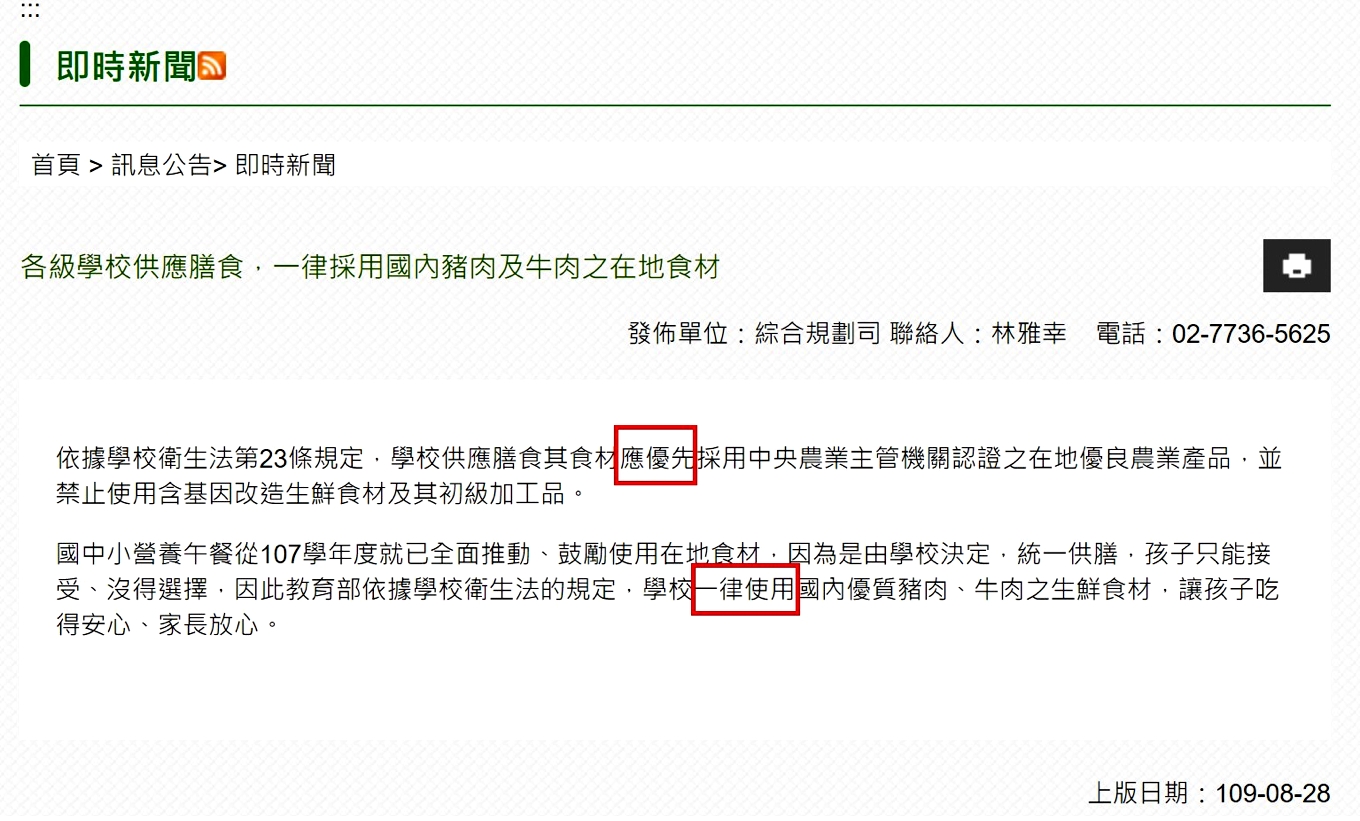
After the policy announcement on the import of ractopamine pork, the Ministry of Education published on the same day (8.28) in the immediate news section of its official website: According to Article 23 of the "School Health Act," "schools supplying meals shall give priority to using locally produced premium agricultural products certified by the central agricultural competent authority, and shall prohibit the use of genetically modified fresh ingredients and their primary processed products." To reassure parents nationwide that ractopamine pork will not become the meat on the chopping block of school group meals, or the food in children's mouths.
However, while the regulation clearly uses suggestive wording "shall give priority to using," the Ministry of Education's press release states "uniformly use" domestic premium pork. What exactly is the Ministry of Education's stance? In fact, the government currently cannot mandatorily regulate the ingredients used in campus group meals. Lin Ya-hsing, Section Chief of the Comprehensive Planning Division of the Ministry of Education, stated: "Unless legislative amendments are passed that explicitly stipulate 'only domestic products may be used' and establish penalties, Article 23 of the 'School Health Act' currently has no mandatory force."
Processed foods do not fall under "fresh ingredients" and are not even within the scope of control
Furthermore, the so-called "fresh ingredients" also leave enormous room for interpretation. Lin Ya-hsing said that the "fresh ingredients" mentioned in the "School Health Act" are defined according to the "Food Labeling Regulations" of the Food and Drug Administration under the Ministry of Health and Welfare: "those that have not undergone processing procedures such as combining, adhering, or pressing into shapes, and have only had fascia removed, been trimmed, cut, or prepared." In other words, lion's head meatballs, pickled melon pork, pad krapow pork, ants climbing a tree, and other familiar faces on school group meal menus are not "fresh ingredients," let alone other common side dishes such as pork thick soup, Fuzhou meatballs, and other frozen processed pork products, as well as foods named "fish balls," "fish dumplings," and the like that appear to be seafood products but actually also contain pork components.
Since it is difficult for children's meals to include whole cuts of pork, ground meat, meat paste, and reconstituted meat are already fragmented -- the details where the devil can best hide -- yet none of these fall under "fresh ingredients" and are not within the scope of control.
Parents anxious: "Why can't ractopamine pork simply be banned on campus?"
Regarding the Ministry of Education's regulations, a parent surnamed Yang in Taipei City said that her child's school lunch is not something she can directly control. She had always trusted the parent committee members' oversight of group meal companies. Today she was shocked to realize that the government had never required a ban on imported pork, which makes her extremely anxious about the situation after ractopamine pork imports begin. "I just have no way to prepare a lunchbox, which is why I let my child participate in the school's nutritional lunch. Can't the government let me have peace of mind?" she said.
"I thought that as long as I didn't buy imported pork myself, there would be no problem. So my child could still possibly eat imported pork at school?" said parent Mr. Kao. "The government keeps saying it wants to take care of the next generation. Is 'children are the pillars of the nation's future' just a slogan? Why can't ractopamine pork simply be banned on campus?"
Government prepares in advance for "origin labeling"; in the future parents can go online to learn the source of ingredients
In response to parents' appeals, Lin Ya-hsing clarified: "Of course we do not want schools to use ractopamine pork, and we have already sent letters requiring everyone to give priority to local ingredients. The 'priority use' regulation has been in place since 2015, and over these years a certain proportion of domestic products has gradually been achieved. In the future, of course, it can be further strengthened through inter-ministerial cooperation. We hope the Council of Agriculture will provide more local ingredient cooperation, and the Ministry of Health and Welfare will conduct more sampling inspections."
When further pressed on the Ministry of Education's stance on using ractopamine pork, Section Chief Lin stated: "The Ministry of Education sent letters to schools at all levels precisely in the hope that everyone will use domestic agricultural products. Children at school can only passively accept the meals provided, unlike adults outside who can make choices based on labeling. This is also the reason for requiring schools to use domestic pork." However, traceability testing and penalties for violations are not within the Ministry of Education's authority. Lin Ya-hsing said: "We hope the regulations of the Council of Agriculture and the Ministry of Health and Welfare will be completed as soon as possible, so that schools can truly purchase domestic agricultural products in accordance with the rules."
In addition, Chiu Chiu-chan, a specialist of the K-12 Education Administration of the Ministry of Education, mentioned that the government has commissioned the vendor of the "Ingredient Login Platform" to add a "raw material origin" field. "In the future, even parents can log into this platform to learn which country the raw materials of the meatballs their precious child ate for lunch today came from." At the same time, the Ministry of Education will cooperate with the Council of Agriculture to successively hold educational training for lunch ingredient acceptance personnel, so that they understand how to verify the accuracy of "pork origin" in accordance with regulations.
Testing requires manpower and funding. Is the government ready?
However, testing requires manpower and funding. How exactly are local governments to cooperate with the regulations? This has consistently been the missing part in all the various explanations the government has released. In order to understand the existing testing capacity, "Upstream and Downstream" analyzed the Taichung City Government's testing reports on schoolchildren's lunches in the first half of this year (February to July). A total of 144 "ingredient" tests were conducted for elementary and junior high school lunches. Taichung City has 307 junior high and elementary schools in total. Is this ratio sufficient?
In addition, after New Year's Day next year, testing for whether ractopamine exceeds standards should logically be added. The testing prices the reporter currently inquired about range from 2,500 yuan to 5,000 yuan. Does the city government have sufficient funding and manpower? Are all the supporting measures ready? So far, no locality has proposed a specific administrative plan that could convince parents of the government's gatekeeping ability.
Group meal operators: All follow government regulations; schoolchildren's lunches are unlikely to contain ractopamine pork
But after ractopamine pork is opened up, will it really enter campuses as parents fear? In order to understand the risk of schoolchildren eating ractopamine pork, "Upstream and Downstream" actually interviewed group meal operators. Peng Kuang-hsien, division chief of a Taichung group meal company, said: "Fresh meat products have always used CAS certification in accordance with regulations. Whether or not imported ractopamine pork is allowed cannot change our options." When further asked about the selection of processed foods, Peng Kuang-hsien said: "We also try to choose dumplings, meat buns, and the like with CAS certification." However, he also admitted that there are not many processed foods with CAS certification, and the government has not stipulated that processed foods in group meals must meet CAS certification.
Peng Kuang-hsien pointed out that from the perspective of the industry chain, group meal operators play only an "assembly and processing" role, merely blending and cooking purchased ingredients into food, and do not themselves produce or manufacture any processed foods. Meatballs, lion's head meatballs, and pork thick soup are all supplied by upstream manufacturers. If we want to ensure that schoolchildren stay away from ractopamine pork, the government needs to gatekeep raw material manufacturers.
In addition, Liu Hsiao-ching, a dietitian at a group meal company, also mentioned that school group meals are already promoting the Four Labels and 1Q. In addition to fresh meat products needing CAS certification, processed foods may appear only twice a week, but those two times may be soy products, surimi products, or root vegetable products. The chance of schoolchildren actually eating processed pork products is actually less than 10 percent. Moreover, some schools even request that no processed foods be provided to children at all.
Liu Hsiao-ching stated that group meals have contractual regulations, and operators must log into the ingredient login platform every day. She made it clear: "Compared with ordinary vendors who mostly rely on self-discipline, schools are actually more easily managed by the government. Parents do not need to worry excessively."
Chairman of the boxed meal food union: About 80 percent of commercially available processed pork foods use Taiwanese meat
Chen Ming-hsin, founding chairman of the National Federation of the Republic of China Boxed Meal Food Commercial Associations, observed, "There will be no problem with the supply of fresh pork from Taiwan's domestic products." He said this because of concerns about the source of processed raw materials. The association recently took stock of suppliers nationwide and found that the outer boxes of processed food packaging only indicated "pork." Chen Ming-hsin therefore demanded that manufacturers revise the origin labeling on packaging, and at the same time provide goods sources, slaughter certificates, and other documents as a written guarantee. Chen Ming-hsin stated that currently only 20 percent of manufacturers are unwilling to provide such guarantees. He inferred that among Taiwan's current processed pork foods, about 80 percent still use Taiwanese meat.
As for the 20 percent of suppliers "suspected" of using imported meat, will their products be dumped into counties and cities with lower nutritional lunch budgets? Chen Ming-hsin was unwilling to speculate. Because this semester's group meal contracts have already been awarded and are being executed, he believes no manufacturer would be willing at this time to "go against public opinion" and boldly use imported pork. "What I worry about most is whether, after this observation period and transition period, schools and parents will continue to care?" After all, the government does not require food to be labeled as containing or not containing ractopamine. As long as American pork is used, there will be a risk of ractopamine.
In addition, Chen Ming-hsin also worries that starting New Year's Day next year, because consumers avoid American pork, Taiwanese pork prices may rise. "The price of school group meals is limited and cannot withstand too much fluctuation in pork prices. If operators cannot afford Taiwanese fresh pork, or will avoid using pork, or will use more processed products, this will absolutely have an impact on Taiwan's livestock industry."