Zone Expropriation Destroys Homes 03"Academics: The evil expropriation law should have been abolished long ago; Hsu Shih-jung: The DPP's stance before and after elections differs so greatly that its "love for Taiwan" is all fake
(Continued from previous article) Seven years ago, on August 18, in order to seek justice for residents forcibly evicted in Dapu, Miaoli, petitioners occupied the Ministry of the Interior office building and planted vegetables on the ministry's lawn, hoping to remind civil servants of the precious value of land. Seven years later, environmental groups, academics and experts, and self-rescue associations from five major zone expropriation cases gathered once again to hold a press conference, bitterly denouncing the persecution caused by zone expropriation.
Environmental groups and self-rescue associations called on the government to suspend disputed cases, restart amendments to the Land Expropriation Act, and put forward three major demands: abolish zone expropriation, clearly define the methods for assessing public interest and necessity as well as review standards, and hold comprehensive hearings for all land expropriation cases - three major directions for amending the Land Expropriation Act.
Hsu Shih-jung, professor in the Department of Land Economics at National Chengchi University, Dai Hsiu-hsiung, assistant professor in the Department of Land Economics at National Chengchi University, and Kang Min-jie, associate professor in the Graduate Institute of Building and Planning at National Taiwan University, examined the unconstitutional and controversial aspects of zone expropriation and condemned the oppression inflicted on residents by both the central and local governments. Hsu Shih-jung said: "When in opposition, the DPP kept saying that zone expropriation was an evil law, but after coming to power it warmly embraced zone expropriation and became even more brutal than when the Kuomintang was in power. Such a government should step down!"
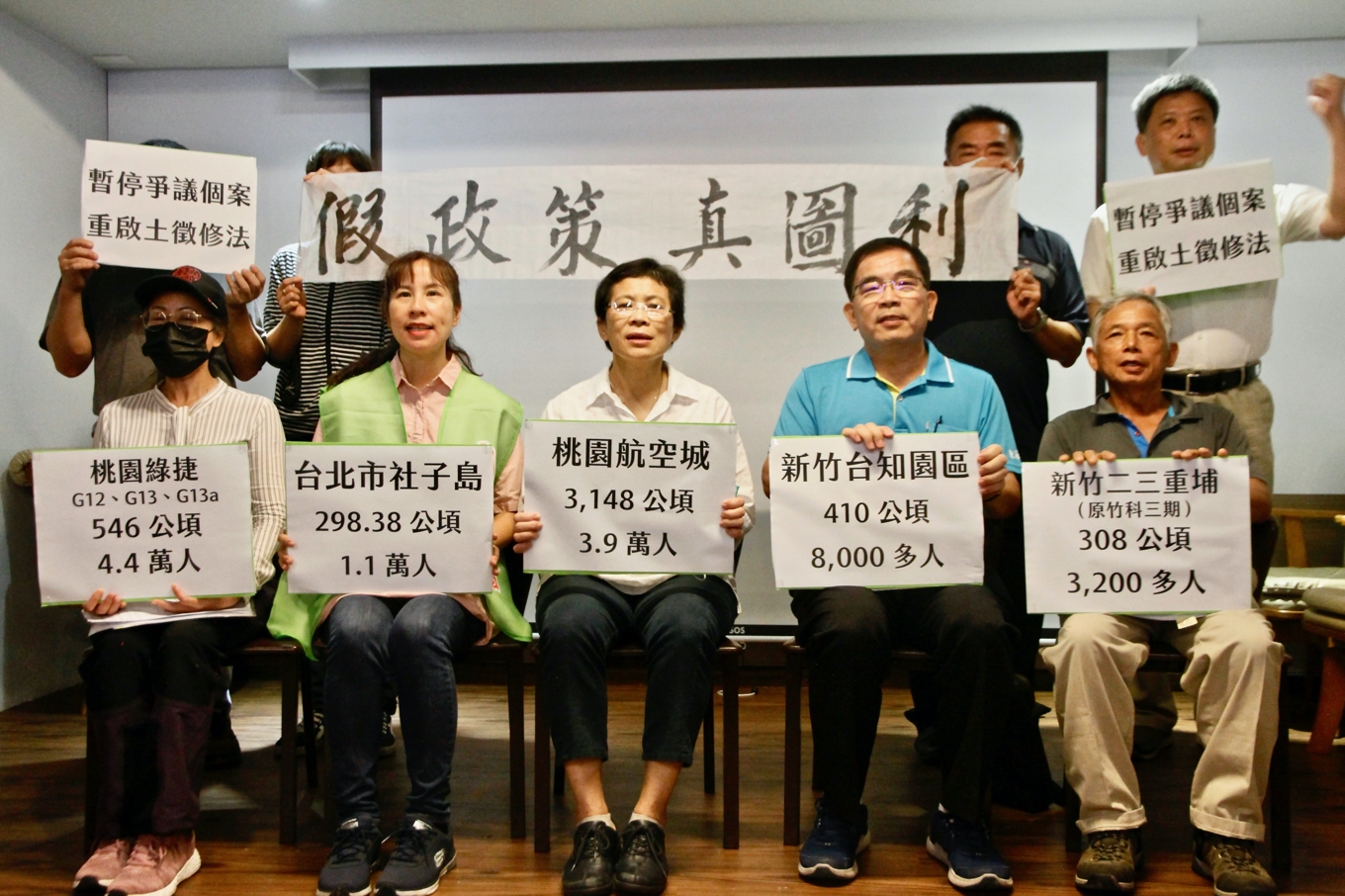
Hsu Shih-jung: The DPP's attitude toward zone expropriation differs greatly before and after elections; its love for Taiwan is all fake, and it should step down
Hsu Shih-jung, professor in the Department of Land Economics at National Chengchi University, said that Taiwan's zone expropriation system originates from the excess condemnation system of Europe and the United States. This system was applied in France, the United Kingdom and Belgium in the 19th century and later spread to the United States and Japan, but by the early 20th century both the United States and Japan had abolished it, because at that time Professor Fescu of Cornell University considered it a very dangerous system. More than a hundred years ago, various U.S. states had already reached a consensus that this system was unconstitutional, yet land-related books in Taiwan never mention that zone expropriation has already been abolished.
Hsu Shih-jung said that the current DPP government clearly knows that zone expropriation is unconstitutional, yet is unwilling to take action to abolish it. He pointed out that after the Dapu incident in Miaoli, the DPP, then still an opposition party, saw 22 DPP legislators jointly propose "abolish zone expropriation" on February 26, Minguo 103 (Legislative Yuan General Proposal No. 666, Member Proposal No. 16088, proposed by Chen Chi-mai, Lin Shu-fen and Yu Mei-nu), with the stated reason being that "the zone expropriation system is unconstitutional and infringes on people's rights and interests."
"They clearly know the system has problems, yet their attitude before and after elections is completely different!" Hsu Shih-jung angrily denounced, and publicly condemned: "A political party so lacking in integrity should step down. The so-called native consciousness and identification with Taiwan are all fake. The ones who truly love Taiwan and love the land are these five self-rescue association members!" Hsu Shih-jung concluded with the words of Justice Jan Sheng-lin: "The people need not live on merely because of the law; the law exists because of the people."

Dai Hsiu-hsiung: If the government wants joint development, why should the people provide property rights as capital stock for joint development?
Dai Hsiu-hsiung, assistant professor in the Department of Land Economics at National Chengchi University, explained that a modern constitutional state is built on the people possessing basic rights, and the social obligation attached to private property rights will not be so strong as to lead to property rights being deprived or rendered hollow. Therefore, any expropriation carried out by public authority does not fall within the scope of social obligations that private property rights must endure. "The reasons for making expropriation justified and legalized must absolutely exceed the requirements of general and universal social obligations; therefore, the public interest of the expropriation purpose involved must be examined on a case-by-case basis."
Dai Hsiu-hsiung explained that even if price-offset land zone expropriation is regarded as joint development, zone expropriation is still expropriation in the truest sense. "If the government wants joint development, why should the people provide property rights as capital stock for joint development?" Dai further explained that the state should originally bear the infrastructure needed for people's lives, such as water, electricity and transportation, unless local people have special needs, in which case local people should bear the cost themselves. However, the public facilities in the various major zone expropriation cases effectively make people in specific areas bear the cost of public facilities, which violates the principle of fairness.
In addition, Dai Hsiu-hsiung questioned that since public facilities benefit neighboring landowners, there have from the beginning been mechanisms such as the engineering benefit fee and the land value increment tax on rising land prices, which are sufficient to handle so-called natural appreciation. Why then use the zone expropriation mechanism separately to take away part of the usable land in order to remove the appreciation that occurs because of the land?
Dai Hsiu-hsiung reminded that the consequences of zone expropriation are irreversible. Taking the Dapu case as an example, with large-scale land-for-land compensation, the price-offset land allocated back is usually someone's original land, making it difficult to handle restoration on an individual parcel basis. Therefore, under the law, the right of redemption cannot be exercised in zone expropriation, and even when a court revokes zone expropriation, it cannot restore the state before expropriation. "In recent years, government agencies have only emphasized the later-stage compensation operations, but the zone expropriation system almost comprehensively contradicts the spirit of the Constitution in protecting private property rights, not to mention the rights to survival, work and residence!"

Related Articles
- How to prevent and control rabies in dogs? Timely vaccination of puppies ensures safety
- How to Explore Keelung's Fishing Port Docks? Practical Tips for Picking Fresh Seafood
- The Slow Food movement advocates that how you eat matters more than what you eat, helping you eat your way to health
- How to Identify Inferior Cooking Oil? Key Points for Quality Control from Cultivation to Purchase
- Which agricultural activities require tax payment? The ranch court case clarifies the boundary of tax exemption
- Ractopamine, a lean meat agent, is banned; scientific pig farming to increase lean meat percentage is the right path
- Horizontal Windbreak Nets for Welsh Onion Cultivation in Winter Reduce Losses
- Top Ten Fungicides Ranking Released, a Useful Reference for Farmers Choosing Products