How do you train climbing flowers? A detailed guide to growing techniques
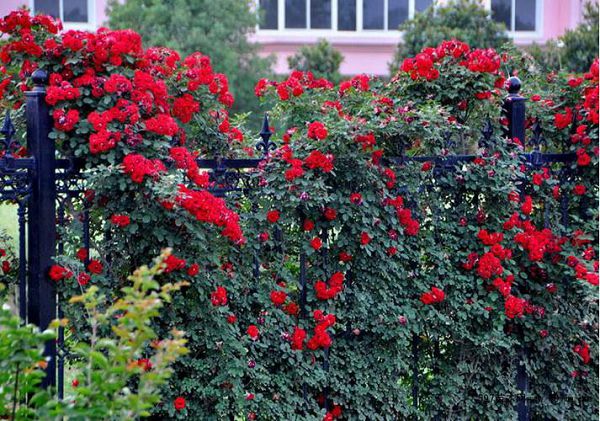
Bougainvillea, wisteria, clematis, climbing roses, star jasmine and others are all relatively easy climbing flowers to grow. First, let's talk about the problem of bougainvillea and wisteria not blooming much and instead putting out thick branches like crazy. This is because they are in a young state, still developing and growing taller, and have not yet reached sexual maturity. There are two ways to encourage them to bloom earlier: one is controlling water; the other is summer pruning, and there is also winter root pruning or heavy pruning. Cutting some roots and controlling water uptake will make the plant mature faster. Heavy pruning must be done in winter, while in summer, both bougainvillea and wisteria also need pruning, cutting away all unwanted parts.
The fixing method for wisteria and bougainvillea is very simple, low-cost, and also invisible: fix hooked expansion screws at the four corners of the wall, then use steel wire rope to form a grid pattern. Fix the branches to the steel wire rope; thick ones should be close to the wall. Bougainvillea, wisteria, and fruit trees all use steel wire rope. For lightweight vines like clematis, just drive in a few steel nails, some hemp rope or wire, or build a wooden frame. Remember, when putting up a grid on the wall, be sure to leave some space between the grid and the wall so the plant can grow through it.
Remember, train them horizontally! Because you need to expose all the axillary buds, let sunlight reach them, and let them sprout. That way, the sprouts will bloom neatly after producing a few leaves, each flower like a child's smiling face.
Please note, climbing roses are not pruned in summer! Apart from winter, do not try to force training on climbing roses at other times, or they will break. Apart from winter, do not pinch the tips or heavy prune in other seasons either; just prune diseased branches. And in winter, you must be willing to cut off diseased branches, weak branches, and thin branches, keep the basal shoot branches, keep a limited number of branches, and train these branches horizontally. After training, also cut off 10 to 20 cm from the top to remove apical dominance. At the same time, around Spring Festival, strip off all the leaves. After doing this, the roses will bloom all over from head to toe.
So what if there is no wall, no arch, and I only have a heart that loves flowers? How do I grow climbing plants? Try using a flower pot on a balcony, or even indoors, to shape a climbing plant and see! I often see heart-shaped plants, which take a long time to grow. I always think, if you have a secret crush on someone, from the day you start liking them until you grow a plant like this and give it to her (him), what a great confession that would be?! Climbing plants planted in the ground in a flower border, whether clematis or roses, can all use this method: make a flower column, a tower, a flat panel on site, or any shape you want.
In addition, repeat-flowering climbing rose varieties: Abraham Darby, Climbing Romantic Baby, Blue Rain, Golden Celebration, Princess Margaret, Welcome, Morris, Independence Day, Christopher Columbus, Florentina. Among them, except for Princess Margaret and Golden Celebration, the others are basically flowering machines among climbing roses - from April to late October they bloom continuously, sometimes three or five flowers, sometimes thirty or fifty, and in early spring they bloom in a big mass. One more thing: upright roses usually bloom continuously, so they need constant pruning, pruning once after each bloom, which ensures continuous flowering.