Herbicide sprayed on adzuki beans 11"The Council of Agriculture drew heavily on Bayer-funded research, ignored the conflict of interest, and public opinion overwhelmingly opposed opening up glufosinate
Text / by Upper and Lower Stream reporters Zheng Jieyi, Li Huiyi, Cai Jiashan, Lin Jiyang
Less than four months after paraquat was phased out, the Council of Agriculture said that because farmers had a need, it planned to open up glufosinate as a defoliant for adzuki beans, and the Ministry of Health and Welfare also announced a residue tolerance of 2ppm. Once the news came out, not only were consumers worried about food safety, but adzuki bean farmers who had already followed government guidance and moved toward friendly farming were also puzzled, "Why go back to the old way?"
The Bureau of Animal and Plant Health Inspection and Quarantine's statements were contradictory, going from "the company did not apply" to "the company withdrew its application"
The Council of Agriculture heard the public's outcry and held another press conference on August 4 to clarify the various doubts about glufosinate.
At the start of the meeting, Bureau of Animal and Plant Health Inspection and Quarantine Deputy Director-General Zou Huijuan responded to the Upper and Lower Stream report that "German officials slapped down Taiwan's pesticide companies and officials, confirming that glufosinate has already been banned in the EU." Perhaps because she was already too used to the original wording, she said: "We specifically asked our representative office in the EU to verify, and it is indeed because when the agent was being extended, the company did not apply, so use was not approved." Along with the slides, she later changed her wording to "the company withdrew its application."
Zou Huijuan's contradictory statements precisely proved that before the Upper and Lower Stream report, the Council of Agriculture's statements had been misleading the public, taking the same line as Taiwan's major glufosinate manufacturer BASF, repeatedly claiming: "Glufosinate was given up in the EU because the company did not submit an application, not because it was banned." In fact, the company did submit an application, but knowing it would not pass, it voluntarily withdrew it.
No matter how Zou Huijuan nitpicked the English wording of the EU ban, the fact is that the German Federal Office of Consumer Protection and Food Safety (BVL) clearly told Upper and Lower Stream reporters that glufosinate in the EU "The use is forbidden." Sweden's Chemicals Agency also said that the glufosinate license has expired in the EU, and no products containing that ingredient are allowed to circulate anymore.

The Taiwan Agricultural Chemicals and Toxic Substances Research Institute cited Bayer-funded research reports heavily, ignoring conflict-of-interest recusal
In line with the Council of Agriculture's "professional" nature, Taiwan Agricultural Chemicals and Toxic Substances Research Institute Applied Toxicology Division chief Cai Weiren explained the toxicological assessment of glufosinate. Although the first page of the slides said "approved use, cautious assessment," he particularly favored a 2006 study in which Bayer served as a "scientific partner," using it to downplay the European Food Safety Authority's (EFSA) 2005 finding that glufosinate carries a high reproductive toxicity risk.
To emphasize the unique "professionalism" of this study, Cai Weiren said: "Bayer provided these materials, these animal toxicology materials are very precious, we could not redo them. These scholars also told everyone plainly that my scientific partner is Bayer, because it provided the data." Zou Huijuan beside him also helped explain: "Only data that complies with Good Laboratory Practice (GLP) has reference value. Although the company provided the data, our review is quite rigorous."
Under such rigorous review, did the Council of Agriculture notice that the second page of this report states in black and white: "This analysis was funded by Bayer (Bayer CropScience)"? A report funded by Bayer, which at the time was applying for a license in the EU, very likely had a conflict-of-interest problem.
When the reporter showed the document with the key sentence marked, Cai Weiren explained that this should mean a "foundation" provided materials for scholars to analyze, not that it provided funding. Zou Huijuan, meanwhile, repeated like a broken record: "The point is that the quality of this data must be complete, authentic and traceable, and must all be produced under Good Laboratory Practice. That is the focus of our review."

Zeng Deci: Council of Agriculture officials' professional understanding is also off
Emeritus professor Zeng Deci of National Chung Hsing University's Department of Plant Pathology, watching the livestream in front of his computer, was caught between laughter and tears: "Why would 'Funded by Bayer' be interpreted as a foundation? It is truly baffling."
The Council of Agriculture officials guarding Taiwan's pesticide oversight not only need to improve their English, but even their understanding of laboratories is off. Zeng Deci said: "GLP laboratories are usually related to specific verification or commercial considerations; ordinary scientific laboratories would not obtain this kind of certification." He also pointed out: "The 2006 report that the Agricultural Chemicals and Toxic Substances Research Institute mainly referenced was published as a supplement, not an ordinary peer-reviewed report."
Cai Weiren tried to show off his pesticide expertise by citing the Bayer-sponsored study to explain the reproductive toxicity problem caused by inhibition of glutamine synthetase. But other experts had different views. "This explanation completely misses the point. It is obvious that he still does not understand the relevant mechanism of action well enough, or else he is just forcing an argument." Zeng Deci, who had attended expert meetings and also written many commentaries explaining the mechanism of reproductive toxicity, explained: "Unlike metabolic toxicity, which commonly shows a correspondence between dose and response severity, the key to reproductive toxicity lies in the site affected, the timing of action, and how long the action lasts."
Andreas Bauner-Panskus, a researcher at Testbiotech who has long followed EU risk assessment issues, also told Upper and Lower Stream reporters that the EU did not cite the Bayer-sponsored report in its multiple review processes, "because it did not meet the research standards required by the EU."
The Agricultural Chemicals and Toxic Substances Research Institute denied the importance of the French study; Zeng Deci: the institute should not fob people off
A 2014 paper published by French scholar Anthony Laugeray and others pointed out that when mother rats ingested low doses of glufosinate during pregnancy and lactation, it was enough to harm embryos and young pups. To deny the importance of this study, Cai Weiren again said at the press conference, "In our ordinary spraying, it is inhaled, not poured into the rat's nose as in the experiment."
Regarding this professional explanation, Zeng Deci retorted: "Laugeray's experiment used 10ul, that is, only 0.01cc, and it was applied to the nose to simulate inhalation from field drift contamination, not 'pouring' as the Agricultural Chemicals and Toxic Substances Research Institute said. Moreover, each mouse was given only 1ppm, while our field application can reach as high as two or three thousand ppm. This is something that can be understood with common sense; there is no need to trot out some international standard to fob people off!"
Consumers are very worried about the food safety issue of glufosinate as a defoliant for adzuki beans, especially pregnant women who drink adzuki bean water to reduce edema. But farmers spraying and working in the fields, and nearby residents, are exposed to even higher risk.
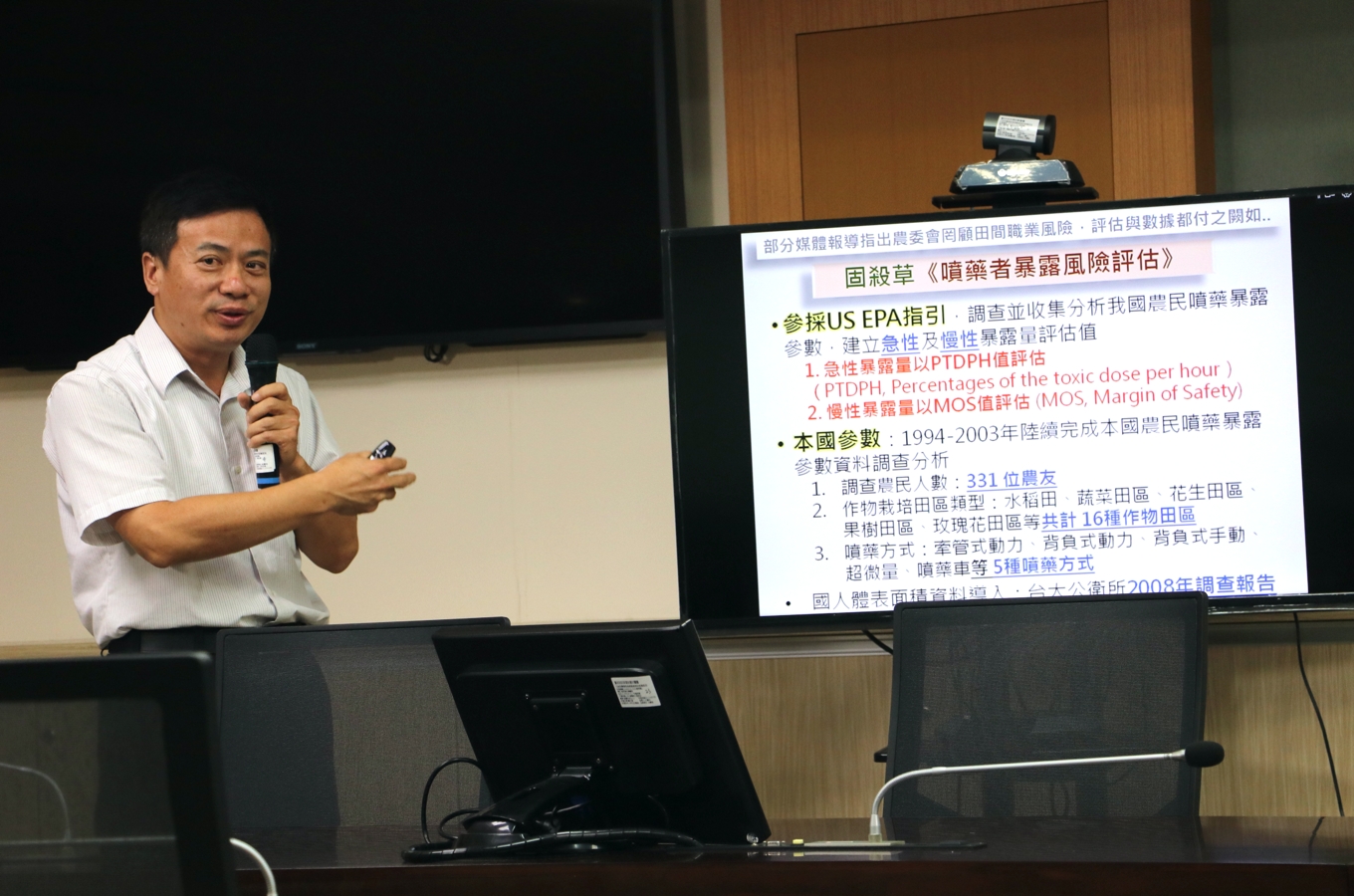
The Agricultural Chemicals and Toxic Substances Research Institute claims the data show "safe and without concern," but it never underwent expert review at all
After the Upper and Lower Stream report "French officials: glufosinate poses too high a health risk to sprayers, fully banned; Council of Agriculture distorts international report," today the Council of Agriculture also specifically explained the risks of dermal and respiratory exposure in the field. Cai Weiren first admitted: "We do not know what the EU's testing method was or exactly how it was used." This shows that during the review process, the Council of Agriculture had insufficient grasp of international information. But he also said: "Taiwan has local parameters established domestically; every country must establish its own parameters for assessment."
The Council of Agriculture repeatedly emphasized that EU data are not applicable because pesticides need to be adapted to local conditions. Cai Weiren's wording seemed to show special consideration for the people of Taiwan, and indeed the first page of today's slides also said "pesticide management rigorous and orderly, approved use cautiously assessed, ensuring safety and no concern." However, in previous expert meetings, the Council of Agriculture did not provide attending experts with the latest assessment report on the human health impact of field exposure, and the data presented at today's press conference came from research conducted from 1994 to 2003, nearly twenty years ago.
In other words, the data that the Council of Agriculture repeatedly used today at the press conference to "ensure safety and no concern" lacked expert review. Facing reporters' questions about why France, which uses enclosed-cab spraying, still exceeds limits, while in Taiwan spraying is all manual and directly exposes workers to the agent, yet supposedly does not exceed limits, Cai Weiren responded: "How strong is the spraying force in France? How fast is the spraying speed? What is the amount? We have not seen the actual spraying amount, and we cannot obtain it." The problem is that the experts who participated in reviewing the expanded use of glufosinate on adzuki beans also did not receive the Council of Agriculture's field exposure test data. Clearly, there was no "cautious assessment."
Public opinion overwhelmingly one-sided; among 287 comments on Join, 253 opposed opening up glufosinate for use on adzuki beans
The Council of Agriculture emphasized that pesticides all go through rigorous review and professional decision-making. However, the Council of Agriculture did not use professionalism to clear up the public's doubts, but instead showed off technical jargon as a barrier, and it simply could not withstand the test of public opinion. On "Join," public opinion was overwhelmingly one-sided.
Starting July 6, the Council of Agriculture's Bureau of Animal and Plant Health Inspection and Quarantine collected public opinions through open comments on the government's "Join - Public Policy Network Participation Platform," and it was expected to close tonight (August 4) at 12 a.m.
As of 8 p.m. tonight, when this publication went to press, a total of 287 comments had been collected. Of these, 253 comments opposed opening up glufosinate for adzuki bean harvest, while only 20 comments leaned toward supporting the Bureau of Animal and Plant Health Inspection and Quarantine in opening up glufosinate as a pre-harvest defoliant for adzuki beans. As for some netizens who did not clearly express a stance and instead expressed concern about the matter with comments such as "Why is pesticide use in Taiwan excessive," "Thanks for your hard work," and "Pesticide testing never tests for herbicides," there were 14 in total.
Among them, a member of the public signing as "Shang-Yan Tsai" repeatedly emphasized: "At present, the total ADI control for glufosinate is 0.01 mg/kg bw/day. Adding one use method of glufosinate as an adzuki bean defoliant at 2ppm = 0.00347 mg/kg bw/day, which is still less than the total control of 0.01 mg/kg bw/day. Since the use method is safe and reasonable, providing farmers with one use option is also scientifically sound."
Netizen "Matcha" also echoed "Shang-Yan Tsai's" view, arguing that "the residue standard truly related to consumer rights has already, in scientific terms, taken the safe level and lowered the risk consideration by another 100 times." He also emphasized, "If in the end this matter pushes regulators, producers, and consumers to make a bold cut and burn their boats, and ultimately develops into a contract-spraying system plus a fully in-place pesticide registration management system, that would also be a good result."
Among the 253 comments opposing the opening, most directly expressed opinions such as "Reject glufosinate," "Ban glufosinate," and "I want safe adzuki beans, not glufosinate." Others, such as netizen "chin," hoped the authorities concerned would explain things clearly to consumers and farmers in easy-to-understand language, while "Tina" questioned, "Farmers have already begun transitioning, and experimental research institutions have also begun looking for alternatives, yet the government wants to go back to the old way?"
Wandan Farmers' Association calls on the Council of Agriculture: think carefully before acting
Consumers and producers are often on opposite sides, but now it is rare for both sides to be of one mind. After closely observing the direction of public opinion on "Join" for many days, Zhang Zhilie, director-general of the Wandan Farmers' Association in Pingtung, loudly appealed: "I hope the Council of Agriculture can hear the voices of the public strongly opposing glufosinate as a defoliant when adzuki beans are harvested. Think carefully before acting!"