Indonesia's Agricultural Policy Response to the COVID-19 Pandemic and Recommendations for Taiwan's Agricultural Strategic Development

Asia-Pacific Food and Fertilizer Technology Center Agricultural Policy Information Platform Translation[1]
Foreword
The recent global pandemic of Coronavirus Disease 2019 (COVID-19) also poses a threat to public health in Indonesia. The COVID-19 pandemic represents a significant growth in cases and deaths and has spread among countries, while also causing direct or indirect impacts on Indonesia's politics, economy, society, culture, national defense and security, as well as community welfare.
COVID-19 has also greatly hindered economic activity and severely affected the economies of most countries. This pandemic leads to certain situations requiring special precautions, and the Indonesian government has therefore issued several regulations, such as Government Regulation No. 1/2020, Presidential Decree No. 11/2020, and Government Regulation No. 21/2020. One notable policy is the large-scale social restrictions on certain activities in areas with suspected or infected cases, to prevent wider spread of the COVID-19 pandemic. The considerations for this policy incorporate factors including epidemiology, threat level, effectiveness, resource support, technical operations, politics, economy, society, culture, national defense and security.
This article discusses Indonesia's main policy responses to COVID-19, focusing on the socioeconomic policy aspect, namely large-scale social restrictions and strengthening social protection and economic safeguards to face the pandemic. The latter part of this article will specifically analyze the impact of this pandemic on Indonesia's agricultural sector.
The COVID-19 Pandemic
COVID-19 is an infectious disease caused by a newly discovered coronavirus that severely affects global public health systems (WHO, 2020). This pandemic is the first of its kind and a disaster for humanity, affecting hundreds of thousands of people, with an increasingly large impact on the global economy. The World Health Organization first declared COVID-19 a global health emergency in January 2020 (WHO, 2020). As of April 30, 2020, COVID-19 had affected 213 countries worldwide, with a total of 3,090,445 confirmed cases and 217,769 deaths, including cases still ill (moderate/severe) and removed cases (recovered/discharged and deceased), with a case fatality rate (CFR) of 7.04% (Worldometers, 2020).
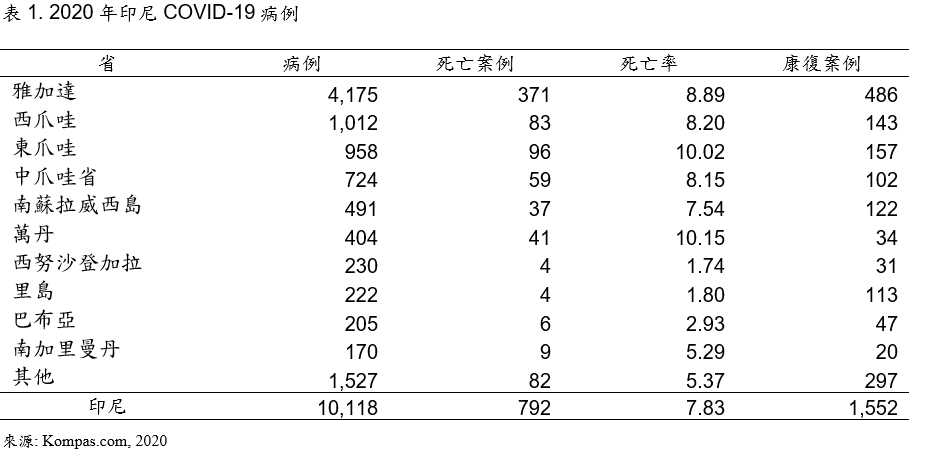
Indonesia discovered its first COVID-19 case in early February 2020 in Depok (near the border of Jakarta), and subsequently found similar cases in Jakarta and other provinces. According to official data as of April 30, 2020, Indonesia's total number of cases was 9,771, of which 784 died (8.02%) and 1,391 recovered successfully. COVID-19 has spread to 32 of Indonesia's 34 provinces, while East Nusa Tenggara and Gorontalo provinces have no cases yet. The capital Jakarta has the most severe outbreak, accounting for 41.88% and 47.19% of Indonesia's overall case count and death count, respectively. By region, more than 70% of recorded COVID-19 cases and deaths come from the island of Java (Table 1).
From a policy perspective, it is quite important to grasp when the pandemic might end. The latest forecast from the Driven Innovation Lab of Singapore mentions that Indonesia's COVID-19 will have 3 time points: 97% of cases will end by June 7, 2020, 99% of cases will end by June 29, 2020, and 100% of cases will end by September 7, 2020. Therefore, the Indonesian government should remain vigilant against the pandemic at least until September 2020. What worries many people is that the festive holidays in late May 2020 will encourage people to return to their hometowns, which will lead to the risk of the virus spreading from infected cities to rural areas, especially on the island of Java. Although the Indonesian government has issued regulations prohibiting people from returning to their hometowns, there will always be some who slip through the net.